Who is Wormly? And What Does Wormly Do for Elementary Students?
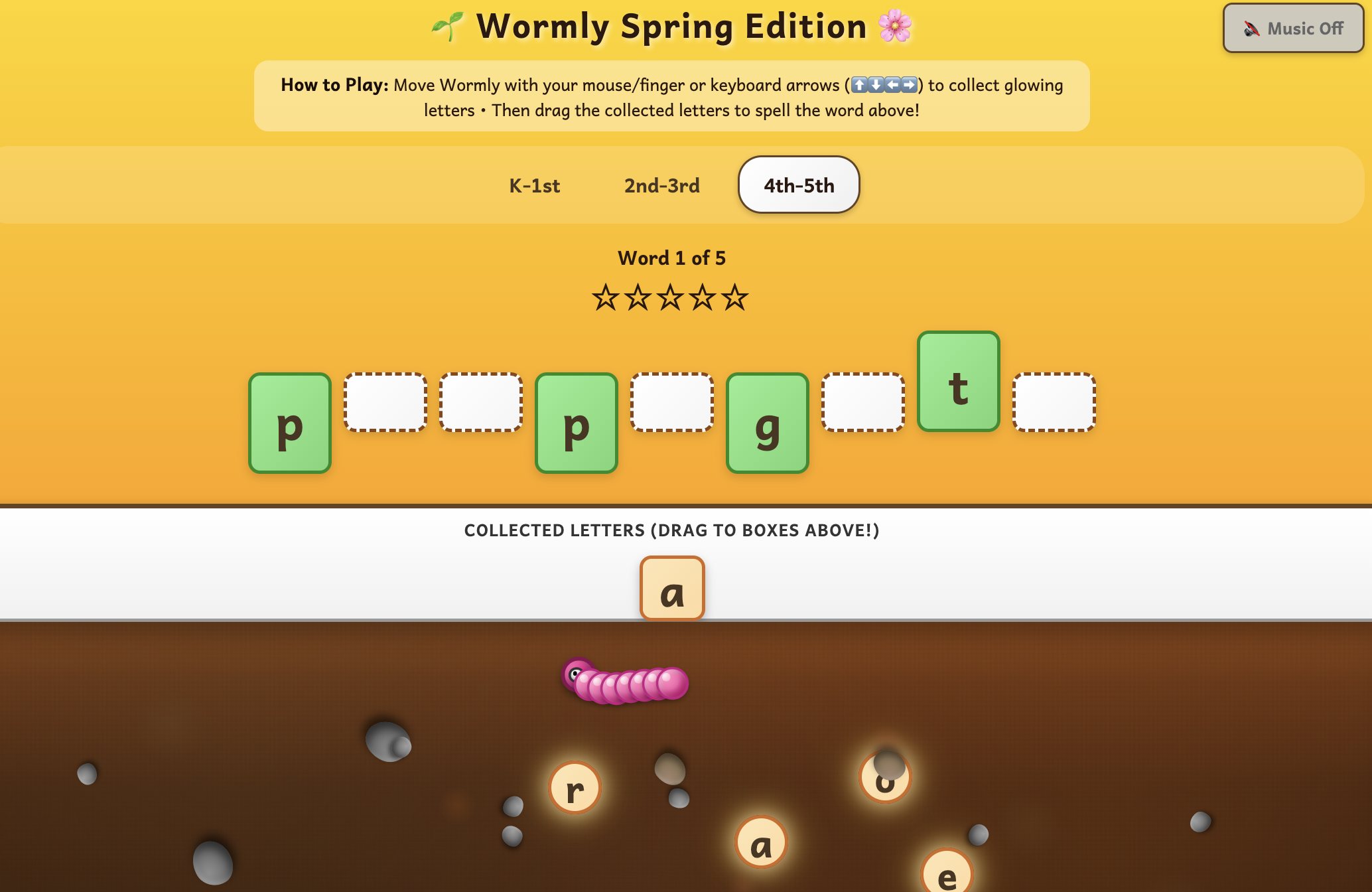
Wormly is an interactive letter-collecting spelling game built on Science of Reading (SoR) principles, developed by This Month™ Educational Resources. Students guide a worm character through a dirt field to collect hidden letters, then drag and arrange them to spell a target word. It’s simple to play, immediately engaging, and pedagogically precise.
What Students Practice
Every session is five words, drawn from grade-differentiated word banks aligned to three tiers: K–1, Grades 2–3, and Grades 4–5. The words aren’t arbitrary — they’re tagged to SoR construct categories including phonemic awareness, phonics, orthography, morphology, and fluency. Students at each level are working on exactly the skills that research shows matter most for reading development at that stage.
A distinctive design feature reinforces this further: each letter box is shaped to match the physical form of the letter it holds — tall boxes for letters like b, d, and l; standard boxes for mid-height letters; and boxes with descending accommodation for letters like g, p, and y. This isn’t cosmetic. It reinforces letter formation and visual discrimination, supporting the word recognition strand of the Reading Rope in a way students feel intuitively rather than consciously.
What Teachers and Administrators Get
Every session generates a formative assessment receipt — a structured record of words attempted, accuracy, session duration, grade level, SoR construct categories practiced, and aligned ELA standards. It’s built to be FERPA-compliant using privacy-safe student tokens rather than identifying information, making it safe for district-level tracking.
The assessment data is designed to feed directly into a student performance layer, with the roadmap pointing toward a teacher-facing dashboard that flags patterns and skill gaps across students automatically.
Why Pilot Engagement Is High
Wormly hits a rare combination: it’s genuinely fun to play (students ask to play it again), and every mechanic serves a learning goal. The movement, the letter hunting, the drag-and-drop spelling — none of it is filler. The game is also themed monthly and seasonally, which keeps the content fresh across the school year rather than feeling like a static resource.
The ROI Case in Plain Terms
- Curriculum alignment: Every word list maps to SoR constructs and grade-band ELA standards — it’s not a game bolted onto a curriculum; it is the curriculum practice.
- Assessment without extra work: Teachers get formative data automatically from play sessions, with no additional test prep or grading overhead.
- Differentiation built in: Three grade bands mean one platform serves K–5, reducing the number of tools a school or district needs to manage.
- Engagement that sticks: Pilot data shows students return to the game voluntarily — which means practice reps happen that wouldn’t otherwise.