Kick of the school year with your classroom read aloud time or to send the book home for family reading
Beach Toys vs. School Supplies
Two old rivals square off at the beach in a book that’s all pun, all the way down, and sneaks in a real lesson about how the same word can mean two totally different things depending on where you’re standing.
Grade range
The publisher lists ages 3–6, and that tracks for the plot and pictures alone. But the wordplay is where an adult voice earns its keep: a shared laugh over a pun lands twice as hard during shared read aloud time. It’s likely that even a confident 1st or 2nd grade reader will catch more of the double meanings with someone reading alongside them the first time through. For example, when Shovel says, “And we really dig your castle,” the adult may need to explain that “dig” means both to enjoy something and to scoop sand with a shovel.
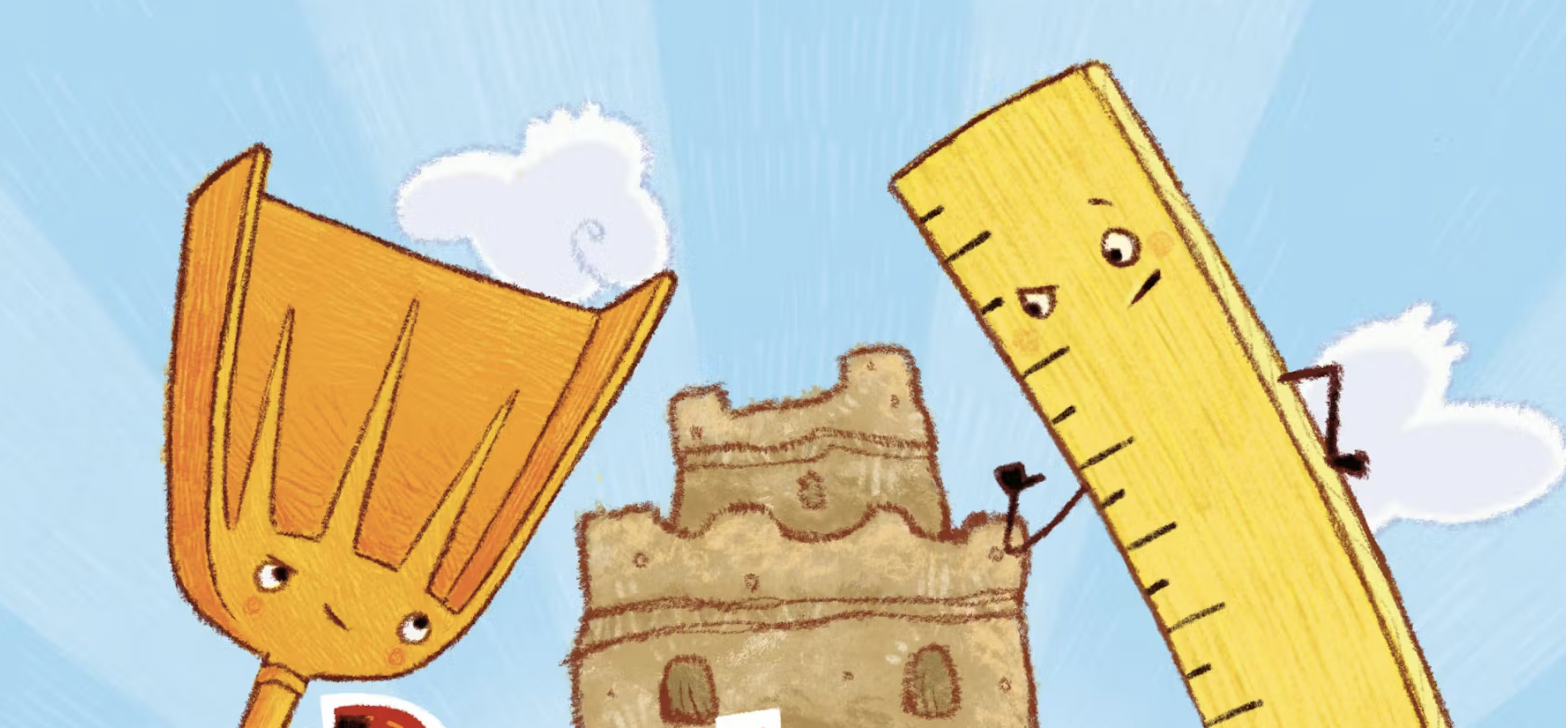
Summer is almost over, and two rival gangs of beach toys and school supplies are about to settle an old grudge. Beach Toys vs. School Supplies by Mike Ciccotello (2023 Bill Martin, Jr. Picture Book Award winner) turns the last days of summer break into a full-on competition: Shovel’s crew thinks Ruler’s crew are uptight know-it-alls, and Ruler’s crew thinks Shovel’s crew are all fun and no follow-through. Naturally, it takes a beachfront disaster to make them realize they need each other.
This picture book has wonderfully expressive illustrations, with the characters’ eyes carrying a lot of each scene’s emotional tension. That makes it an excellent conversation starter: What do you think the school supplies are feeling here? A character’s expression often gives away a clue to the wordplay and the state of the conflict, which is part of what makes it funny instead of confusing for younger children. As a child works out the double meaning of a word, ask them to notice the characters’ expressions too. (Dr. Katherine Schlatter)
A developmental note: as a developmental psychologist, I’d add that these exaggerated, clearly-drawn expressions can also be a wonderful tool for adults supporting neurodiverse children who find it harder to read facial expressions on real faces. The feelings here are drawn plainly enough to name together, which gives a low-stakes way to practice that skill, with an adult right there to talk through what a child notices.
What makes this one worth reading twice is how hard it leans into double meaning. A ruler measures things, and also wants to rule. A shovel digs, and is also, well, a shovel. Every character’s name is doing two jobs at once, which is a genuinely useful thing for an almost-first-grader to notice: the same word can mean something completely different depending on the sentence it’s standing in.
It’s bright, it’s fast, and it’s the kind of book that gets funnier on a second read once the puns start landing before you finish the sentence, which makes it a great one to read more than once during that back-to-school stretch.
A note from our house: even though this book came out in 2021, I still had to stop and explain to my nearly-seven-year-old what an index card actually is before one of the jokes could land, since she’d never seen one, which turned into its own side conversation entirely. My daughter is also bilingual, so I don’t assume a pun lands on the first pass just because the vocabulary is common to native English speakers. Sometimes the word needs unpacking before the wordplay can even show up, and that’s a fine thing to build into the reading, not a sign the book isn’t working.
- 1Give the names a beat. The first time “Ruler” or “Shovel” acts like their name, pause half a second before the punchline. That tiny gap is what turns a pun into a laugh instead of a sentence that just goes by.
- 2Feel free to name the joke. Some kids catch the double meaning instantly; plenty of others need you to point it out, especially multilingual readers or anyone missing a piece of vocabulary (an index card, for instance, isn’t something every kid has handled). Explaining it doesn’t ruin the fun, it just lets more kids in on it.
- 3Do two voices, minimally. You don’t need a full cast: a slightly clipped, no-nonsense voice for the school-supply gang and a looser, sillier voice for the beach-toy gang is enough to keep the rivalry clear.
- 4Slow down at the turn. When the disaster hits and the two gangs have to team up, drop the competitive energy and read it a little quieter. The shift in tone sells the shift in the story.
- 5Read it twice, close together. This is a book that gets funnier on a second pass, once the listener already knows the punchlines are coming. Don’t be surprised if it’s requested again immediately.
Would you rather spend a whole day playing at the beach, or a whole day at school? Can you think of one good thing about each?
Pre-K – K ↻ Tap to flipTry this: Draw two pictures side by side: your favorite beach thing and your favorite school thing.
A ruler measures things, and it also means someone who’s in charge. Can you think of another word that means two different things?
Pre-K – K ↻ Tap to flipTry this: Make a list of “two-job words” you find around the house this week, like watch or bat.
Shovel and Ruler didn’t like each other at first. What changed their minds? Has that ever happened with someone you didn’t get along with right away?
Grades 1–2 ↻ Tap to flipTry this: Think of a friend you didn’t like right away. What’s one thing that changed your mind about them?
If your favorite toy and your favorite school supply had a rivalry like Shovel and Ruler’s, who would they be, and what would they compete over?
Grades 1–2 ↻ Tap to flipTry this: Draw your toy-vs-supply rivalry and give both characters a silly catchphrase.
📋 Standards Alignment for This Read Aloud ⌄
Common Core (National)
- L.K.4 / L.1.4: Determine or clarify the meaning of unknown and multiple-meaning words and phrases based on grade-level reading and content — the core skill this book practices, since every character name means two different things.
- RL.K.1 / RL.1.1: Ask and answer questions about key details in a text.
- RL.K.3 / RL.1.3: Identify or describe characters, settings, and major events in a story.
- RL.1.9: Compare and contrast the adventures and experiences of characters in stories (Shovel’s crew vs. Ruler’s crew, before and after the storm).
- SL.K.1 / SL.1.1: Participate in collaborative conversations about grade-level topics and texts with peers and adults — the skill the discussion questions above are built to practice.
Georgia Standards (2024 Revision)
- K.L.V.3.a / 1.L.V.3.a: Determine or clarify the meaning of unknown and multiple-meaning words and phrases — the exact skill this book builds a whole plot around.
- 1.L.V.3.b: Identify the relationship between words and their synonyms and antonyms, which supports noticing “two-job words” like ruler and dig.
- K.T.T.1.a / 1.T.T.1.a: Identify techniques used to craft stories, including characters, setting, and major events.
- K.T.T.1.d / 1.T.T.1.d: With adult support, compare and contrast characters and their experiences in stories — Shovel’s crew and Ruler’s crew, before and after the storm.
- K.P.CP.1 / 1.P.CP.1: Contribute to discussions by offering ideas, listening to the ideas of others, and providing feedback — the skill the discussion questions above are built to practice.
A Read Aloud review of Beach Toys vs. School Supplies by Mike Ciccotello, with discussion questions, reading tips, and Common Core, Michigan, & Georgia standards.