Twice a year, the clocks change, but our body clocks don’t change with them. The result can be a groggy few days. So what can we learn from astronauts, who have to manage sleep without a reliable sunrise?
Why does the autumn clock change leave you groggy? Why would astronauts struggle to sleep when they see 16 sunrises a day? One scientist explains the same body clock in two very different places.
The clocks change, but your body clock lags behind.
With no reliable Sun, light and schedules must be managed on purpose.
As you read, ask yourself
- If your body does not read the numbers on a clock, what does it use to tell day from night?
- Feeling tired and being ready to sleep: why are they not always the same thing?
- Which habits from Part 1 could help an astronaut, and which would need to change?
Read in order, on purpose. In Part 1, notice the four habits and the careful words the author uses, such as “generally,” “may,” and “still need experimental verification.” In Part 2, look for the same two systems, the body clock and sleep pressure, working in a place where there is no sunrise to rely on.
For teachers
- Careful claims are a teaching tool. Both articles separate what is well supported from what is still a prediction. Part 1 calls daylight “a useful daily cue” but “not a precisely proven clock-change prescription,” and Part 2 reports a preliminary study with 14 adults that found no difference. Students can practice noticing how scientists report limits and null results.
- The body as a system. The articles describe two interacting systems, the circadian clock and sleep pressure, and show what happens when they fall out of step. This supports MS-LS1-3.
- Life skills, within reach. The plan builder asks students to choose habits, not to follow a prescription. Many students do not control every part of their evenings, so invite them to choose only what is within their reach. The page is not medical advice, and the plan builder says so.
- Caffeine. The articles discuss coffee doses for adults. Caffeine also appears in some sodas and energy drinks, so this is a good moment to practice reading labels. We do not recommend any caffeine amount for children.
- Math connection. The “By the numbers” section turns figures from the articles into short calculations, such as how fast a 40 minute longer day adds up.
Both articles below are republished in full and unchanged from The Conversation under a Creative Commons license (CC BY-ND). The introduction, notes, vocabulary, activities, and questions are our own and are not part of either article. Spelling in the articles follows British usage, so you will see “synchronise” where our notes use “synchronize.”
Body clock word hunt
Select a word to see what it means, why it matters in life science, and how it connects to your own life. Then find the word in the reading and mark it found. Words from Part 1 are tagged Earth, words from Part 2 are tagged Space, and words in both are tagged Both.
The definition opens just below the group you choose from.
Four ways to help your body adjust to the autumn time change

An extra hour in bed sounds like a good deal. But while our phones may update to the autumn time change automatically, our body clock isn’t quite so quick. You may even find yourself waking up earlier than normal and ready for bed before your evening has properly begun.
The reason for this partly lies in our circadian system: the roughly 24-hour internal timing system that helps organise tiredness and alertness. Changing the time on a clock does not instantly reset that system.
But there are some things you can do to support your body clock in adapting to the time change. While these strategies won’t offer a guaranteed overnight reset, they will help you get back on track.
1. Dim the lights before bedtime
Your body doesn’t judge whether it’s day or night by using the numbers on a clock. Rather, a tiny region in the brain called the suprachiasmatic nucleus (SCN) – which acts as the body’s master clock – uses light signals from the eyes to help keep our circadian rhythm on track.
Bright evening light can suppress melatonin, a hormone that signals biological night, and shift your internal clock later. This can help explain why some people feel less sleepy at their usual bedtime during the long, bright evenings of summer.
But even the light from electronic devices such as phones or e-readers can contribute to melatonin suppression.
So as your intended bedtime approaches, switch to lower, softer lighting and reduce screen brightness. It’s recommended you keep light exposure low in the hours before bed and make the bedroom as dark as practical during sleep.
Of course, the autumn time change often means we’re tired before our usual bedtime as the early nights draw in. Shifting your body clock a little later can be helpful if you’re becoming sleepy and waking too early.
To do this, only start winding down before the bedtime you want. Don’t spend the entire evening in darkness as soon as the sun sets.
2. Get daylight
A walk, an outdoor lunch break or simply spending more of the day outside can strengthen the contrast between bright days and dim evenings. That contrast helps synchronise the circadian system, which evolved under a much stronger daily light–dark cycle than many indoor lifestyles provide.
When you get this daylight is important, however. Morning light generally moves the body clock earlier, while evening light generally pushes it later. That distinction matters when the clocks go back, because someone waking too early doesn’t necessarily need another signal to wake earlier.
After the clocks change, try to get daylight during your normal waking day rather than deliberately seeking bright light at an unusually early hour. A lunchtime walk is one practical option.
If early-evening sleepiness is the problem, spending time outdoors later in the afternoon, while daylight remains, may be better than prioritising first-thing morning light. In fact, a 2024 modelling study predicted that later-day light exposure could speed the autumn adjustment. However, the authors emphasised that these proposed interventions still need experimental verification.
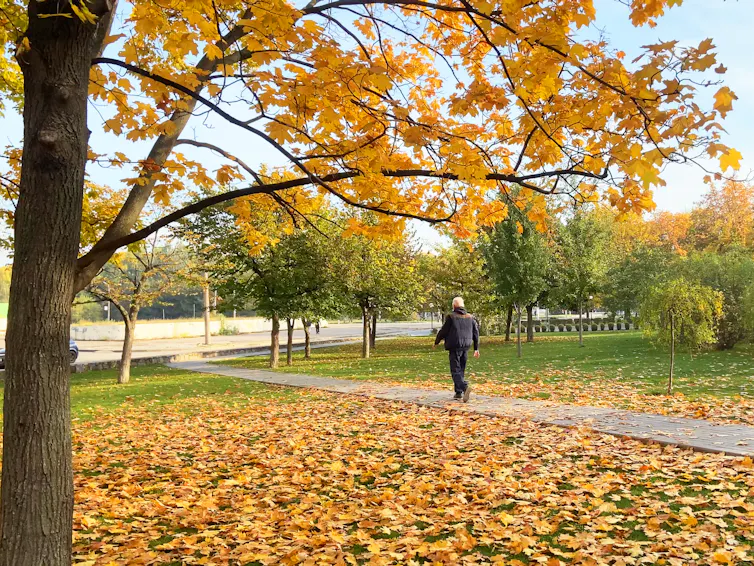
Think of daylight as a useful daily cue – not a precisely proven clock-change prescription.
3. Stick to a regular sleep schedule
It’s tempting to treat the extra hour of sleep as permission to overhaul your weekend. But a regular routine is key.
Sleep depends on both the pressure that builds while you’re awake and the circadian signals that determine when you feel sleepy or alert. These processes interact, which is why sleep can’t always be summoned simply by deciding to go to bed.
Aim for reasonably consistent bedtimes and waking times according to the time change. Avoid swinging between very early nights, long lie-ins and late bedtimes. Keeping weekday and weekend schedules similar can support healthy sleep.
If you find that even with a consistent sleep schedule you’re struggling to fall asleep, choose a quiet activity done in low light until you feel ready for bed.
Dark autumn mornings can also make waking up feel harder. Keeping a broadly consistent waking time, getting morning daylight when possible and allowing enough time for sleep may help maintain a stable sleep–wake rhythm – although some grogginess immediately after waking is normal.
4. Re-think your afternoon coffee
The earlier nights that accompany the winter months can make it harder to get through the afternoon. When you feel groggy, coffee can look like the obvious solution. But as much as it pains me to give this advice as a coffee lover, you might want to skip that midday coffee.
Caffeine interferes with sleep long after its effects have worn off. A recent, small study found that a 400mg dose of caffeine (equivalent to around 3-5 cups of coffee) affected sleep even when consumed eight hours before bedtime. That’s quite a substantial dose, of course – and not one many of us are consuming in the mid-afternoon. Fortunately, the study also found that when a 100 mg dose of caffeine (equivalent to a single cup of coffee) was consumed four hours before bedtime, it had no effect on sleep compared to a placebo.
If sleep is difficult, moving your last caffeinated drink earlier and reducing the amount you drink are sensible things to try. Evening caffeine can also push the body clock later, so avoiding it may help when you’re trying to keep an earlier sleep schedule.
The autumn time change is a useful reminder that sleep depends on more than the number displayed on your phone’s clock. Most people adjust to the time change within a few days to about a week, although some can take longer. But if you’re still struggling a month later, the clock change may not be the whole story.
Ronan Lordan, Postdoctoral Researcher in Circadian Biology, FutureNeuro Research Ireland Center & School of Pharmacy and Biomolecular Sciences, RCSI University of Medicine and Health Sciences
This article is republished from The Conversation under a Creative Commons license. Read the original article.
What space travel teaches us about sleep and circadian rhythms
On Earth, most of us rarely have to think about the signals that keep our internal clocks aligned. The Sun rises, daylight changes, darkness arrives and morning comes again.
Our bodies have evolved alongside this roughly 24-hour cycle. Light is one of the strongest signals our bodies use to synchronise the circadian clock. But what happens when the Sun no longer provides a reliable schedule?
A spacecraft orbits Earth roughly every 90 minutes, so astronauts experience about 16 sunrises and sunsets every 24 hours. They cannot go to sleep every time the Sun disappears – but their bodies still need to know when it is time to sleep, wake, eat, exercise and work.
This makes spaceflight more than just an engineering challenge. It is an extraordinary experiment in human biology – one that can reveal what happens when the environmental cues that normally regulate our sleep disappear.
Sleep is thought to be controlled by two interacting biological systems. One is the circadian clock, which helps determine when the brain expects sleep and wakefulness. The other is sleep pressure, which gradually builds the longer we remain awake and dissipates while we sleep. Usually, these systems work together. But jet lag, shift work and spaceflight can pull them apart.
An astronaut may be exhausted after many hours awake but still struggle to sleep because their circadian system is signalling it is daytime. Feeling tired and being biologically ready to sleep are not always the same thing. This distinction is one of the most important lessons spaceflight can teach us about sleep.
Research in chronobiology and sleep science has demonstrated that carefully guiding astronaut schedules around exercise, meals, tailored lighting and work scheduling can help offset some of the negative effects of sleep loss and circadian disruption. Artificial lighting can also be controlled to provide more appropriate environmental cues.
But there is a catch: giving astronauts time to sleep does not necessarily mean they will sleep. Astronauts have traditionally been given around eight and a half hours of sleep opportunity on each day of spaceflight. But research across different types of mission suggests they often obtain only about six to six and a half hours.
Repeated night after night, that gap becomes chronic sleep restriction. Research aboard the International Space Station has linked daily sleep patterns of six hours or less with measurable reductions in vigilant attention – the ability to notice and respond reliably to important information. In an environment where a missed signal could have serious consequences, sleep is not simply a matter of comfort – it is part of mission safety.
How much does sleep depend on timing?
My favourite part of Nasa’s Artemis II lunar flyby mission in April 2026 was when crew members were woken each day by music chosen by the astronauts and their families. One morning, American astronaut Christina Hammock Koch called out Nasa for cutting off Pink Pony Club by Chappell Roan before the chorus.
The music was a morale-boosting tradition rather than a circadian treatment. But the astronauts also wore wrist-mounted movement and sleep monitors as part of Nasa’s Artemis Research for Crew Health and Readiness study before, during and after the mission. These allowed researchers to examine how sleep and activity changed across training, deep-space flight and recovery on Earth – alongside measurements of cognition, behaviour and team performance.
Missions such as Artemis II, together with Nasa’s ongoing Mars simulations, offer scientists an unusual window into human sleep. Rather than treating it as something that simply happens when we are tired, space research highlights how much sleep depends on timing.
Nasa is not only observing sleep disruption. It is also testing ways to prevent it – such as whether playing pink noise (an audio signal containing all frequencies humans can hear, but with lower frequencies sounding louder and higher frequencies softer) through a headband during a four-hour daytime sleep opportunity can improve subsequent alertness.
The preliminary study, involving 14 healthy adults, found no difference in sleep inertia or vigilant attention between the pink-noise and control conditions during the first 40 minutes after waking.
Space sleep trade-offs
In spacecraft, light is treated as part of the biological life-support system. Blue-enriched white light can support alertness and help synchronise the circadian clock during scheduled waking hours, while dimmer, blue-depleted light can help prepare the brain for sleep.
But this creates an unexpected engineering trade-off. Recent Nasa-supported testing found that pre-sleep lighting allowed greater melatonin production, but impaired colour discrimination. A light setting that benefits the circadian system may therefore be unsuitable when astronauts need to identify colour-coded controls, equipment or warning signals.
Caffeine can protect some aspects of performance when sleep-deprived astronauts must remain alert, but it has also been found to interfere with the sleep they need to perform well the next day.
In space as on Earth, caffeine can temporarily solve one problem while quietly helping to create the next one.
Beyond Earth days
The next challenge is even more fundamental: what happens when humans stop living according to an Earth day altogether? A Martian “sol” lasts approximately 24 hours, 40 minutes. That extra 40 minutes may sound trivial, but for the human circadian system, it presents a persistent scheduling problem.
In late September 2026, the four-person crew of Nasa’s latest year-long Chapea Mars simulation was scheduled to move from an Earth-based 24-hour schedule to this longer Martian day. The crew is now expected to remain on Martian time until the mission, based at Johnson Space Center in Houston, Texas, ends on October 31.
Forty minutes may sound trivial, but repeatedly delaying sleep and wake times means continually asking the circadian system to adjust. Future Mars explorers may experience the most literal form of jet lag imaginable – not simply travelling across time zones, but travelling between planetary days.
Ronan Lordan, Postdoctoral Researcher in Circadian Biology, FutureNeuro Research Ireland Center & School of Pharmacy and Biomolecular Sciences, RCSI University of Medicine and Health Sciences
This article is republished from The Conversation under a Creative Commons license. Read the original article.
Check your thinking
Choose an answer for each question. A wrong answer is not a penalty. Read the hint and try again. Every answer comes from the two articles.
Build your own wind-down plan
Part 1 lists habits that may help your body clock. Pick the ones that are within your reach on a normal school day. Choose as many or as few as you like. Your plan appears at the bottom.
By the numbers
Select a number to open it. Some include a short calculation of our own, based on figures in the articles.
Discussion questions
- Why does changing the time on a clock not instantly change how sleepy you feel? Use the words “circadian” and “light” in your answer.
- Explain the difference between feeling tired and being biologically ready to sleep. Use the astronaut example from Part 2.
- Part 1 says morning light generally moves the body clock earlier and evening light generally pushes it later. What advice does the author give to someone who feels sleepy too early in the evening, and what does the author say scientists still need to test?
- Which of the four habits in Part 1 could astronauts use? Which might not work in a spacecraft, and why? Use the lighting trade-off in Part 2.
- Part 2 describes a trade-off between helping the body clock and seeing colors clearly. Where in your own life do you face a trade-off between two good things?
- The author often writes “generally,” “may,” and “preliminary.” Find three examples across the two articles. Why do scientists write this way?
- The pink noise study found no difference. Is that a failed study or useful information? What would you want to learn next?
- Choose one habit from your wind-down plan to try for a week. How could you tell whether it helped? Decide what you would observe and how you would keep a fair record.
Standards connections: MS-LS1-3 MS-LS1-8 RST.6-8.1 RST.6-8.4
Go deeper: Mars on a different clock
Follow the missions named in Part 2
Part 2 mentions two NASA efforts that study sleep and timing: a year-long Mars simulation based at Johnson Space Center, and research on the Artemis II crew. The articles link to the NASA pages below, and the videos are already in Part 2.
- What would be hardest about living on a day that is 40 minutes longer than yours?
- Which of the habits in your wind-down plan would you keep on Mars?
NASA: CHAPEA Mars simulation · NASA: Artemis II crew research · NASA: Sunset from the space station