A chestnut stand word problems game for grades 2-5
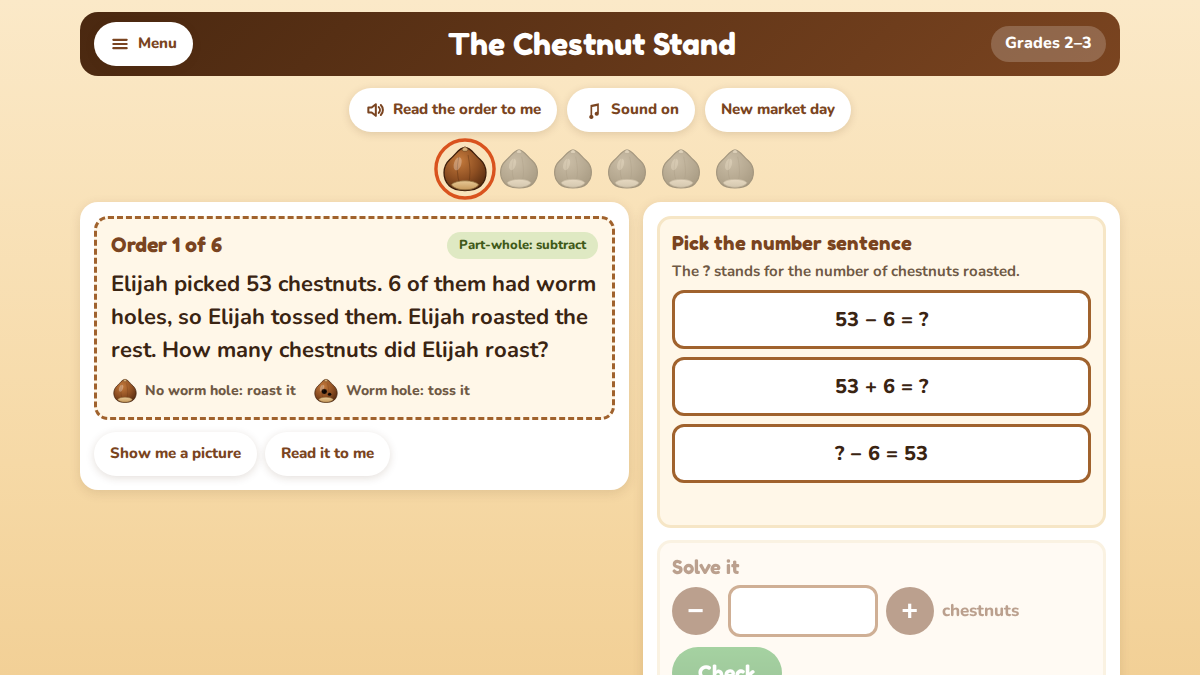
Students run a busy chestnut stand on market day and fill six customer orders. Each order is a short story, and students choose the number sentence that matches it before they solve for the missing number. When all six orders are filled, the stand closes for the day and students can print a receipt that shows how they did.
 Preview
How these chestnut stand word problems work
Every order is a real situation, such as chestnuts picked, tossed, roasted, or sold. Chestnuts with worm holes get tossed and the rest get roasted. The missing number is shown as a question mark, which makes the unknown easy to spot. If a student gets stuck, a bar model picture turns the story into colored boxes, and a short explanation after each order shows why the answer makes sense.
Practice for grades 2 through 5
Two levels match the math to what students are ready for:
- Grades 2-3: The first three orders use addition and subtraction within 100, and the last three move up to Grade 3 problems within 1,000, with equal groups and a missing starting amount.
- Grades 4-5: The first four orders use Grade 4 problems such as times as many, dividing with remainders, and multi-step stories, and the last two reach Grade 5 work like dividing by two-digit numbers.
Choosing the number sentence that matches the story
The big idea is that a story and a number sentence say the same thing in two different ways. Students ask what is happening: are chestnuts being added, taken away, put into equal groups, or compared? Each of the three choices is a real equation, so students must think about the story and cannot simply grab the numbers. Many children feel a spark of wonder when the picture, the words, and the equation all line up.
Standards and learning goals
Teachers can match these chestnut stand word problems to their standards, which are listed inside the game for Georgia, Common Core, New York, New Jersey, and North Carolina. Learn more about the Common Core State Standards for Mathematics, or open the Standards Alignment panel on the start page to see each state side by side.
A printable receipt for families and teachers
After a market day, students can type a first name and print a receipt, or save it as a PDF. The receipt shows accuracy, how many orders were solved on the first try, and the average time, along with a QR code that opens a short summary for families. The name appears on the paper only and is not included in the QR code.
Why word problems make math stick
Word problems give numbers a reason to exist, because students can picture the chestnuts they are counting. Careful work makes the answer trustworthy, so each order invites students to reread the story, check that the number sentence fits, and ask whether the answer makes sense. These habits help far beyond the game, in kitchens, farm stands, stores, and classrooms.
Tips for playing at home or in class
Read each story aloud together before touching the choices. Ask the student to retell it in their own words and to say what the question mark stands for. On a smart board, one student can read the order, another can pick the sentence, and the whole class can vote before the answer is checked.
How to play
To try the chestnut stand word problems, choose Play Full Screen to open the game in its own tab. It works on Chromebooks, tablets, phones and computers, and there is nothing to install. The speaker button turns the music off.
More word problems to try
Want more practice with word problems? Try the Easter Egg Word Problems or the To Roast or Toss? chestnut sorting game. After these chestnut stand word problems, families can keep going at the farmers market or the grocery store by asking how many were bought, how many are left, and how many more are needed.