A to roast or to toss chestnuts game for pre-K to grade 2
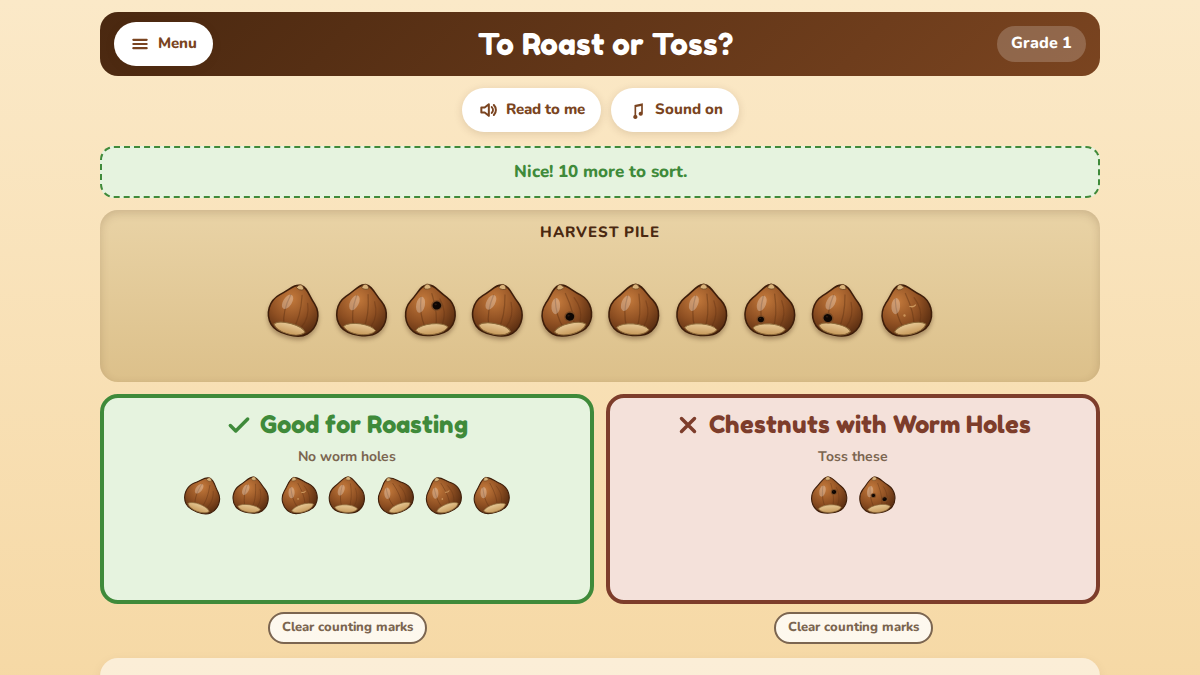
Students help at a chestnut harvest by sorting a pile of chestnuts into two bins. Chestnuts with black worm holes get tossed, and the good ones go in the bin for roasting. When the sorting is done, students count each bin and type their answers, and after three harvests they can print a receipt.
 Preview
How this to roast or to toss chestnuts game works
Students drag each chestnut to a bin, or tap a chestnut and then tap a bin. If a chestnut lands in the wrong bin, it goes back to the pile with a hint. Once every chestnut is sorted, students tap the chestnuts in each bin to count them one by one, then type how many are in each bin. The game checks the answers and shows which boxes to fix.
Practice for pre-K through grade 2
Three levels match the math to what students are ready for:
- Pre-K and K: Sort 6 to 10 chestnuts and count each bin, and the Read to me button reads the directions out loud.
- Grade 1: Sort 12 to 20 chestnuts, count each bin, find the total, and decide which bin has more.
- Grade 2: Sort 21 to 30 chestnuts, count by tens and ones in ten frames, find the total, and tell how many more are good for roasting than have worm holes.
Sorting, counting, and comparing
The big idea is that sorting turns a messy pile into numbers that can be counted and compared. Students decide with one clear rule, a worm hole or no worm hole, then count each group and see how the groups relate. Many children feel a spark of wonder when the two bins add up to the whole pile.
Standards and learning goals
Teachers can match this to roast or to toss chestnuts game to their standards, which are listed inside the game for Georgia, Common Core, New York, New Jersey, and North Carolina. The Pre-K standards come from the Georgia Early Learning and Development Standards. Learn more about the Common Core State Standards for Mathematics.
A printable receipt for families and teachers
After three finished harvests, students can type a first name and print a receipt, or save it as a PDF. The receipt shows how many harvests were completed, how many chestnuts were sorted right on the first drop, accuracy, and average time, along with a QR code that opens a short summary for families. The name appears on the paper only and is not included in the QR code.
Why counting and sorting make math stick
Sorting gives counting a purpose, because students count the chestnuts they just decided about. Careful work matters here, since one chestnut in the wrong bin changes every number that follows, so students look closely before they drop. These habits show up everywhere, when children sort laundry, put away toys, or share snacks and count each pile.
Tips for playing at home or in class
Ask the student to say the rule out loud before sorting: worm hole means toss, and no worm hole means roast. Count each bin together, touching each chestnut once, and ask how the student knows the count is right. On a smart board, one student can sort, another can count, and the whole class can check the answer together.
How to play
To try the to roast or to toss chestnuts game, choose Play Full Screen to open it in its own tab, then pick a level on the start page. It works on Chromebooks, tablets, phones and computers, and there is nothing to install. The speaker button turns the music off.
More counting and sorting to try
Want more practice with counting and sorting? Try the chestnut sorting lesson plan and printouts or the Chestnut Stand word problems. After the to roast or to toss chestnuts game, families can keep counting and sorting at home with laundry, toys, or a bowl of fruit.