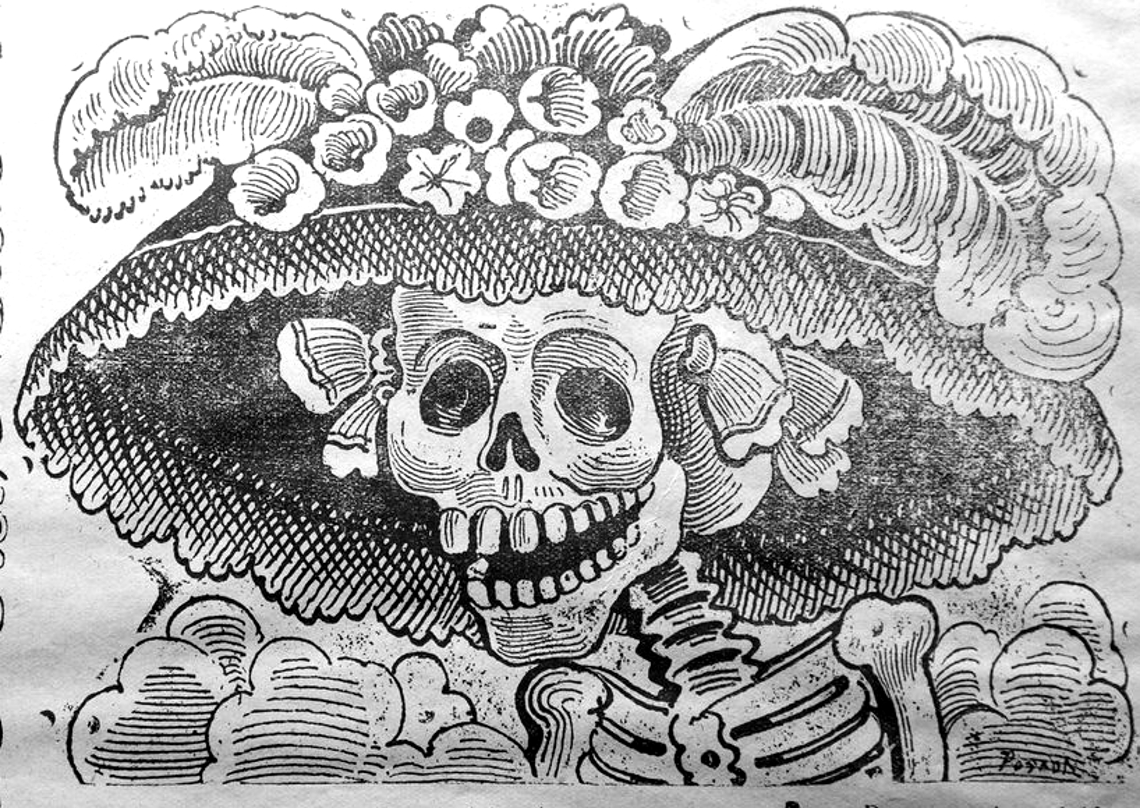
La Calavera Catrina (see feature image above) was created by José Guadalupe Posada in 1910 as political commentary criticizing wealthy Mexicans who abandoned their cultural heritage. She has since become a beloved icon of Día de los Muertos. The tradition of face painting as La Catrina is modern, not ancient, yet it represents an important form of cultural expression and celebration participation.
The Story of La Catrina
A read-aloud history for art class while students work on their sculptures
Today we’re going to learn about a very special character from Mexico called La Catrina!
La Catrina is a fancy skeleton lady who wears beautiful clothes and a big fancy hat. She’s not scary at all—she’s actually quite elegant and even a little bit funny!
A long time ago, about 100 years before your grandparents were born, there was an artist in Mexico named José Guadalupe Posada. That’s a big name! We can just call him Mr. Posada.
Mr. Posada loved to draw pictures for newspapers and books. One day, he drew this skeleton lady wearing fancy clothes. He wanted to remind people that everyone is the same on the inside, no matter what clothes they wear or how much money they have.
In Mexico, people celebrate a special holiday called Día de los Muertos, which means “Day of the Dead” in English. It’s not a sad or scary day—it’s actually a happy celebration! Families remember loved ones who have passed away by telling happy stories about them, decorating with bright colors, and making special treats.
La Catrina became a very important symbol for this celebration. She reminds everyone that we should celebrate life and remember the people we love with joy and happiness, not sadness.
Today, you’ll see La Catrina everywhere during Día de los Muertos—in parades, on decorations, and in artwork just like the sculpture you’re making right now! Every Catrina is special and unique, just like each of you.
As you work on your Catrina, think about making her colorful and happy. Remember, she’s not meant to be scary—she’s meant to make us smile and think about happy memories!
While you work on your art projects today, I want to tell you the fascinating story of La Catrina and how she became one of the most famous symbols of Mexican culture.
Our story begins over 100 years ago in Mexico City. A talented artist named José Guadalupe Posada worked as an illustrator, which means he drew pictures for newspapers, magazines, and posters. His job was to create images that would catch people’s attention and make them think.
Around 1910, Posada created a special drawing that would become famous all around the world. He drew an elegant skeleton woman dressed in fancy European clothing, complete with a large decorative hat covered with feathers and flowers. He called her “La Calavera Catrina”—which means “The Elegant Skull” or “The Dapper Skeleton.”
But why would he draw a skeleton dressed in fancy clothes? Posada had an important message. During that time in Mexico, some wealthy people tried to act more European and looked down on traditional Mexican culture. They wore fancy imported clothes and pretended to be more sophisticated than others.
Posada’s drawing was actually making a point—a kind of gentle joke with a serious meaning. He was saying, “No matter how fancy your clothes are or how much money you have, we’re all the same underneath. We’re all human, and we all face the same fate eventually.” His message was about equality: rich or poor, we’re all equal in the end.
For many years, Posada’s work was appreciated by regular people who saw his images in newspapers, but he wasn’t famous outside of Mexico. Then, about 30 years later, a very famous Mexican artist named Diego Rivera included La Catrina in one of his large murals. Rivera painted her wearing fancy clothes and standing with other important figures from Mexican history. This helped make La Catrina famous around the world!
Today, La Catrina has become the most recognizable symbol of Día de los Muertos, or Day of the Dead. This Mexican holiday, celebrated on November 1st and 2nd, is a time when families remember and honor loved ones who have died. But unlike some traditions that focus on sadness, Día de los Muertos is actually a joyful celebration!
Families create beautiful altars decorated with bright orange marigold flowers, candles, photos, and the favorite foods of those they’re remembering. They believe that on these special days, the spirits of their loved ones return to celebrate with them. La Catrina appears everywhere—in parades, decorations, face paint, and artwork.
What’s wonderful is that La Catrina’s message of equality and her reminder to celebrate life has traveled around the world. The art project you’re creating today connects you to this rich cultural tradition and to the artist who created her over 100 years ago!
As you work on your Catrina, think about Posada’s message: we should treat everyone equally and remember to celebrate life with joy and color.
As you work on your art projects, I’d like to share the remarkable history of La Catrina—a character that transformed from political satire into one of Mexico’s most powerful cultural symbols.
José Guadalupe Posada was born in 1852 in Aguascalientes, Mexico. He became one of Mexico’s most influential printmakers, though he remained largely unknown outside Mexico during his lifetime. Posada worked as an illustrator for newspapers and publishers, creating thousands of images using a technique called etching, where designs are carved into metal plates and then printed.
Between 1910 and 1913, during Mexico’s Revolutionary period, Posada created what would become his most famous work: La Calavera Catrina. Originally, she was part of a larger tradition in Mexican art—artists often drew calaveras, or skulls and skeletons, as satirical commentary on contemporary society. These weren’t meant to be morbid or frightening; they were meant to be humorous and thought-provoking.
Posada’s Catrina was specifically designed as social and political satire. During the Porfiriato—the period when Porfirio Díaz ruled Mexico from 1876 to 1911—there was a growing division between classes. Wealthy Mexicans, particularly in urban areas, began adopting European fashions and manners. They dressed in French styles, spoke French phrases, and sometimes looked down on indigenous Mexican traditions. These people were called “malinchistas,” after Malinche, a historical figure associated with favoring foreign culture.
The word “catrina” itself is related to “catrín,” which described a dandy or someone who dressed elegantly and fashionably. By depicting an elegantly dressed skeleton—a calavera dressed as a wealthy European lady in a large feathered hat—Posada was making a pointed statement: “No matter how you dress or how wealthy you become, death is the great equalizer. Underneath all those fancy clothes, we’re all the same.”
This was a radical message about equality and social justice, delivered through art. Posada was reminding viewers not to forget their roots or to think themselves superior to others based on wealth or appearance.
For about 30 years after Posada’s death in 1913, La Catrina remained relatively obscure. Then, in the 1940s, the famous muralist Diego Rivera—husband of Frida Kahlo—featured La Catrina prominently in his massive mural “Dream of a Sunday Afternoon in Alameda Park.” In Rivera’s mural, La Catrina appears elegantly dressed, standing between Rivera himself as a child and Posada, linking Mexico’s artistic past with its present.
Rivera’s inclusion of La Catrina in such a prominent work helped transform her from a piece of political satire into a beloved national symbol. She came to represent not criticism of Mexican society, but celebration of Mexican culture itself, particularly the unique Mexican relationship with death.
In Mexican culture, influenced by both indigenous traditions and Catholic practices, death is not something to be feared or hidden away. Instead, Día de los Muertos—celebrated on November 1st and 2nd—treats death as a natural part of life’s cycle. These days are designated to remember and honor those who have died, but not with mourning. Instead, families create elaborate ofrendas (altars) decorated with marigolds, candles, papel picado (decorative cut paper), photographs, and the favorite foods and drinks of deceased loved ones.
The belief is that during these days, the boundary between the world of the living and the world of the dead becomes thin, allowing spirits to return and celebrate with their families. Rather than being somber, these celebrations are joyful, colorful, and even playful. La Catrina embodies this spirit perfectly—she’s elegant, celebratory, and a reminder that death is nothing to fear.
Today, La Catrina has become a global icon. During Día de los Muertos celebrations, you’ll see her image everywhere: in parades where people dress as elegantly dressed skeletons, in face paint designs, in decorations, and in artwork like the sculptures you’re creating today. The artistic technique you’re learning—cartonería, or papier-mâché sculpture—is itself a traditional Mexican folk art form used to create figures for celebrations.
What’s remarkable is how Posada’s satirical image has been reclaimed and transformed. La Catrina started as a critique of people abandoning their cultural identity, but she became a powerful symbol of Mexican cultural pride and the beautiful, unique Mexican perspective on death and remembrance.
As you complete your art project today, you’re not just making a craft—you’re participating in a artistic tradition that stretches back over a century, carrying forward Posada’s legacy and the rich cultural traditions of Día de los Muertos. Your Catrina will be unique, just as each person’s relationship with this tradition is unique, but she connects you to this fascinating history.
For additional historical context and details, visit: The Grace Museum – La Catrina: A History
• What do you think José Guadalupe Posada was trying to say with his drawing?
• How is La Catrina both elegant and playful at the same time?
• Why do you think it’s important to remember and celebrate people we love who have died?
• How does your Catrina art project reflect your own creativity while honoring this tradition?
Dig into these rich face painting traditions with your students or kids by printing and coloring together while learning about the origin of this newer tradition. Have kids color in the original cartoon by José Guadalupe Posada (below) or our full Dia de los Muertos Coloring Activity, with background information and explanations about the newer traditions of face painting popularized more recently. Scroll to down past the coloring activity, for a more involved art project; we have a suggested sculpture activity of Catrina. Navigate using the buttons after the coloring.
Art Lesson with La Calavera Catrina