A Black Friday math game for grades K-5
Children shop a Black Friday sale with a budget and work out what each sale tag really saves. They add every item to a cart, check the total, and finish with a receipt they can print. It is part of Shopping Cart Math™, in our Miraculous Math Moments™ series.
 Preview
How this Black Friday math game works
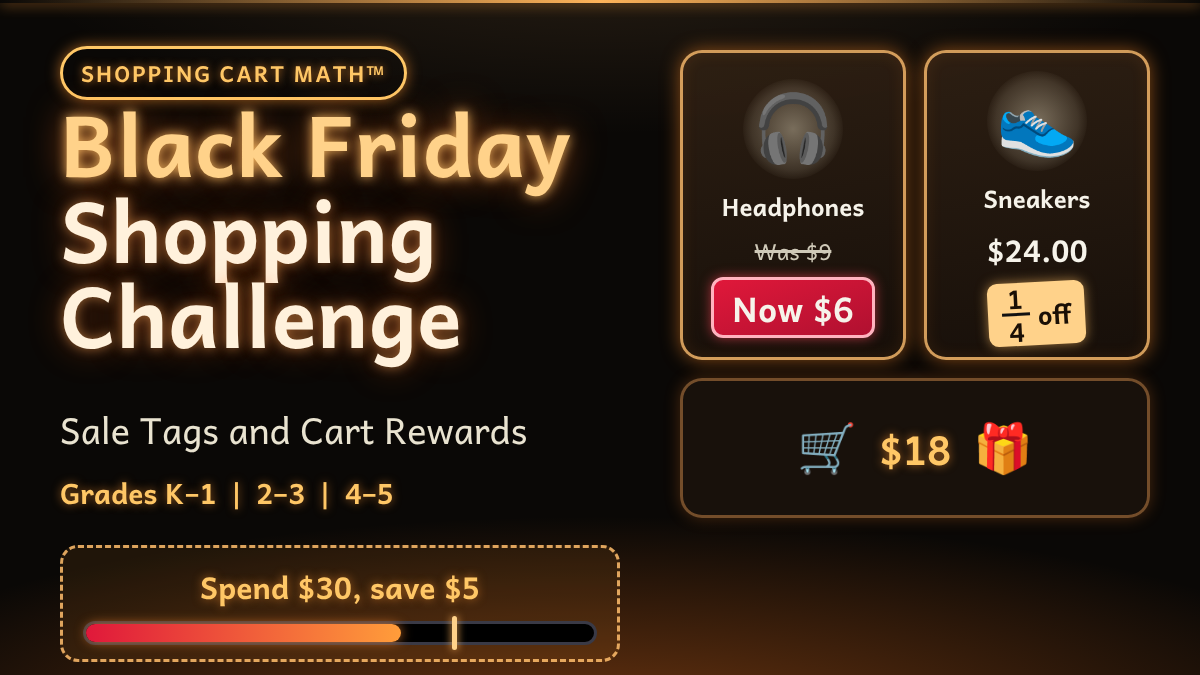
Every item on the shelf wears a sale tag. Every item on the shelf wears a price or a sale tag. Younger shoppers count dollar bills to add prices to the cart and spot the lower price on the same item, and older shoppers see Was and Now prices, a cart reward or a fraction off. Some items open a short check, and at the register children add up their own cart, one item at a time. Every answer gets feedback right away: a try again, then a hint, then the answer.
Practice for kindergarten through grade 5
Three levels match the math to what students are ready for:
- Grades K-1: count dollar bills to find each price, add them to the cart within 10, and tap the lower price when the same item shows a Black Friday price and a regular price.
- Grades 2-3: fill in a six-item invoice with what each tag saves, a running total, and what is paid under the store’s deal, plus an optional multiplication bonus.
- Grades 4-5: find fractions of a whole-dollar price, keep a running total with cents, and on the Challenge+ sheet show the work for harder discounts.
Sale tags and cart rewards, explained
The big number on a sale tag is not what you pay. A Was and Now tag shows the savings as the gap between two prices, and a cart reward sets a line to reach before the savings begin. Children find that checking the tag and the cart total before deciding is the careful habit real shoppers use.
Standards and learning goals
Teachers can match this Black Friday math game to their standards, listed inside the game for Common Core and Georgia. The practice centers on adding and subtracting within 20 and within 100, a fraction of a quantity, and comparing decimals to the hundredths. Read the full Common Core State Standards for Mathematics.
Printable receipts and worksheets for families and teachers
After checkout, a child picks a favorite animal and a favorite number, and both print on the receipt so each child can find theirs in a pile. The child writes their own name on the paper copy, so the game never asks for a name or collects anything personal. The kindergarten and first grade sheets are short and in large print, with a note for grown-ups to read aloud and help count. Fresh worksheets with an answer key are one tap away for each level, with cursive available from Grades 2-3 up: grades K-1, grades 2-3, grades 4-5 and a grades 4-5 Challenge+.
Why Black Friday, and why make it a game
Children notice what the adults around them talk about, and in November that talk is about sales. This game turns that talk into reasoning: what a sale saves, what a cart costs and what is left. Prices are chosen to be friendly, so children work them out in their heads with no scrap paper.
Tips for playing at home or in class
Ask your child to explain how they found each answer before they type it. At home, grab a store flyer and compare two prices together. In class, partners can take turns shopping and checking each other’s totals.
How to play
To try the Black Friday math game, choose Play Full Screen to open it in its own tab. It works on Chromebooks, tablets, phones and computers, and there is nothing to install. The speaker menu has separate switches for music, sound effects and read aloud.
More shopping math to try
More money practice? Try the Halloween Shopping Challenge: Bargain Edition. After this Black Friday math game, families can keep the conversation going at the store by comparing sale tags together.