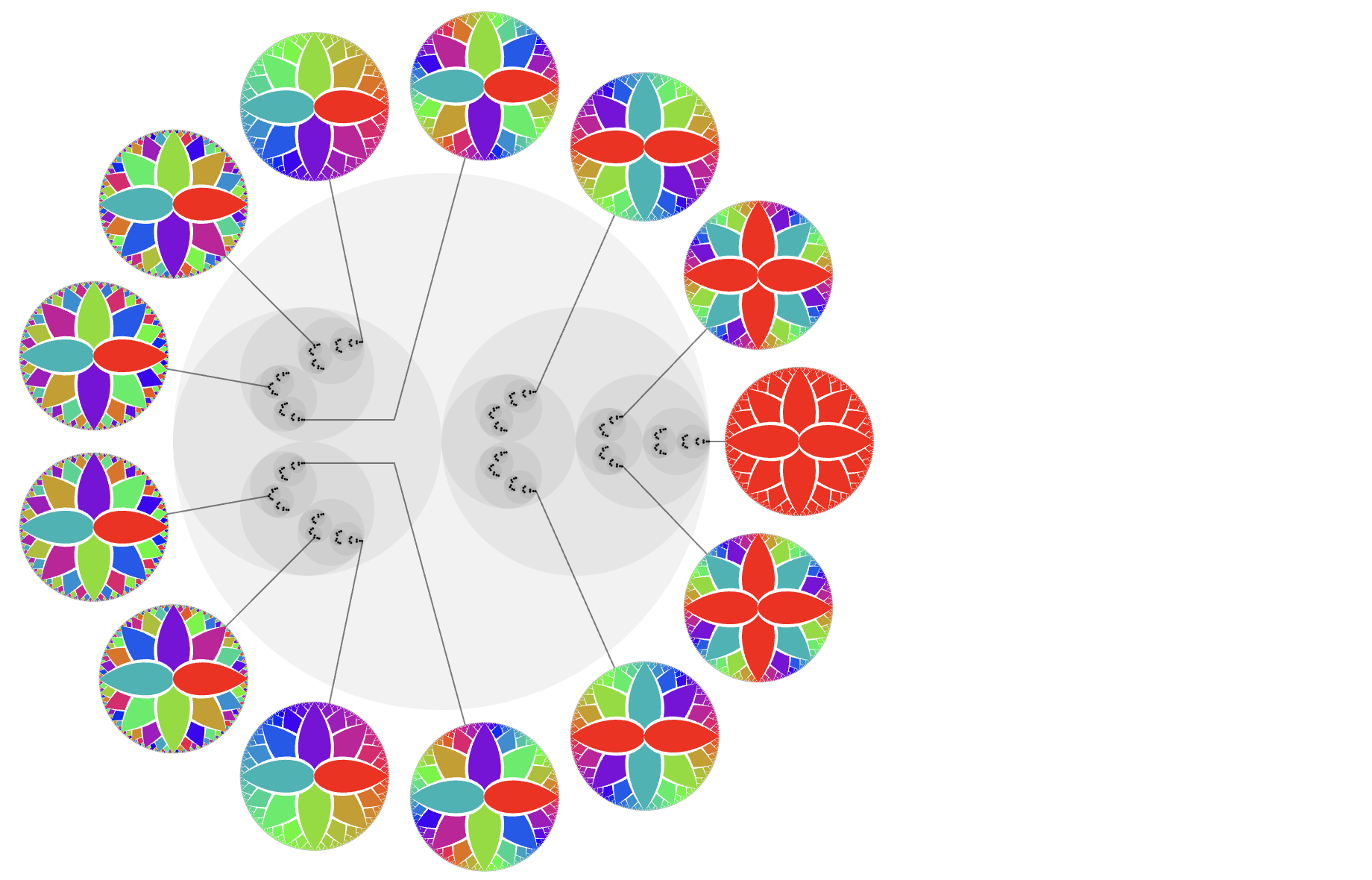
Every digit from 0 to 9 has its own color. Can you spot a repeating pattern? Article 1 explains why you cannot.
Pi is a number you can never finish writing. People have chased its digits for nearly four thousand years. Read how mathematicians explain the hunt, then become one yourself in the Pi Lab.
Why pi is everywhere, even where there are no circles.
Article 2The long hunt for pi’s digits, and a method you can try.
Two Pi Days every year
Written 3/14, the date matches the first digits of pi. This is the Pi Day that Article 1 describes.
In 2026 that is November 10. January through October add up to 304 days, and 304 plus 10 is 314. In a leap year it comes one day earlier, on November 9.
As you read, ask yourself
Make a hunch for each question before you read, then check it against the readings afterward. Nobody is graded. The goal is to read with a question in your head.
Your hunch: Tap the four approaches in the order you think people first used them.
Your order: tap an approach to start
Your hunch: Which statement lets you know how far off it could be?
All three checked. Go to the Pi Lab and see how close your own estimates can get.
Read in order, on purpose. Article 1 shows why pi matters and how many places it appears. Article 2 shows how people closed in on its value, and it ends with a method you can try with a pencil. Then the Pi Lab lets you try that method and two others, and compare your results with the ancient ones.
For teachers
- Why this order. Article 1 is a short roundup that hooks students with the surprising places pi appears. Article 2 is the longer history, and it closes with the dart-throwing method that leads straight into Station 2 of the Pi Lab.
- Three ways to estimate pi. Station 1 squeezes pi between two polygons, an idea Article 2 traces from Archimedes to Liu Hui and beyond. Station 2 uses random darts (the Monte Carlo method from Article 2). Station 3 has students measure real circles. Ask students to compare the methods for speed, effort, and accuracy.
- Station 1 does not use pi to find pi. The perimeters come from a doubling recipe that starts with a hexagon. Only the picture is drawn with trigonometry.
- Random results are lumpy. Station 2 uses a computer’s random numbers. Early estimates swing widely, and the swings shrink slowly. It takes roughly 100 times as many darts to gain one more decimal place of accuracy.
- A wording note on Article 2. Article 2 says Lindemann proved that pi cannot be expressed in a “rational algebraic equation.” Mathematicians today say pi is transcendental: it is not the solution of any polynomial equation with whole-number coefficients. Republished text cannot be edited, so you may want to say this aloud.
- Dates matter. Article 2 was written in 2016 and Article 1 in 2017. The record number of digits Article 2 reports has been broken since, so check a current source before quoting a record.
- A sentence students will meet twice. Article 1 quotes other Conversation authors, including the line about the earliest written approximations of pi, which is also in Article 2. Ask students to spot it.
- Color carries meaning. Warm colors mark Article 1 and cool colors mark Article 2. Each Pi Lab station has its own color, and it matches that station’s marker on the number line. Every digit from 0 to 9 has one fixed color wherever it appears, so students can track digits by color, for example when they compare the digits their polygons agree on.
- The second Pi Day. Neither article mentions the 314th day of the year, so it is our own addition. It is a good chance for students to add up month lengths and to see why leap years shift the date by one day.
- Printables and answer key. Printable PDFs of both articles, the standards, and a teacher’s key are in Teachers’ notes at the bottom of the page.
Both articles below are republished in full and unchanged from The Conversation under a Creative Commons license (CC BY-ND). The introduction, notes, vocabulary, Pi Lab, timeline, and questions are our own and are not part of either article.
Pi word hunt
Select a word to see what it means and which article to search. Then find it in the reading and mark it found. Words from Article 1 are tagged Article 1, words from Article 2 are tagged Article 2, and words in both are tagged Both.
The definition opens just below the group you choose from.
3.14 essential reads about π for Pi Day

Editor’s note: The following is a roundup of archival stories.
On March 14, or 3/14, mathematicians and other obscure-holiday aficionados celebrate Pi Day, honoring π, the Greek symbol representing an irrational number that begins with 3.14. Pi, as schoolteachers everywhere repeat, represents the ratio of a circle’s circumference to its diameter.
What is Pi Day, and what, really, do we know about π anyway? Here are three-and-bit-more articles to round out your Pi Day festivities.
A silly holiday
First off, a reflection on this “holiday” construct. Pi itself is very important, writes mathematics professor Daniel Ullman of George Washington University, but celebrating it is absurd:
The Gregorian calendar, the decimal system, the Greek alphabet, and pies are relatively modern, human-made inventions, chosen arbitrarily among many equivalent choices. Of course a mood-boosting piece of lemon meringue could be just what many math lovers need in the middle of March at the end of a long winter. But there’s an element of absurdity to celebrating π by noting its connections with these ephemera, which have themselves no connection to π at all, just as absurd as it would be to celebrate Earth Day by eating foods that start with the letter “E.”
And yet, here we are, looking at the calendar and getting goofily giddy about the sequence of numbers it shows us.
There’s never enough
In fact, as Jon Borwein of the University of Newcastle and David H. Bailey of the University of California, Davis, document, π is having a sustained cultural moment, popping up in literature, film and song:
Sometimes the attention given to pi is annoying. On 14 August 2012, the U.S. Census Office announced the population of the country had passed exactly 314,159,265. Such precision was, of course, completely unwarranted. But sometimes the attention is breathtakingly pleasurable.
Come to think of it, pi can indeed be a source of great pleasure. Apple’s always comforting, and cherry packs a tart pop. Chocolate cream, though, might just be where it’s at.
Strange connections
Of course π appears in all kinds of places that relate to circles. But it crops up in other places, too – often where circles are hiding in plain sight. Lorenzo Sadun, a professor of mathematics at the University of Texas at Austin, explores surprising appearances:
Pi also crops up in probability. The function f(x)=e-x², where e=2.71828… is Euler’s number, describes the most common probability distribution seen in the real world, governing everything from SAT scores to locations of darts thrown at a target. The area under this curve is exactly the square root of π.
It’s enough to make your head spin.
Historical pi
If you want to engage with π more directly, follow the lead of Georgia State University mathematician Xiaojing Ye, whose guide starts thousands of years ago:
The earliest written approximations of pi are 3.125 in Babylon (1900-1600 B.C.) and 3.1605 in ancient Egypt (1650 B.C.). Both approximations start with 3.1 – pretty close to the actual value, but still relatively far off.
By the end of his article, you’ll find a method to calculate π for yourself. You can even try it at home!
An irrational bonus
And because π is irrational, we’ll irrationally give you even one more, from education professor Gareth Ffowc Roberts at Bangor University in Wales, who highlights the very humble beginnings of the symbol π:
After attending a charity school, William Jones of the parish of Llanfihangel Tre’r Beirdd landed a job as a merchant’s accountant and then as a maths teacher on a warship, before publishing A New Compendium of the Whole Art of Navigation, his first book in 1702 on the mathematics of navigation. On his return to Britain he began to teach maths in London, possibly starting by holding classes in coffee shops for a small fee.
Shortly afterwards he published “Synopsis palmariorum matheseos,” a summary of the current state of the art developments in mathematics which reflected his own particular interests. In it is the first recorded use of the symbol π as the number that gives the ratio of a circle’s circumference to its diameter.
What made him realize that this ratio needed a symbol to represent a numeric value? And why did he choose π? It’s all Greek to us.
Jeff Inglis, Environment + Energy Editor, The Conversation
This article is republished from The Conversation under a Creative Commons license. Read the original article.
The search for the value of pi

The number represented by pi (π) is used in calculations whenever something round (or nearly so) is involved, such as for circles, spheres, cylinders, cones and ellipses. Its value is necessary to compute many important quantities about these shapes, such as understanding the relationship between a circle’s radius and its circumference and area (circumference=2πr; area=πr2).
Pi also appears in the calculations to determine the area of an ellipse and in finding the radius, surface area and volume of a sphere.
Our world contains many round and near-round objects; finding the exact value of pi helps us build, manufacture and work with them more accurately.
Historically, people had only very coarse estimations of pi (such as 3, or 3.12, or 3.16), and while they knew these were estimates, they had no idea how far off they might be.
The search for the accurate value of pi led not only to more accuracy, but also to the development of new concepts and techniques, such as limits and iterative algorithms, which then became fundamental to new areas of mathematics.
Finding the actual value of pi

Between 3,000 and 4,000 years ago, people used trial-and-error approximations of pi, without doing any math or considering potential errors. The earliest written approximations of pi are 3.125 in Babylon (1900-1600 B.C.) and 3.1605 in ancient Egypt (1650 B.C.). Both approximations start with 3.1 – pretty close to the actual value, but still relatively far off.

The first rigorous approach to finding the true value of pi was based on geometrical approximations. Around 250 B.C., the Greek mathematician Archimedes drew polygons both around the outside and within the interior of circles. Measuring the perimeters of those gave upper and lower bounds of the range containing pi. He started with hexagons; by using polygons with more and more sides, he ultimately calculated three accurate digits of pi: 3.14. Around A.D. 150, Greek-Roman scientist Ptolemy used this method to calculate a value of 3.1416.

Independently, around A.D. 265, Chinese mathematician Liu Hui created another simple polygon-based iterative algorithm. He proposed a very fast and efficient approximation method, which gave four accurate digits. Later, around A.D. 480, Zu Chongzhi adopted Liu Hui’s method and achieved seven digits of accuracy. This record held for another 800 years.
In 1630, Austrian astronomer Christoph Grienberger arrived at 38 digits, which is the most accurate approximation manually achieved using polygonal algorithms.
Moving beyond polygons
The development of infinite series techniques in the 16th and 17th centuries greatly enhanced people’s ability to approximate pi more efficiently. An infinite series is the sum (or much less commonly, product) of the terms of an infinite sequence, such as ½, ¼, 1/8, 1/16, … 1/(2n). The first written description of an infinite series that could be used to compute pi was laid out in Sanskrit verse by Indian astronomer Nilakantha Somayaji around 1500 A.D., the proof of which was presented around 1530 A.D.

In 1665, English mathematician and physicist Isaac Newton used infinite series to compute pi to 15 digits using calculus he and German mathematician Gottfried Wilhelm Leibniz discovered. After that, the record kept being broken. It reached 71 digits in 1699, 100 digits in 1706, and 620 digits in 1956 – the best approximation achieved without the aid of a calculator or computer.

In tandem with these calculations, mathematicians were researching other characteristics of pi. Swiss mathematician Johann Heinrich Lambert (1728-1777) first proved that pi is an irrational number – it has an infinite number of digits that never enter a repeating pattern. In 1882, German mathematician Ferdinand von Lindemann proved that pi cannot be expressed in a rational algebraic equation (such as pi²=10 or 9pi4 – 240pi2 + 1492 = 0).
Toward even more digits of pi
Bursts of calculations of even more digits of pi followed the adoption of iterative algorithms, which repeatedly build an updated value by using a calculation performed on the previous value. A simple example of an iterative algorithm allows you to approximate the square root of 2 as follows, using the formula (x+2/x)/2:
- (2+2/2)/2 = 1.5
- (1.5+2/1.5)/2 = 1.4167
- (1.4167+2/1.4167)/2 = 1.4142, which is a very close approximation already.
Advances toward more digits of pi came with the use of a Machin-like algorithm (a generalization of English mathematician John Machin’s formula developed in 1706) and the Gauss-Legendre algorithm (late 18th century) in electronic computers (invented mid-20th century). In 1946, ENIAC, the first electronic general-purpose computer, calculated 2,037 digits of pi in 70 hours. The most recent calculation found more than 13 trillion digits of pi in 208 days!
It has been widely accepted that for most numerical calculations involving pi, a dozen digits provides sufficient precision. According to mathematicians Jörg Arndt and Christoph Haenel, 39 digits are sufficient to perform most cosmological calculations, because that’s the accuracy necessary to calculate the circumference of the observable universe to within one atom’s diameter. Thereafter, more digits of pi are not of practical use in calculations; rather, today’s pursuit of more digits of pi is about testing supercomputers and numerical analysis algorithms.
Calculating pi by yourself
There are also fun and simple methods for estimating the value of pi. One of the best-known is a method called “Monte Carlo.”

The method is fairly simple. To try it at home, draw a circle and a square around it (as at left) on a piece of paper. Imagine the square’s sides are of length 2, so its area is 4; the circle’s diameter is therefore 2, and its area is pi. The ratio between their areas is pi/4, or about 0.7854.
Now pick up a pen, close your eyes and put dots on the square at random. If you do this enough times, and your efforts are truly random, eventually the percentage of times your dot landed inside the circle will approach 78.54% – or 0.7854.
Now you’ve joined the ranks of mathematicians who have calculated pi through the ages.
Xiaojing Ye, Assistant Professor of Mathematics and Statistics, Georgia State University
This article is republished from The Conversation under a Creative Commons license. Read the original article.
The Pi Lab: estimate pi three ways
Nobody ever looked pi up. People closed in on it. In this lab you will trap it, throw darts at it, and measure it. Each station gives you an estimate, and the number line at the bottom shows where your estimates land next to the ancient ones from Article 2.
The idea from Archimedes. This circle has a diameter of 1, so its circumference is exactly pi. A polygon inside the circle is a little too short. A polygon outside is a little too long. Pi has to fit between the two perimeters. Press the button to double the number of sides and watch the gap close.
Try this: How many doublings does it take for both perimeters to begin with 3.14? Past a certain point you cannot see any difference between the polygons and the circle, but the numbers still can. Article 2 says Archimedes ended up with three accurate digits. How does your estimate compare?
The Monte Carlo method from Article 2. Picture a square that is 2 units wide with a circle of diameter 2 tucked inside it. The circle covers pi/4 of the square, about 78.5%. Throw darts at random. Teal dots land inside the circle and orange dots land outside. The share inside should creep toward pi/4, so 4 times that share estimates pi.
Predict first. After 1,000 darts, how close to 3.14 will your estimate be?
Try this: Throw 10 darts, record your estimate, start over, and do it twice more. How much do the three estimates differ? Then repeat with 1,000 darts. With a partner, add your dart counts and your inside counts together and compute 4 × (total inside ÷ total darts).
The oldest method of all. Pi is the ratio of a circle’s circumference to its diameter, so you can estimate it by measuring. Wrap a piece of string once around a round object, then lay the string against a ruler to get the circumference. Measure straight across the widest part for the diameter. Use the same units for both. Good objects: a cup, a lid, a plate, a trash can, a bike wheel.
| Object | Circumference | Diameter | Ratio |
|---|
Try this: Your ratios will be close to each other but not identical. Where could the differences come from? Does a bigger object give a better ratio than a small one?
Where do your estimates land?
Each station you run adds a marker. The ancient estimates come from Article 2.
Save your work
Nothing you type or throw in the Pi Lab is stored on this page, so save a copy before you close it. Add any notes, then press the button. Please do not type your name or any other personal information. Your browser’s print window will open. Choose Save as PDF as the destination.
Follow the digits: from guesses to trillions
Select a stage to open it. Each one points to the part of the reading where you can find more, and some point to a station in the Pi Lab.
-
The earliest written approximations are 3.125 in Babylon and 3.1605 in ancient Egypt, both from between about 1900 and 1600 B.C. Both start with 3.1. People knew these were estimates, but they had no idea how far off they might be.
Think about it: Why is an estimate with no error range hard to trust? Look at where the two ancient values land on the number line in the Pi Lab.
-
Around 250 B.C., Archimedes drew polygons outside and inside a circle, and their perimeters gave an upper and a lower bound for pi. He reached three accurate digits. Ptolemy found 3.1416 around A.D. 150. Liu Hui found four digits around A.D. 265, and Zu Chongzhi reached seven around A.D. 480, a record that held for 800 years.
Think about it: Try Station 1 in the Pi Lab. Which stage of this story does your polygon match when its two perimeters first agree on 3.14?
-
In 1630, Christoph Grienberger reached 38 digits, the most accurate approximation anyone achieved by hand with polygons.
Think about it: In Station 1, each doubling gives only a few more digits. Why might getting to 38 digits by hand have taken so much effort?
-
Infinite series made the hunt much more efficient. Nilakantha Somayaji described a series for pi in Sanskrit verse around 1500 A.D. In 1665 Isaac Newton used series and calculus to reach 15 digits. The record then climbed to 71 digits in 1699, 100 digits in 1706, and 620 digits in 1956, the best done without a calculator or computer.
Think about it: The article’s example series is ½, ¼, 1/8, 1/16, and so on. What number do you think the running total gets closer and closer to?
-
While others chased digits, Johann Lambert proved that pi is irrational: its digits go on forever and never settle into a repeating pattern. In 1882, Ferdinand von Lindemann proved something more about the kinds of equations pi can and cannot solve. Article 1 calls pi irrational in its very first paragraph.
Think about it: Why does knowing pi is irrational tell us that nobody will ever finish writing it out?
-
In 1946, ENIAC, the first electronic general-purpose computer, calculated 2,037 digits of pi in 70 hours. The article reports a later calculation of more than 13 trillion digits in 208 days. Records have been broken since, so check a current source before quoting one.
Think about it: In Station 2, a computer throws thousands of darts in a blink. What would that take you by hand, and what would you gain by sharing the work with a class?
-
A dozen digits are enough for most calculations. The article says 39 digits are enough to find the circumference of the observable universe to within the width of one atom. Beyond that, chasing more digits is about testing supercomputers and calculation methods.
Think about it: Look at the markers on your number line in the Pi Lab. About how many digits of pi does each of your three methods get right?
Discussion questions
- Article 1 includes one writer who says celebrating Pi Day is absurd and others who show pi turning up in books, films, and songs. Which argument do you find more convincing, and why?
- Article 1 says pi shows up in probability, and Article 2 uses chance to estimate pi. What is the link between circles and chance in the dart game?
- In Station 1, what happens to the gap between the inside and outside perimeters each time the sides double? Why does a shrinking gap mean your estimate is getting better?
- Article 2 says early people had no idea how far off their estimates might be. How did Archimedes’ method solve that problem?
- In Station 2, your estimate swung widely at first and then settled down. Why does that happen? About how many darts did it take before your estimate stayed close to 3.14?
- In Station 3, your ratios were close to each other but not identical. Where could the differences come from, and how is that like the early estimates from Babylon and Egypt?
- Article 2 says 39 digits are enough to measure the universe to within an atom. Why might people still want trillions of digits? Use evidence from the article.
- Pi is celebrated twice a year: on March 14 and on the 314th day of the year. Add up the days in January through October of a non-leap year. Which date is the 314th day, and why does it land one day earlier in a leap year?
Teachers’ notes
Standards, printable versions, and the answer key for this piece. Select a heading to open it.
Standards connections
7.G.B.4 7.SP.C.6 8.NS.A.1 8.NS.A.2
- 7.G.B.4 (circumference and area of a circle): Pi as the ratio of circumference to diameter in both articles, and Station 3, where students measure real circles.
- 7.SP.C.6 (long-run relative frequency): Station 2, the dart game, where the share of darts inside the circle settles toward pi/4.
- 8.NS.A.1 (irrational numbers): Both articles describe pi as irrational, and the digit panel at the top of the page shows digits that never repeat.
- 8.NS.A.2 (rational approximations of irrational numbers): Station 1, the polygon squeeze, and the timeline of ever better estimates.
Printable classroom versions
Each article has a text-only, black-and-white PDF that is easy to photocopy. The articles are unchanged. The images from the online versions are left out.
- Article 1: a word hunt sheet, the full article, and a timeline fill-in sheet.
- Article 2: a two-page word hunt sheet with a mini crossword, then the full article.
Key: Article 1 timeline fill-in
- Babylon
- Egypt
- 3.1605
- 1702
- navigation
- π
- 314,159,265
- Pi
Do the math. From 1650 B.C. to A.D. 1702 is 3,351 years (there is no year 0), so accept about 3,350. From 1702 to 2012 is 310 years.
Where students find the answers: blanks 1 to 3 in the “Historical pi” section, blanks 4 to 6 in “An irrational bonus,” blank 7 in “There’s never enough,” and blank 8 in the first paragraph.
Key: Article 2 mini crossword
| 1C | 2A | 3R | ||||||||
| 4D | I | A | M | E | T | E | R | A | ||
| L | E | D | ||||||||
| C | 5D | 6R | A | T | I | O | ||||
| U | I | A | U | |||||||
| 7P | O | L | Y | G | O | N | S | |||
| R | U | I | D | |||||||
| O | S | T | O | |||||||
| O | M | |||||||||
| F |
Across
- 4. Diameter
- 6. Ratio
- 7. Polygon
Down
- 1. Calculus
- 2. Area
- 3. Radius
- 5. Digit
- 6. Random
- 7. Proof