A Halloween shopping challenge for grades K-5
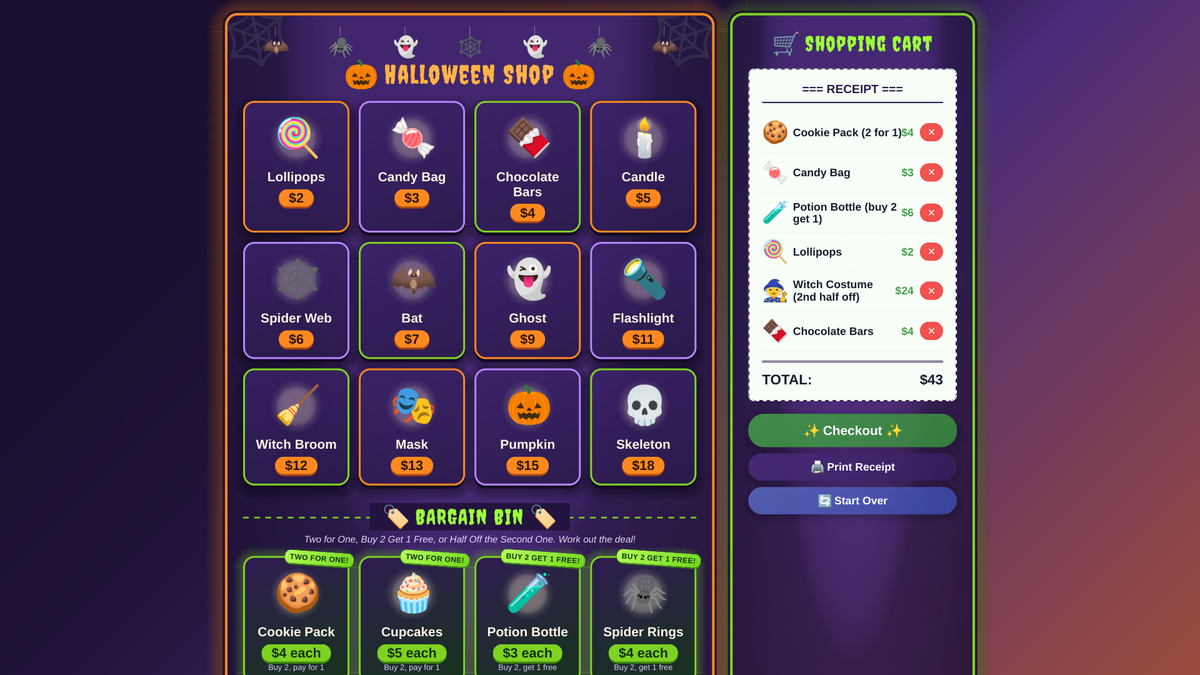
Students shop for Halloween treats and decorations within a set budget, then hunt the Bargain Bin for deals like two for one and buy 2 get 1 free. Every deal asks three short questions: what the items cost without the deal, what they cost with it, and how much is saved. A printable receipt at the end shows families and teachers how the shopping trip went.
 Preview
How this halloween shopping challenge works
Every grade level starts with a set budget and a shop full of Halloween treats and decorations. In the Bargain Bin, each deal opens a Bargain Check with three short questions, and then the student adds the deal price to the cart. A budget tracker shows how close they are to the limit, so every choice changes the numbers.
Bargain practice for kindergarten through grade 5
Three levels match the deals to what students are ready for:
- Grades K-1: a $20 budget with Two for One deals on treats, priced so totals stay within 10.
- Grades 2-3: a $50 budget with Two for One, Buy 2 Get 1 Free, and Half Off the Second One deals on treats and costumes.
- Grades 4-5: an $80 budget with prices in dollars and cents, a cheaper-one-free deal, Buy 2 Get 1 Free, dollar-off coupons, and questions that ask which deal is better.
Two for one and other bargains
A two for one deal means you pay for one item and take two. Buy 2 get 1 free means you pay for two items and take three, and half off the second one means the second item costs half as much. Students in grades 4-5 also compare two deals for the same item and decide which costs less.
Standards and learning goals
Teachers can match this halloween shopping challenge to their standards, which are listed inside the game for Common Core and Georgia. The skills include adding and subtracting within 20 in the early grades, finding half of an even number with equal addends in grades 2-3, and adding, subtracting and comparing decimals in grades 4-5. Percent off is left for later grades, so every deal uses skills students have already learned, and you can read more in the Common Core State Standards for Mathematics.
A printable receipt for families and teachers
At the end of the shopping trip, the game shows a receipt with the items bought, the bargains found, the total spent and how many answers were right on the first try. It prints for the classroom or saves as a PDF. A QR code on the receipt opens a short summary that families can read on a phone and use to play again.
Why bargains make math stick
Shoppers see deals everywhere, and working out what a deal really saves is a real-life use of adding and subtracting. Talking about prices at home or in the store builds the same skills, and the receipt gives families something concrete to talk about together.
Tips for playing at home or in class
Play together and ask the student to explain how they found each saving. Younger students can say the prices out loud while an adult keeps the running total on paper, and older students can estimate before they work out the deal. Set a small goal, such as finding every bargain without going over budget. Then print the receipt and ask which deal saved the most.
How to play
To try the halloween shopping challenge, choose Play Full Screen to open it in its own tab. It works on Chromebooks, tablets, phones and computers, and there is nothing to install. The speaker button turns the music off.
More budget math to try
Want more practice with money? Try the Back to School Math Game or the Sports Gear Shopping Challenge. After this halloween shopping challenge, families can keep the budgeting talk going at the store.