🌍 The Instant Guide to Earth’s Solstice and Equinox
Understanding Earth’s Tilt and the Science Behind Our Seasons
🌞 What is the Solstice?
The solstice happens when Earth is in a special spot in its trip around the Sun! Earth is always tilted like a spinning top that leans to one side, and this tilt never changes.
🎥 NASA Animation: Winter Solstice
Watch how Earth’s constant tilt creates the winter solstice when we’re on one side of our orbit around the Sun!
Animation: NASA’s Scientific Visualization Studio
Credit: Krystofer Kim & Joy Ng, KBR Wyle Services, LLC
Earth’s tilt always points the same direction – it NEVER changes!
(Dec 21)
(March 20)
(June 21)
(Sept 22)
Notice: Earth’s tilt always points the same way!
🌏 Fun Facts About Our Planet!
Opposite Seasons: When it’s summer in the Northern Hemisphere (like the United States), it’s winter in the Southern Hemisphere (like Australia)! The seasons are opposite!
Nearly Equal Day and Night: During the equinoxes (spring and fall), almost everywhere on Earth gets about 12 hours of daylight and 12 hours of darkness! The word “equinox” means “equal night.”
🎥 NASA Video: Watch Earth Through the Seasons
This video shows one year of images from space, with one picture taken each day. Watch how the shadow line moves across Earth as we travel around the Sun! You’ll see how our constant tilt creates our changing seasons.
[NASA GOES-16 Satellite – 2023 Summer Solstice Animation]
Flashlight Earth:
- Get a flashlight (this is the Sun!) and a ball on a pencil (this is Earth with its axis!)
- Tilt the pencil/ball and KEEP IT TILTED THE SAME WAY
- Walk in a circle around the flashlight, keeping the tilt pointing the same direction
- Watch how different parts of the ball get more or less light as you walk around!
🗿 What’s So Special About Stonehenge Anyway?
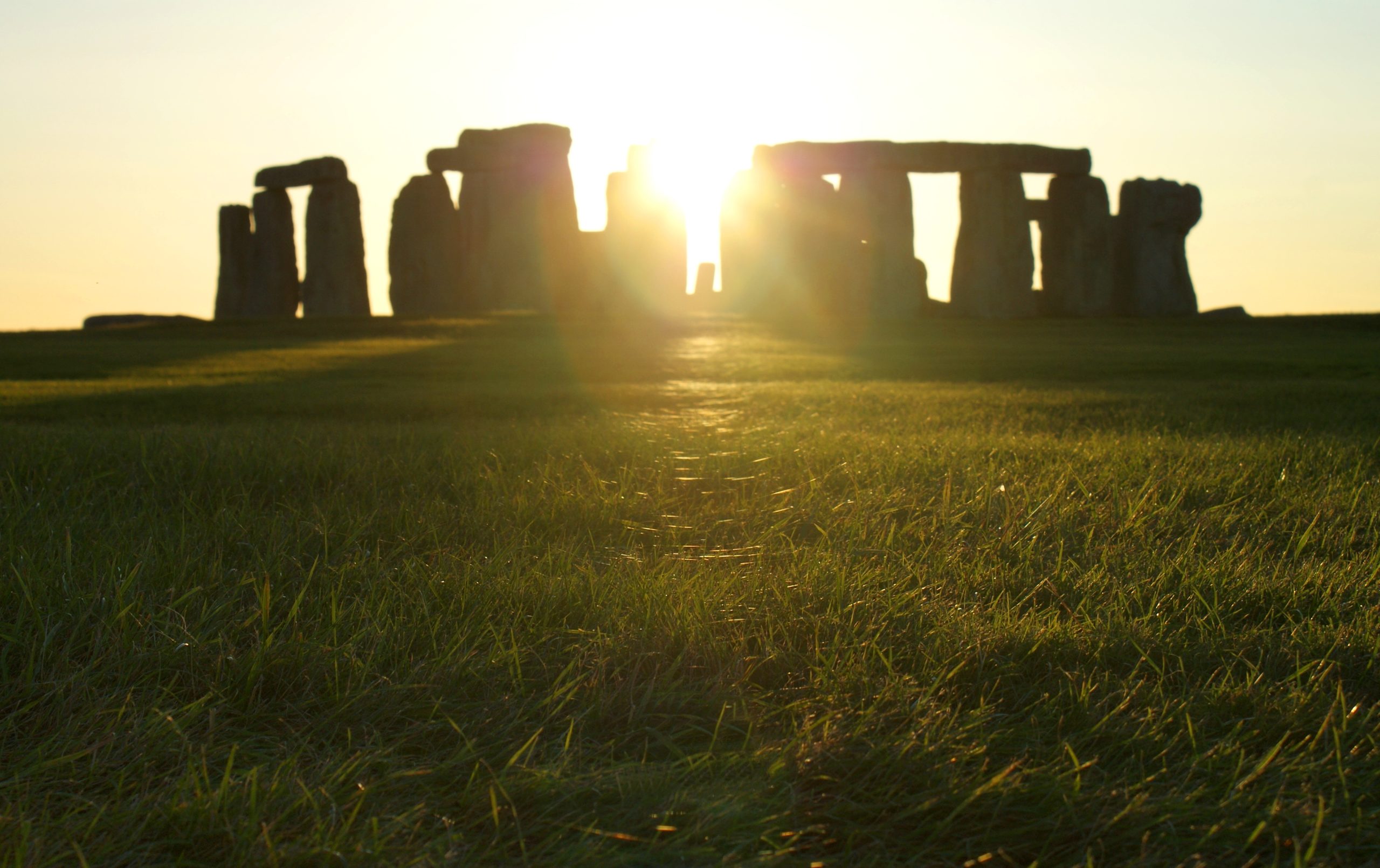
Stonehenge, England
Photo: Andy Powell | CC BY 2.0
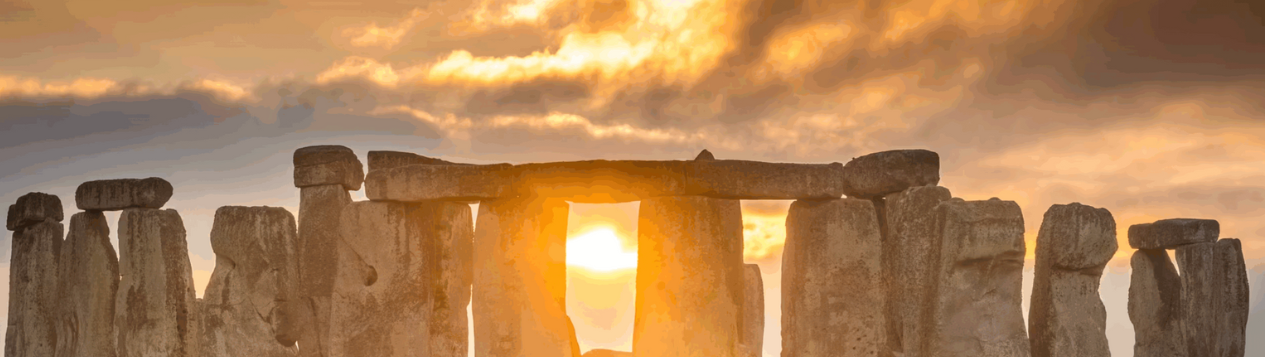
Long, long ago—about 4,500 years!—people in England built a giant circle of huge stones called Stonehenge. They didn’t have computers or even books, but they were really smart about watching the sky!
☀️ Stonehenge is Like a Giant Calendar!
The people who built Stonehenge put the stones in special places so they could track the Sun!
On the longest day (Summer Solstice):
- If you stand in the middle of the circle, the Sun rises right over a special stone called the “Heel Stone”!
- Thousands of people visit Stonehenge every year to watch this amazing sunrise
On the shortest day (Winter Solstice):
- The Sun sets perfectly in line with the stones
- Ancient people probably had big celebrations on this day!
- Newgrange in Ireland – Even older than Stonehenge! Sunlight shines into a special room on the winter solstice
- Pyramids in Mexico – Shadows make it look like a snake crawling down the stairs during the equinox!
- Machu Picchu in Peru – The Inca people had a special “sun stone” to track the solstices
- Cahokia Mounds in Illinois – Native Americans built huge earthen mounds that tracked the Sun and seasons!
People all around the world watched the Sun and stars!
🌍 Understanding Planetary Solstice
A solstice occurs when Earth reaches specific positions in its orbit where one hemisphere receives the maximum or minimum amount of direct sunlight due to Earth’s constant axial tilt.
🎥 NASA Animation: Winter Solstice
This animation shows how Earth’s constant 23.5° tilt creates the winter solstice. The tilt stays the same—only our orbital position changes!
Winter Solstice Animation With Labels
NASA’s Scientific Visualization Studio (SVS14366)
Credit: Krystofer Kim & Joy Ng, KBR Wyle Services, LLC
Download original video
📐 Earth’s Constant Axial Tilt: 23.5 Degrees
Imagine a line going through Earth from the North Pole to the South Pole—that’s Earth’s axis. This axis is tilted 23.5° compared to Earth’s orbital path around the Sun.
The key point: As Earth orbits the Sun over 365 days, this tilt stays pointed in the same direction in space. It’s Earth’s changing position that causes the Sun’s rays to hit us at different angles throughout the year!
Watch carefully: The yellow axis line always points the same direction!
North tilts away from Sun
Equal light both sides
North tilts toward Sun
Equal light both sides
The axis tilt stays constant – Earth just moves to different positions in orbit!
When Earth is at the “top” of its orbit, the North Pole points toward the Sun. The Sun reaches its northernmost point at the Tropic of Cancer (23.5°N). This creates:
- The longest day and shortest night north of the equator
- The shortest day and longest night south of the equator
- 24 hours of daylight at the North Pole
- 24 hours of darkness at the South Pole
When Earth is at the “bottom” of its orbit (6 months later), the North Pole still points the same direction in space—but now that means it’s pointing away from the Sun! The Sun reaches its southernmost point at the Tropic of Capricorn (23.5°S). This creates the opposite conditions from summer.
🌐 The Daylight Terminator
The line that separates day and night on Earth is called the daylight terminator. During the solstices, this line is tilted at its maximum angle! You can see this clearly in satellite images of Earth from space.
🎥 NASA GOES-16 Satellite: A Year of Earth’s Orbit
What you’ll see: This animation shows one image per day for an entire year, all taken at the same time (12:00 UTC). Watch how:
- The daylight terminator (shadow line) tilts back and forth
- Snow appears in one hemisphere while disappearing in the other
- The ice at the poles changes size throughout the year
- Remember: Earth’s tilt isn’t changing—Earth is moving around the Sun!
[NASA GOES East (GOES-16) – 2023 Seasonal Animation]
🌍 Earth’s Orbit: Distance vs. Tilt
☀️ A Common Misconception
Many people think: Earth has seasons because our distance from the Sun changes during the year.
The truth: Seasons are NOT caused by Earth’s distance from the Sun! Here’s proof:
- Perihelion (closest to Sun): First week of January – about 91.4 million miles away
- Aphelion (farthest from Sun): First week of July – about 94.5 million miles away
- Earth is actually closest to the Sun during winter in the Northern Hemisphere!
The real cause of seasons: Earth’s 23.5° tilt! The tilt’s orientation stays the same as we orbit, so the Northern Hemisphere tilts toward the Sun in June and away from the Sun in December.
📏 How Daylight Changes Based on Latitude
Your distance from the equator determines how much daylight changes between summer and winter!
- Fairbanks, Alaska (64°N): 21 hours 48 minutes of daylight
- Miami, Florida (25°N): 13 hours 46 minutes of daylight
- At the equator: About 12 hours of daylight year-round
🌡️ Seasonal Lag: Why July is Hotter Than June
Even though the summer solstice brings the most sunlight, the hottest temperatures usually come in late July or August! This is called seasonal lag.
Why does this happen? After the solstice, Earth keeps absorbing more heat during the day than it loses at night. This heat builds up for several weeks, making late summer the hottest time of year.
Example from Cleveland, Ohio:
- July averages 3.3°F warmer than June
- August is still 2.8°F warmer than June
- This happens even though August has much shorter days than June!
Orbital Model Activity:
- Get a lamp (Sun), a ball on a tilted stick (Earth), and a marker
- Mark “North Pole” on top of the ball
- Tilt the stick 23.5° and KEEP IT TILTED THE SAME WAY
- Walk around the lamp in a circle, keeping the tilt pointing the same direction
- Notice: At one point the North Pole leans toward the lamp (summer!)
- Six months later (opposite side), it leans away (winter!)
🔬 The Science of Planetary Solstice
The solstice is a precise astronomical event that occurs when Earth reaches specific orbital positions where its constant 23.5° axial tilt causes one hemisphere to receive maximum or minimum direct solar radiation.
🎥 NASA Scientific Visualization: Winter Solstice
This NASA animation demonstrates how Earth’s fixed axial tilt of 23.5° creates the December solstice. When the Northern Hemisphere tilts maximally away from the Sun at this orbital position, the subsolar point reaches the Tropic of Capricorn (23.5°S), creating the shortest day in the Northern Hemisphere.
Winter Solstice Animation With Labels
NASA’s Scientific Visualization Studio (SVS14366)
Visualization by: Krystofer Kim, KBR Wyle Services, LLC
Producer: Joy Ng, KBR Wyle Services, LLC
Upload date: 21 June 2023
Download original visualization (webm)
Key Observation: The winter solstice occurs when Earth’s tilt away from the Sun is at maximum and the Sun is directly over the Tropic of Capricorn (23.5° S latitude). During this event, the Sun reaches its lowest point in the sky for Northern Hemisphere observers and marks the shortest day of the year.
🌌 Orbital Mechanics and Axial Stability
Earth orbits the Sun at an average distance of 149.6 million kilometers (93 million miles). Throughout this orbit, Earth’s rotational axis points toward the same location in space—approximately toward the star Polaris (the North Star).
Perihelion and Aphelion:
- Perihelion: Earth’s closest approach to the Sun (~91.4 million miles) occurs during the first week of January
- Aphelion: Earth’s farthest point from the Sun (~94.5 million miles) occurs during the first week of July
- This 3.1 million mile variation represents only ~3.4% difference in distance
- Critical point: Earth is closest to the Sun during Northern Hemisphere winter!
This proves seasons are NOT caused by distance from the Sun. The 23.5° axial tilt is responsible for seasons. If distance were the cause, both hemispheres would have summer and winter at the same time!
Why does the tilt stay constant? Earth’s axial tilt resulted from a collision between proto-Earth and a Mars-sized object (often called “Theia”) approximately 4.5 billion years ago. The Moon’s gravitational influence helps stabilize this tilt, preventing it from varying significantly over human timescales.
Note: The tilt does vary slightly over periods of ~41,000 years (between 22.1° and 24.5°) due to gravitational perturbations from other planets—this is called axial precession and is part of the Milankovitch cycles that affect long-term climate patterns.
Observe: The axis always points toward the same position in space (upper-right in this model)
NH: Maximum tilt away from Sun
Terminator perpendicular to axis
NH: Maximum tilt toward Sun
Terminator perpendicular to axis
The axis orientation is constant—only Earth’s orbital position changes!
The summer solstice occurred on Wednesday, June 21, 2023 at 10:57 AM EDT (14:57 UTC). This is the exact moment when Earth reached the orbital position where the Sun appears at its northernmost point in the sky.
At this precise moment:
- The subsolar point (where the Sun is directly overhead at solar noon) reaches 23.5°N – the Tropic of Cancer
- The Sun appears at its highest elevation in the Northern Hemisphere sky
- The Sun’s position changes very little for several days before and after this moment
- The North Pole experiences continuous daylight
- Solar radiation intensity in the Northern Hemisphere reaches annual maximum
The Tropic of Cancer passes through Mexico, the Bahamas, Egypt, Saudi Arabia, India, and southern China.
Six months later, Earth has traveled to the opposite side of its orbit. The axis still points in the same direction in space, but now this orientation means the Northern Hemisphere tilts away from the Sun while the Southern Hemisphere tilts toward it.
At this moment:
- The subsolar point reaches 23.5°S – the Tropic of Capricorn
- The Sun appears at its lowest elevation in the Northern Hemisphere sky
- Shortest day and longest night in the Northern Hemisphere
- Longest day and shortest night in the Southern Hemisphere
The Tropic of Capricorn runs through Australia, Chile, southern Brazil, and northern South Africa.
This demonstrates that the seasonal change is purely a function of orbital geometry, not axial variation.
The equinoxes occur when Earth reaches orbital positions where the axis is tilted neither toward nor away from the Sun. The word comes from Latin: aequus (equal) + nox (night).
During equinoxes:
- The Sun is directly overhead at the equator at solar noon
- “Nearly” equal daylight and darkness at all latitudes
- The daylight terminator passes through both poles
- This is when Earth’s axis is perpendicular to the Sun-Earth line
🌐 Why “Nearly” Equal, Not Exactly Equal?
During equinoxes, we say “nearly” equal day and night because of two physical phenomena:
- Atmospheric refraction: Earth’s atmosphere acts like a lens, bending sunlight around the curve of the Earth. This causes the Sun to appear above the horizon when its actual geometric position is below the horizon, extending daylight by several minutes.
- Solar disk size: The Sun has a diameter of ~0.5°, so sunrise is defined when its upper edge appears, and sunset when its upper edge disappears, adding about 4 minutes to daylight.
- Latitude effects: At higher latitudes, the Sun’s path across the sky is more oblique, taking longer to rise and set.
Actual day length on the equinox:
- 0° (Equator): 12 hours, 6.5 minutes
- 30° latitude: 12 hours, 8 minutes
- 60° latitude: 12 hours, 16 minutes
The day of truly equal day and night (called the equilux) actually occurs a few days before the spring equinox and a few days after the fall equinox, depending on latitude.
📊 Solar Radiation and the Daylight Terminator
The daylight terminator (also called the “twilight zone” or “grey line”) is the boundary between Earth’s illuminated day side and dark night side. This boundary’s orientation relative to Earth’s axis varies throughout the year due to our orbital position, not axial changes.
During the June solstice:
- The terminator is tilted maximally such that it doesn’t cross the North Pole—creating 24-hour daylight
- The terminator fully encloses the South Pole—creating 24-hour darkness
- The terminator’s angle relative to latitude lines creates maximum day length variation between latitudes
- The Sun’s noontime position appears at its highest elevation and changes very little for several days
During equinoxes: The terminator passes through both poles, creating approximately 12 hours of daylight at all latitudes. However, due to atmospheric refraction and the Sun’s angular size, actual daylight exceeds 12 hours by 6-16 minutes depending on latitude.
☀️ Solar Radiation Distribution
The angle at which sunlight strikes Earth’s surface is determined by Earth’s orbital position relative to its fixed axial tilt. During Northern Hemisphere summer:
- Angle of incidence: Solar rays strike the Northern Hemisphere more perpendicularly (higher angle), concentrating energy per unit area
- Atmospheric path length: More direct rays travel through less atmosphere, reducing absorption and scattering losses
- Day length: Longer exposure time to solar radiation compounds the effect
These three factors combine to create the annual temperature cycle in temperate and polar regions.
🎥 NASA GOES-16: GeoColor Animation of Earth’s Annual Orbit
Scientific observation methodology: This animation uses geostationary satellite imagery from GOES East (GOES-16), positioned approximately 35,786 km above the equator at 75.2°W longitude. One image was captured each day at 12:00 UTC for an entire year and looped together.
What to observe:
- Daylight terminator oscillation: Watch the shadow boundary tilt back and forth. This appears as a changing tilt from Earth’s perspective, but it’s actually due to our changing orbital position relative to our fixed tilt.
- Polar ice variation: Arctic sea ice minimum in September; maximum in March (opposite in Antarctic)
- Hemispheric seasonal opposition: When one hemisphere experiences maximum snow cover, the other shows minimum
- ITCZ migration: The Intertropical Convergence Zone shifts north and south following the subsolar point
[NASA GOES-16 GeoColor – 2023 Annual Seasonal Cycle]
📏 Mathematical Relationships: Latitude and Daylight
The daylight hours at any latitude during a solstice can be calculated using spherical trigonometry. The key equation involves Earth’s axial tilt (ε = 23.5°) and the observer’s latitude (φ).
Real examples from the 2023 summer solstice:
- 90°N (North Pole): 24 hours (sun never sets)
- 66.5°N (Arctic Circle): 24 hours (Arctic Circle defined as 90° – 23.5°)
- 64°N (Fairbanks, AK): 21 hours 48 minutes
- 40°N (Philadelphia, PA): ~15 hours
- 25°N (Miami, FL): 13 hours 46 minutes
- 0° (Equator): ~12 hours (year-round)
- 23.5°S (Tropic of Capricorn): ~10 hours 30 minutes
- 66.5°S (Antarctic Circle): 0 hours (sun never rises)
- 90°S (South Pole): 0 hours
🌡️ Seasonal Lag: Thermal Inertia
Despite maximum solar radiation on June 21, Northern Hemisphere maximum temperatures typically occur 4-6 weeks later (late July/early August). This is seasonal lag, caused by Earth system thermal inertia.
Physical mechanism:
- Energy storage: Oceans, land, and atmosphere absorb incoming solar radiation
- Heat capacity: These systems have significant thermal mass requiring time to warm
- Net energy balance: After the solstice, daily solar input > radiative output for several weeks
- Temperature maximum: Occurs when energy input equals output (thermal equilibrium)
Comparison with daily temperature cycle: Just as the warmest part of the day occurs several hours after noon when the Sun is highest, the warmest part of summer lags 3-6 weeks after the summer solstice. Both phenomena result from the time required for heat absorption.
Real-world example (Cleveland, Ohio):
- June 21: Summer solstice (maximum solar radiation)
- July average temperature: 3.3°F warmer than June
- August average temperature: 2.8°F warmer than June
- This occurs even though August has significantly shorter days than June!
- Maximum daily temperature typically occurs in mid-July (~3 weeks after solstice)
Variation by location:
- Oceanic regions: Longer lag (~6-8 weeks) due to water’s high heat capacity
- Continental interiors: Shorter lag (~3-4 weeks) due to lower thermal mass
- Coastal areas: Intermediate lag, moderated by ocean proximity
🗿 What’s So Special About Stonehenge Anyway?
Stonehenge, England (12 October 2009)
Photo: Andy Powell | Licensed under CC BY 2.0
Ancient civilizations tracked solstices without understanding orbital mechanics, yet achieved remarkable precision. Stonehenge (constructed ~2500 BC) demonstrates sophisticated empirical astronomy.
☀️ Solar Alignments at Stonehenge
The monument’s architecture incorporates precise solstitial alignments:
- June solstice sunrise: Aligns with the Heel Stone from the circle’s center
- December solstice sunset: Aligns with the monument’s main axis
- Archaeological interpretation: Evidence from Durrington Walls suggests December solstice celebrations attracted larger gatherings, possibly related to agricultural cycles and livestock management
These alignments required multi-generational observation and geometric knowledge, achieved without written records or instruments.
🌙 Lunar Standstill Hypothesis
Recent research investigates possible lunar alignments:
- Station stones: Four sarsen stones forming a rectangle around the circle
- Major lunar standstill: An 18.6-year cycle when the Moon’s rise/set positions reach maximum range
- Alignment hypothesis: Rectangle’s longer sides may track this lunar cycle
- Current research: Scientists are observing the 2024-2025 major lunar standstill to test this hypothesis
If confirmed, this would demonstrate that Neolithic people tracked astronomical cycles requiring decades of continuous observation.
Solstice Documentation and Analysis:
- Materials: Camera with geotagging, compass, protractor, fixed observation point, data logging
- Pre-solstice phase (2-3 weeks before):
- Select location with unobstructed eastern or western horizon
- Photograph sunrise or sunset every 3-4 days from identical position
- Measure solar azimuth (compass bearing) at rise/set
- Record precise time using accurate clock
- Post-solstice phase: Continue observations for 2-3 weeks
- Data analysis:
- Plot azimuth vs. date to visualize the “solar standstill”
- Calculate rate of azimuth change (degrees per day) before and after solstice
- Identify minimum change date (actual solstice moment)
- Compare measured times with USNO/NASA published data
- Calculate measurement error and uncertainty
💡 Advanced extension: Compare June and December solstice solar positions at your latitude. Calculate the angular difference and verify it matches 2 × 23.5° = 47° (the full range of the subsolar point’s annual motion).
Educational content developed by This Month™
Scientific imagery and data: NASA GOES-16 Satellite
Stonehenge research: Bournemouth University, University of Oxford, English Heritage