Teacher’s Guide to Yalda
Yalda (also called Shab-e-Yalda) is an ancient Persian festival celebrated on December 21st, the winter solstice—the longest night of the year. “Shab” means night, and “Yalda” means birth or light.
Quick Facts:
- When: December 21st (Winter Solstice)
- Also Called: Chelleh
- Who Celebrates: Millions of people from Iran, Azerbaijan, Afghanistan, Tajikistan, and diaspora communities worldwide
- Key Activities: Staying up all night, eating pomegranates and watermelon, reading poetry, gathering with family
- Central Theme: Triumph of light over darkness, rebirth of the sun, celebration of family and resilience
Pre-Zoroastrian Roots
Yalda originated in the pre-Zoroastrian tradition of worship of Mithra, the God of Sun. This ancient celebration predates written history and was later adopted and popularized by Zoroastrians, one of the world’s oldest monotheistic religions.
The Ancient Beliefs
Ancient Persians believed that evil forces were strongest on the longest and darkest night of the year. To combat this darkness, people would:
- Stay up all night together
- Tell stories and share wisdom
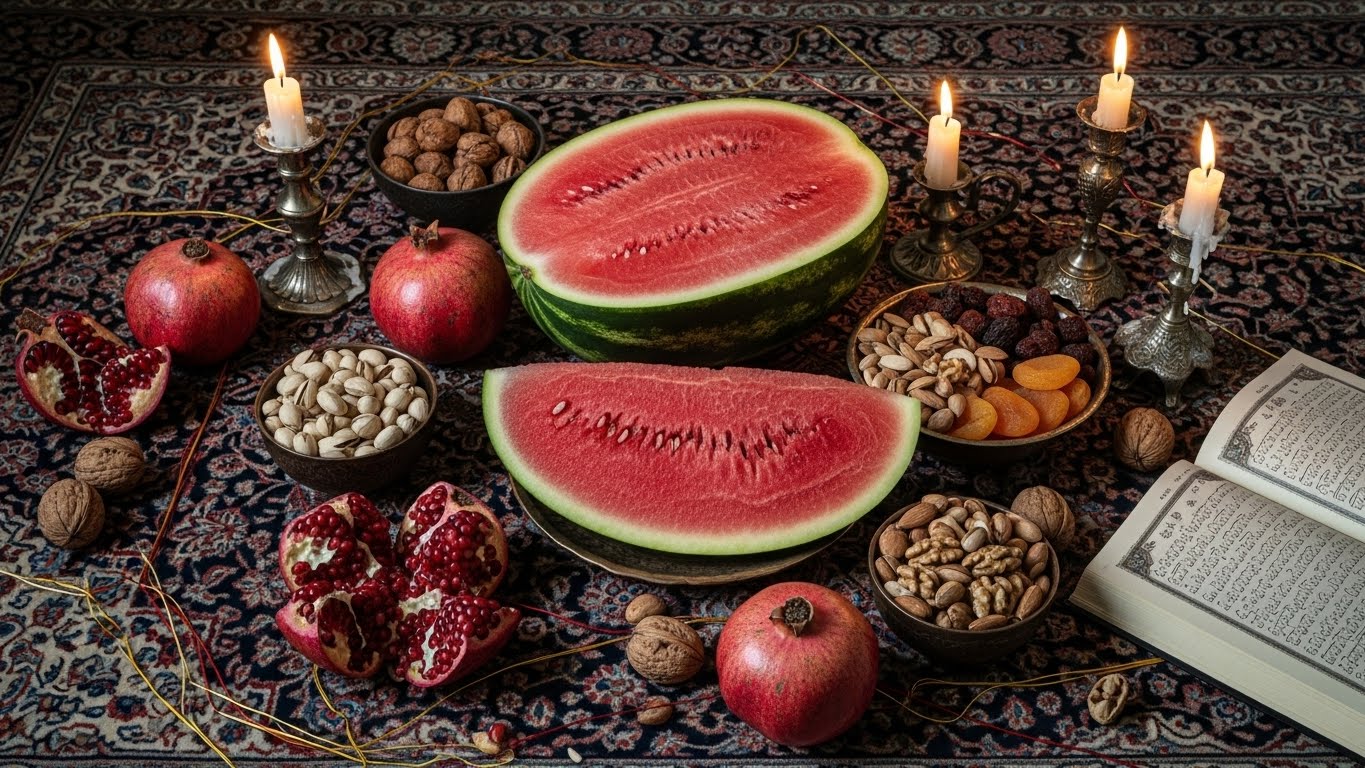
- Eat watermelon and pomegranate (symbols of life and health)
- Consume dried fruits and nuts
- Keep lights burning through the darkness
The Moment of Dawn:
As light spilled through the sky at dawn, Persians celebrated its appearance with drumming and dancing. It was thought that the day after the longest night belonged to Ahura Mazda, the Zoroastrian lord of wisdom.
Connection to Other Traditions
Religious studies scholar Joel Wilbush notes that early Christians loved this ancient Persian celebration. They saw the themes of light, sun, and birth as interconnected with the birth of Jesus, which is why Christmas and Yalda share similar themes despite their different origins.
The Pomegranate 🍎
The pomegranate is the most iconic symbol of Yalda. This fruit, indigenous to Iran, holds deep meaning:
- Symbol of Life and Resilience: It blossoms during the harshest climate of winter
- Represents Perseverance: Its ability to thrive in difficult conditions mirrors human resilience
- Color Connection: The deep red color represents the glow of sunrise
- Seeds of Hope: Each pomegranate contains hundreds of seeds, symbolizing abundance and new beginnings
Watermelon 🍉
Eating summer fruit in the dead of winter might seem unusual, but it carries important meaning:
- Persians believe that eating summer foods like watermelon will keep the body healthy through winter
- It represents the hope for summer’s return
- The red color connects to warmth and life
Dried Fruits and Seeds 🌰
Seeds like pumpkin and sunflower are eaten as:
- A reminder of the cycle of life
- Symbols of rebirth and renewal to come
- Connection to spring planting and harvest
The Korsi 🔥
Families gather under a korsi—a special Persian blanket lined with lumps of coal for warmth. This creates a cozy space for storytelling and celebration throughout the long night.
Poetry and Storytelling 📖
Reading poetry is a cherished Yalda tradition. Families often read the works of famous Persian poets like:
- Hafez: 14th-century poet whose works are considered prophetic
- Rumi: 13th-century mystic poet known for spiritual wisdom
Families may practice fal-e Hafez—opening Hafez’s poetry book to a random page and reading it as a fortune or guidance for the coming year.
Traditional Activities:
- Family Gatherings: Multiple generations come together
- Staying Awake: Families stay up through the longest night, welcoming the return of longer days
- Sharing Food: Serving and eating symbolic foods together
- Reading Poetry: Taking turns reading verses and discussing their meaning
- Storytelling: Elders share family history and cultural stories
- Music: Some families play traditional Persian music
- Games: Playing cards or board games together
The Spiritual Dimension:
Throughout the night, families “speak of the good that can overcome evil.” This isn’t just about ancient myths—it’s about finding hope, resilience, and light in difficult times. The celebration reminds people that even the longest, darkest night will eventually give way to dawn.
✅ DO:
- Present Yalda as a cultural and historical learning opportunity
- Emphasize universal themes: hope, family, resilience, light overcoming darkness
- Acknowledge that this is an ancient tradition that predates many modern religions
- Invite students to share their own family winter traditions
- Connect to similar “Festival of Light” celebrations worldwide
- Use it to teach about Persian/Iranian culture and history
- Respect that some Iranian families may not celebrate Yalda
❌ DON’T:
- Assume all Iranian or Middle Eastern students celebrate Yalda
- Present it as only a “religious” holiday (it has deep cultural significance beyond religion)
- Make political statements about Iran or the Middle East
- Treat it as exotic or strange
- Use it as the only time you discuss Persian/Iranian culture
- Conflate it with other winter holidays without acknowledging its unique origins
Important Context: Many Iranian-American families, like the author’s, celebrate Yalda as a way to maintain cultural connection, especially when they don’t celebrate other winter holidays. For diaspora communities, Yalda can be an important way to preserve identity and pass down traditions.
Grades K-1:
- Focus on simple concept: “The longest night of the year, celebrating when days start getting longer again”
- Emphasize the fun aspects: staying up late, eating special foods, being with family
- Use visual aids: show pomegranates, discuss day/night cycle
- Read age-appropriate books about winter solstice
- Simple craft: decorate paper pomegranates
Grades 2-3:
- Explain the winter solstice and why it’s significant
- Discuss why ancient people might have been afraid of the dark
- Explore the symbolism of pomegranates and watermelon
- Compare Yalda to other winter light festivals (Hanukkah, Christmas, Kwanzaa, Diwali)
- Activity: Taste pomegranate (with allergy awareness) and discuss its significance
Grades 4-5:
- Study ancient Persian civilization and Zoroastrianism
- Explore how traditions change and adapt over thousands of years
- Read simplified Persian poetry (translated) and discuss themes
- Research project: “Winter Solstice Celebrations Around the World”
- Critical thinking: “Why do so many cultures celebrate light during winter?”
- Discuss diaspora experience and maintaining cultural traditions
Language Arts
- Poetry Reading: Read age-appropriate translations of Rumi or Hafez
- Storytelling: Have students write their own “triumph of light over darkness” stories
- Vocabulary: Learn Persian words: Yalda, shab, korsi, pomegranate (anar)
- Compare/Contrast: Winter celebrations across different cultures
- Personal Narrative: “A Family Tradition I Celebrate”
Science
- Astronomy: Study the winter solstice, Earth’s tilt, and seasons
- Day Length: Track sunrise/sunset times throughout the year
- Botany: Study pomegranate plants and their growing conditions
- Nutrition: Explore health benefits of winter fruits
Social Studies
- Geography: Locate Iran, Azerbaijan, and ancient Persia on maps
- Ancient Civilizations: Study Persian Empire and Zoroastrianism
- Cultural Diffusion: How celebrations travel with people who migrate
- Timeline: Place Yalda in context of other ancient celebrations
Math
- Graphing: Chart daylight hours throughout the year
- Measurement: Compare lengths of day vs. night at different times
- Patterns: Seasonal cycles and repeating patterns
- Problem Solving: Word problems about sharing pomegranates
Art
- Pomegranate Art: Paint or draw pomegranates, exploring their unique structure
- Persian Patterns: Study and create geometric patterns from Persian art
- Light and Dark: Create artwork contrasting darkness and light
- Calligraphy: Learn about Persian calligraphy traditions
K-2nd Grade:
- “Why do you think people wanted to stay awake through the longest night?”
- “How does light make you feel? How does darkness make you feel?”
- “What special things does your family do together in winter?”
- “Why might a pomegranate be a special fruit?”
3rd-5th Grade:
- “Why do you think so many cultures celebrate light during the darkest time of year?”
- “What does it mean when we say ‘light triumphs over darkness’?”
- “How might celebrating Yalda help Iranian families feel connected to their heritage?”
- “What are the similarities between Yalda and other winter holidays?”
- “Why do you think poetry and storytelling are important parts of this celebration?”
- “How do traditions help people feel less alone during difficult times?”
“Family, love, resilience, rebirth and a triumph of light over dark.”
— Themes shared by Yalda, Christmas, and many other winter celebrations
What Students Can Learn:
- Hope in Darkness: Even the longest night ends with sunrise
- Family Connection: Staying together through difficult times
- Cultural Resilience: How traditions survive thousands of years
- Universal Values: Different cultures express similar values in unique ways
- Cycles of Nature: Understanding seasonal patterns and their meanings
- Wisdom of Elders: Importance of storytelling and passing down knowledge
Making Personal Connections:
Encourage students to think about:
- Times when their family stays up late together
- Special foods their family eats during celebrations
- Stories their grandparents or elders have told them
- Ways their family creates warmth and light in winter
Books About Persian Culture:
- “Saffron Ice Cream” by Rashin Kheiriyeh (K-3) – A heartwarming story about an Iranian family living in New York and their traditions
- “Seven Special Somethings: A Nowruz Story” by Adib Khorram (K-3) – Explores Persian New Year traditions and culture
- “Aryana and the Magic of Yalda Night” by Saman Gholami (K-3) – A story specifically about Yalda celebration and traditions
Online Resources:
- Cultural organizations representing Persian/Iranian communities
- Museum collections with Persian artifacts
- Educational videos about winter solstice traditions worldwide
Community Connections:
- Invite Iranian-American families to share their Yalda traditions (with their permission)
- Connect with local Persian cultural centers
- Attend multicultural festivals that feature Persian culture
- Ancient Wisdom: Yalda is one of the world’s oldest celebrations, predating most modern religions and demonstrating the continuity of human culture.
- Universal Themes: Light overcoming darkness, family unity, and hope are values that resonate across all cultures and backgrounds.
- Cultural Pride: For Iranian-American students, learning about Yalda in school can validate their cultural heritage and help them feel seen.
- Diaspora Experience: Understanding how immigrant families maintain traditions helps all students develop empathy and cultural awareness.
- Scientific Connection: Yalda provides a perfect opportunity to teach about astronomy, seasons, and Earth’s movements.
- Poetry and Wisdom: The emphasis on poetry shows the value Persian culture places on language, wisdom, and artistic expression.
Pardis Mahdavi is an accomplished author, educator, and academic who brings deep expertise in Middle Eastern studies, migration, and cultural traditions. She serves as Dean of Social Sciences at Arizona State University.
Academic Background:
- BA: Occidental College
- Two Master’s Degrees: Columbia University
- PhD: Columbia University
Published Works:
Dr. Mahdavi has published seven non-fiction books and two edited volumes, including:
- Book of Queens: The True Story of the Middle Eastern Horsewomen Who Fought the War on Terror (Hachette Books, 2023)
- Riding (Duke University Press, 2024)
- Hyphen (Bloomsbury, 2021)
- Crossing the Gulf: Love and Family in Migrant Lives (Stanford University Press, 2016)
- From Trafficking to Terror (Routledge, 2016)
- Gridlock: Labor, Migration and Human Trafficking in Dubai (Stanford University Press, 2011)
- Passionate Uprisings: Iran’s Sexual Revolution (Stanford University Press, 2008)
Research Focus:
As an anthropologist who studies rituals and traditions in the Middle East, Dr. Mahdavi’s personal connection to Yalda—introduced to her by her grandmother in Minneapolis—inspired her scholarly path. Her work bridges academic research with lived experience, making complex cultural topics accessible and meaningful.