Welcome to Insect Anatomy! Bugs have neat bodies. Let's look at the parts of a bug together!
Some words below are colored and underlined, like this. You can tap or click those words to see what they mean. Let's get started!
Every bug has a headThe front part of the bug. It has the eyes and mouth. The head has eyes and a mouth. It also has antennaeTwo feelers on the head. Bugs use them to smell and touch things, two little feelers that help a bug smell and touch things around it.
A bug also has a bodyThe middle and back part of the bug. Its legs and wings connect here. The legsThe parts a bug uses to walk, jump, or hold on tight connect to the body too. A bug has six legs in all.
A bug does not have skin like you do. Instead, it wears a hard shellA hard covering on the outside of the body that keeps the bug safe, like a suit of armor on the outside of its body. The hard shell keeps the bug safe, just like a tiny suit of armor!
What comes next? Look at the fun picture of a bug and tap the dots to learn more. Then try the flip cards to practice each word. After that, try the Clay Insect Sculpting Craft and build your own bug!
Welcome to Insect Anatomy! Insects are some of the smallest animals we can study up close — and once we know where to look, they have a lot to show us. In this lesson, we'll meet the three main parts of an insect's body and see what makes an insect an insect.
As we learn these ideas, you'll meet some new words! The words are underlined like this. You can click on any underlined word to see what it means in a little pop-up box. Let's get started!
Every insectA small animal with three body parts and six legs has the same basic body plan. First comes the headThe front body part with the eyes, antennae, and mouth, with its eyes, mouth, and two feelers called antennaeFeelers on the head used to smell and touch. Next comes the thoraxThe middle body part where the legs and wings attach — this is the busy middle part where all six legsThe body parts insects use to walk, jump, or hold on attach, and where wingsThin, flat parts that help some insects fly attach too, if the insect has them.
Last comes the abdomenThe back body part, usually the longest section, the longest part of the body. Instead of skin like ours, insects wear a hard covering called an exoskeletonA hard outer covering that protects the insect, like a suit of armor — it protects them like a tiny suit of armor! Because this covering doesn't stretch, insects have to moltTo shed the old exoskeleton so the body can grow bigger, or shed it, to grow bigger.
What comes next? After you read this, you'll practice all these vocabulary words with flip cards, and explore a real diagram of an insect's body by clicking on its numbered parts. Then comes the fun part — the Clay Insect Sculpting Craft, where you'll build your own three-part insect body out of clay!
Welcome to Insect Anatomy! Insects are the most numerous group of animals on Earth, and much of their success comes down to a body plan that works incredibly well. In this lesson, we'll look closely at how an insect's body is organized — and why each part does its job so well.
These big ideas come with important vocabulary words — science terms that help us describe what we observe. Throughout this passage, you'll see words that are underlined like this. Tap or click any underlined word to see its definition pop up. After reading, you'll practice these words with flip cards, explore an interactive diagram, and then try the clay-building activity!
An insect's body is divided into three regions. The headThe front region, holding the eyes, antennae, and mouthparts holds large compound eyesEyes made of many tiny lenses, giving insects wide vision made of thousands of tiny lenses, along with antennae for smelling and feeling. The thoraxThe middle region, made of three segments, that carries the legs and wings is actually made of three segments — the prothoraxThe first thorax segment, closest to the head, mesothoraxThe middle thorax segment, which often carries the front wings, and metathoraxThe third thorax segment, which often carries the back wings — and each one carries a pair of legs.
Many insects also have two pairs of wings attached to the thorax: the forewingsThe front pair of wings and hindwingsThe back pair of wings. Insects don't breathe through a nose or mouth — instead, air enters through tiny openings called spiraclesSmall openings along the body that let air in for breathing along the sides of the body. And because the hard exoskeletonThe hard outer covering that supports and protects the body can't grow, insects moltTo shed the old exoskeleton so a new, larger one can form — shedding it again and again as they grow.
Ready to explore? Next, you'll practice these vocabulary words with interactive flip cards, then click through a labeled diagram of a real insect body. Finally, you'll head to the Clay Insect Sculpting Craft to sculpt what you've learned.
Welcome to Insect Anatomy! Insects belong to a huge group of animals called arthropodsInvertebrate animals with an exoskeleton, segmented body, and jointed legs, but they're set apart by a very specific body plan. Understanding that plan means understanding how structure supports function — how the shape of each body part helps the insect survive.
Understanding these structures requires precise scientific vocabulary. Throughout this passage, underlined terms are clickable — tap or click any word to reveal its definition. After reading, you'll reinforce these terms with flip card practice, click through an interactive anatomical diagram, and then apply what you've learned in the clay-modeling activity.
Scientists describe an insect's three body regions using the term tagmataThe three specialized body regions of an insect: head, thorax, and abdomen — the head, thorax, and abdomen, each specialized for a different job. As an invertebrateAn animal without a backbone, an insect has no internal skeleton at all; its exoskeleton does double duty, providing both protection and structural support, much like a building's frame.
The thorax's three segments — prothoraxFirst thorax segment, mesothoraxMiddle thorax segment, and metathoraxThird thorax segment — each bear a pair of legs built from the same repeating parts: coxaThe leg segment closest to the body, trochanterA small connecting leg segment, femurThe thick leg segment that provides most walking power, tibiaThe long, slender leg segment, and tarsusThe foot-like final leg segment. Instead of lungs, insects breathe through spiraclesExternal breathing openings that connect to internal tracheal tubes connected to a network of internal tubes that deliver oxygen directly to the tissues.
Your investigation begins now. First, master the vocabulary through interactive flip cards. Then, click through the diagram's numbered ocelliSimple eyes that detect light and dark, in addition to the compound eyes and legs to see structure and function side by side. As you work, consider: why might having a body built almost entirely of repeating segments be an advantage?
Middle School & Up
Welcome to Insect Anatomy! You already know the external body plan — head, thorax, and abdomen, or tagmataThe three specialized body regions of an insect: head, thorax, and abdomen. Now it's time to go beneath the exoskeleton and look at the internal systems that keep an insect alive.
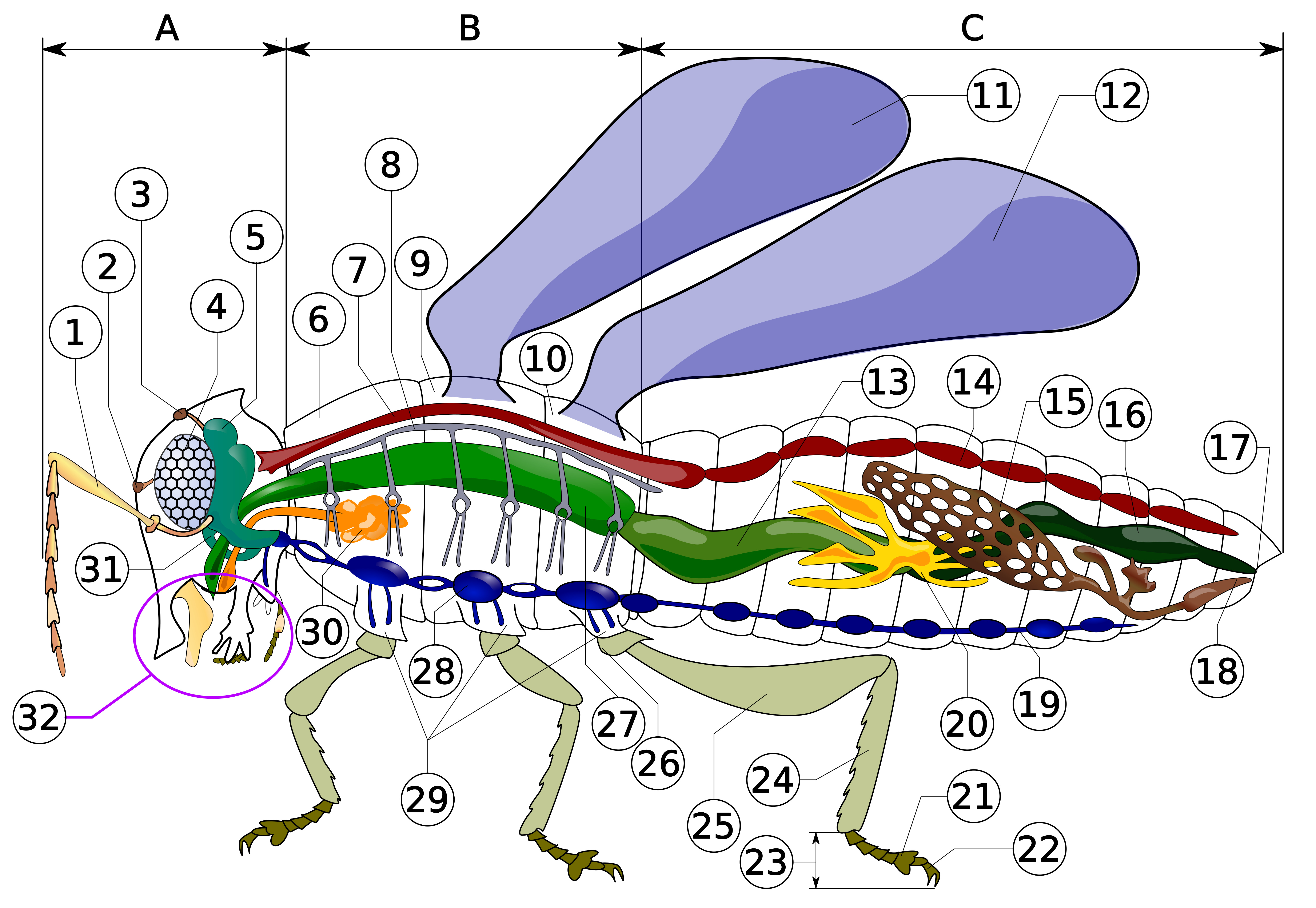
Throughout this passage, underlined terms are clickable — tap or click any word to reveal its definition. After reading, you'll reinforce these terms with flip card practice and can revisit the interactive diagram above, where several hotspots (7, 13–20, 27–31) point to the very structures described here.
Underneath the exoskeleton, an insect runs four internal systems worth a closer look. Its open circulatory systemA circulatory system where blood-like fluid moves freely through the body cavity instead of staying inside vessels moves hemolymphThe fluid, similar to blood, that carries nutrients through an insect's body using a single dorsal blood vesselA tube-like heart running along the insect's back that pumps hemolymph instead of a chambered heart.
Digestion happens in three stages: the fore-gutThe first part of the digestive tract, including the crop and gizzard, where food is stored and ground stores and grinds food, the mid-gutThe stomach-like middle section where digestion and absorption occur digests and absorbs nutrients, and the hind-gutThe last section of the digestive tract, which prepares waste for removal prepares waste for removal. Filtering that waste out of the hemolymph is the job of the Malpighian tubulesThin tubes that filter waste from the hemolymph, working like tiny kidneys.
Instead of one central brain controlling everything, an insect's nervous system is a chain of nerve clusters called gangliaClusters of nerve cells that process information, distributed along an insect's nerve cord running the length of the body, connected by a nerve cordThe chain of nerve tissue connecting the ganglia along an insect's body. The subesophageal ganglionA nerve cluster below the esophagus that helps control the mouthparts alone helps manage the mouthparts, while the thoracic ganglionA nerve cluster in the thorax that helps control leg and wing movement helps control movement — which is one reason some insects can keep walking for a short time even after losing their head.
Investigate further: After practicing the vocabulary below, use the discussion questions to argue why an open, decentralized system of organs might work well for an animal this small — and try the Clay Insect Sculpting Craft to model what you've learned about both internal and external anatomy.
Learning Objectives (Beginner)
Point out basic body parts: Students will point to the head, body, and legs on a picture of a bug.
Name the antennae: Students will name the antennae and tell that a bug uses them to smell and touch.
Describe the hard shell: Students will describe, in their own words, that a bug wears a hard shell instead of skin.
Count legs: Students will state that a bug has six legs.
Learning Objectives (K–1)
Identify the three body parts: Students will name and point out the head, thorax, and abdomen on a diagram.
Count insect legs: Students will recognize that insects have six legs, distinguishing them from other small creatures.
Describe the exoskeleton: Students will explain, in their own words, that insects have a hard outer covering instead of skin and bones.
Use new vocabulary in context: Students will use at least three vocabulary words (head, thorax, abdomen, antenna, wing, leg) when describing an insect.
Learning Objectives (2–3)
Segment the thorax: Students will identify the prothorax, mesothorax, and metathorax and state that each carries one pair of legs.
Explain molting: Students will explain why an insect must molt in order to grow.
Connect structure to breathing: Students will describe how spiracles allow insects to breathe without lungs.
Compare eye types: Students will describe what a compound eye is and how it differs from a human eye.
Learning Objectives (4–5)
Apply the term tagmata: Students will use the term tagmata to describe the three specialized body regions of an insect.
Classify insects as invertebrate arthropods: Students will explain how insects relate to the larger arthropod group and to other invertebrates.
Trace leg structure: Students will name and sequence the five leg segments from coxa to tarsus.
Relate structure to function: Students will construct an argument for how at least two external structures (e.g., spiracles, compound eyes) support survival.
Learning Objectives (Middle School & Up)
Describe an internal system: Students will describe at least one internal system (circulatory, digestive, nervous, or excretory) in their own words.
Explain the open circulatory system: Students will explain how hemolymph moves through the body without enclosed blood vessels.
Trace the digestive pathway: Students will sequence the fore-gut, mid-gut, and hind-gut and state the role of each.
Contrast decentralized vs. centralized control: Students will compare an insect's chain of ganglia to a single centralized brain and reason about the tradeoffs of each.
Companion Activity: Pair this lesson with the Clay Insect Sculpting Craft, where students sculpt a three-part insect body with the correct number of legs and body regions — a hands-on check for understanding across all grade bands.
Standards Alignment: Specific state standards (Georgia GSE, Common Core, NGSS, and standards for North Carolina, New York, Michigan, and New Jersey) are detailed in the Standards Alignment section below.
Image credit: The interactive diagram is based on the "Illustration of unspecified insect anatomy" by Piotr Jaworski, used under CC BY‑SA 3.0 via Wikimedia Commons. The original image is unmodified; the clickable labels and definitions layered over it are original This Month™ content.
🐛
Explore the Diagram
Click any numbered dot or colored bar to see what that part of the insect is called and what it does.
Head
Thorax
Abdomen
1
🛡
2
3
4
5
6
7
8
9
10
11
12
13
14
15
16
17
18
19
20
21
22
23
24
25
26
27
28
29
30
31
32
Diagram: "Illustration of unspecified insect anatomy" by Piotr Jaworski, CC BY‑SA 3.0, via Wikimedia Commons.
AntennaeHeadBodyLegs
👆 Click a numbered dot or a colored bar above to see its name and definition here.
📚
Vocabulary by Grade Band
Click any card to hear the word and see its definition.
Beginner
6 terms • Focus: naming the basic parts of a bug's body
Head
Tap to reveal
Head
The front part of the bug. It has the eyes and mouth.
Antennae
Tap to reveal
Antennae
Two feelers on the head. Bugs use them to smell and touch things.
Body
Tap to reveal
Body
The middle and back part of the bug. Its legs and wings connect here.
Legs
Tap to reveal
Legs
The parts a bug uses to walk, jump, or hold on tight. A bug has six legs.
Hard Shell
Tap to reveal
Hard Shell
A hard covering on the outside of the body that keeps the bug safe, like a suit of armor.
Straw-Like Mouth
Tap to reveal
Straw-Like Mouth
Some bugs have a straw for a mouth. They use it to sip up food, like juice from a flower or plant.
Kindergarten – 1st Grade
12 terms • Focus: naming the three body parts and basic external features
🐜
Insect
Tap to reveal
🐜 Insect
A small animal with three body parts and six legs.
Head
Tap to reveal
Head
The front body part, with the eyes, antennae, and mouth.
Thorax
Tap to reveal
Thorax
The middle body part, where the legs and wings attach.
Abdomen
Tap to reveal
Abdomen
The back body part — usually the longest section.
Antenna
Tap to reveal
Antenna
A feeler on the head, used to smell and touch.
Leg
Tap to reveal
Leg
Insects use their six legs to walk, jump, or hold on.
🦋
Wing
Tap to reveal
🦋 Wing
A thin, flat part that helps some insects fly.
👁️
Eye
Tap to reveal
👁️ Eye
Helps the insect see the world around it.
Exoskeleton
Tap to reveal
Exoskeleton
The hard outer covering that protects an insect, like a suit of armor.
👄
Mouth
Tap to reveal
👄 Mouth
Used to eat food.
Claw
Tap to reveal
Claw
A tiny hook at the end of the foot, used for gripping.
🔄
Molt
Tap to reveal
🔄 Molt
To shed the old exoskeleton so the body can grow bigger.
Students choose 1–3 North American insects to sculpt — monarch butterfly, dragonfly, ladybug, firefly, or praying mantis — building the head, thorax, abdomen, six legs, and antennae in clay. A free downloadable instruction sheet and demo video (by resident artist Nikita Lai Jing Tse) walk students through every step. Younger grades focus on getting the count and placement of parts right; older grades can be asked to justify each structure's placement using what they learned above.
Now that students know the parts of an insect's body, this drag-and-drop sorting game lets them put that knowledge to work identifying real insects by order. Clues, quizzes, and difficulty all adjust to the same grade bands used in this lesson, making it a natural next step after the anatomy vocabulary and the clay-sculpting craft.
💬
Discussion Questions
Use these before, during, or after the clay activity to deepen understanding. Questions and teacher notes adjust to your selected grade band.
Can you point to the head on the bug picture?
💡Click to reveal key concepts and teacher's note
Discussion Guide
Key Concepts:
The head is the front part of the bug, with the eyes, mouth, and antennae.
Teacher Note:
Have students point to their own head first, then to the bug's head, to build the comparison.
How many legs does a bug have?
💡Click to reveal key concepts and teacher's note
Discussion Guide
Key Concepts:
A bug has six legs.
Teacher Note:
Have students count aloud on their fingers as a group to reinforce the number six.
Why do you think a bug has a hard shell?
💡Click to reveal key concepts and teacher's note
Discussion Guide
Key Concepts:
The hard shell keeps the bug safe, like a tiny suit of armor.
Teacher Note:
Accept any reasonable protective comparison. The goal is the idea of "keeping safe," not the vocabulary.
How many body parts does an insect have? Can you name them?
💡Click to reveal key concepts and teacher's note
Discussion Guide
Key Concepts:
Three: head, thorax, and abdomen. Students should point to each on the diagram.
Teacher Note:
Have students count on their fingers as they name each part. Watch for confusion with spiders (8 legs, 2 body parts) — a great chance to preview the difference.
How many legs does an insect have?
💡Click to reveal key concepts and teacher's note
Discussion Guide
Key Concepts:
Six legs, always attached to the thorax.
Teacher Note:
This is the single most reliable way for young students to identify an insect versus another small creature.
Why do you think an insect's outside is hard instead of soft like our skin?
💡Click to reveal key concepts and teacher's note
Discussion Guide
Key Concepts:
The hard exoskeleton protects the insect's soft insides, similar to armor or a helmet.
Teacher Note:
Accept any reasonable protective comparison (shell, armor, shield) — the goal is the idea of protection, not the vocabulary.
What do you think antennae help an insect do?
💡Click to reveal key concepts and teacher's note
Discussion Guide
Key Concepts:
Antennae help insects smell and feel their surroundings.
Teacher Note:
Ask students to wiggle their fingers near their nose as a playful physical analogy for "feeling and smelling" the air.
Do all insects have wings?
💡Click to reveal key concepts and teacher's note
Discussion Guide
Key Concepts:
No — some insects, like ants, don't have wings, or only some members of the colony do.
Teacher Note:
If time allows, brainstorm a list of insects with and without wings as a class.
Why does an insect need to molt in order to grow?
💡Click to reveal key concepts and teacher's note
Discussion Guide
Key Concepts:
The exoskeleton is rigid and doesn't stretch, so the insect must shed it and grow a new, larger one to increase in size.
Teacher Note:
Compare to outgrowing a pair of shoes that can't stretch — you need a new pair, not a bigger version of the old one.
Why might having three separate thorax segments, each with its own pair of legs, be useful?
💡Click to reveal key concepts and teacher's note
Discussion Guide
Key Concepts:
Spreading the legs across three segments gives more balance and stability while moving, and can allow different pairs of legs to specialize for different jobs.
Teacher Note:
If students have seen a grasshopper's jumping hind legs versus its walking front legs, bring that up as a concrete example.
How is a compound eye different from your eye?
💡Click to reveal key concepts and teacher's note
Discussion Guide
Key Concepts:
A compound eye is made of thousands of tiny lenses working together, giving a much wider field of view, instead of one lens like a human eye.
Teacher Note:
Analogy: a compound eye is like thousands of tiny cameras pointed in slightly different directions all at once.
Insects don't have noses. How do they breathe?
💡Click to reveal key concepts and teacher's note
Discussion Guide
Key Concepts:
Air enters through small openings called spiracles along the body, not through a nose or mouth.
Teacher Note:
This is a good misconception to surface early — many students assume all animals breathe the same way.
Where on the diagram would you expect to find the wings, and why there?
💡Click to reveal key concepts and teacher's note
Discussion Guide
Key Concepts:
The wings attach to the thorax (specifically the mesothorax and metathorax), the same body region that carries the legs — the "engine room" of the body.
Teacher Note:
Send students back to the interactive diagram above to click hotspots 9–12 to confirm their prediction.
Why are insects classified as invertebrate arthropods rather than as their own separate group?
💡Click to reveal key concepts and teacher's note
Discussion Guide
Key Concepts:
Insects share the defining arthropod traits — exoskeleton, segmented body, jointed legs — with spiders and crustaceans, and share the lack of a backbone with all invertebrates. Classification groups organisms by shared structural traits.
Teacher Note:
Connects directly to S5L1.a's vertebrate/invertebrate sorting model — consider revisiting that standard's classification activity here.
Construct an argument: how does the structure of a spiracle-and-tracheal-tube system support an insect's survival?
💡Click to reveal key concepts and teacher's note
Discussion Guide
Key Concepts:
Delivering oxygen directly to tissues through branching tubes, rather than relying on blood to carry it, is efficient for a small body and doesn't require lungs or a complex circulatory system.
Teacher Note:
This is a direct application of NGSS 4-LS1-1 — have students write their answer as a claim-evidence-reasoning argument.
The insect leg has five segments — coxa, trochanter, femur, tibia, and tarsus. Why might a jointed, segmented leg work better than one solid piece?
💡Click to reveal key concepts and teacher's note
Discussion Guide
Key Concepts:
Joints between segments allow bending and flexibility, which is necessary for walking, jumping, climbing, and gripping — a solid rigid leg couldn't move at all.
Teacher Note:
Have students act out "walking" with a straight arm versus a bent, jointed arm to feel the difference physically.
Compare the insect body plan to your own. What's one job your skeleton does that an insect's exoskeleton also does?
💡Click to reveal key concepts and teacher's note
Discussion Guide
Key Concepts:
Both provide structural support and a framework for muscles to pull against for movement, and both offer some protection for internal organs — though the exoskeleton is on the outside and the skeleton is on the inside.
Teacher Note:
Watch for the common misconception that an exoskeleton is "just a shell" with no functional role in movement.
If an insect has an "open" circulatory system with no arteries or veins, how might hemolymph still reach every part of the body?
💡Click to reveal key concepts and teacher's note
Discussion Guide
Key Concepts:
The dorsal blood vessel pumps hemolymph, but it then moves freely through the open body cavity rather than staying inside enclosed vessels, eventually bathing all the internal organs directly.
Teacher Note:
Contrast with the human closed circulatory system — ask students why a closed system might be necessary for a much larger body.
Trace a bite of food through an insect's digestive tract. What happens to it in each of the three regions?
💡Click to reveal key concepts and teacher's note
Discussion Guide
Key Concepts:
The fore-gut stores and grinds it (crop, gizzard); the mid-gut digests and absorbs nutrients; the hind-gut prepares remaining waste for removal through the anus.
Teacher Note:
Have students draw and label the pathway as a simple flowchart before writing their explanation.
An insect has no single centralized brain the way we do. What advantages or disadvantages might a chain of ganglia have compared to one central brain?
💡Click to reveal key concepts and teacher's note
Discussion Guide
Key Concepts:
Advantage: nearby ganglia can control local movement quickly without waiting for a signal to travel to and from the head. Disadvantage: less centralized coordination and no single point of complex decision-making.
Teacher Note:
Mention that this decentralization is part of why some insects can briefly continue reflexive movements even after losing their head — a striking but accurate detail for this age group.
Malpighian tubules are sometimes compared to kidneys. What job do they share with a human kidney, and how is their setup different?
💡Click to reveal key concepts and teacher's note
Discussion Guide
Key Concepts:
Both filter waste out of body fluid. Malpighian tubules filter waste directly out of the open hemolymph and empty into the gut, rather than filtering enclosed blood through a dedicated circulatory loop.
Teacher Note:
This connects the excretory and digestive systems — a good moment to emphasize that body systems rarely work in total isolation.
Construct an argument: is an insect's internal body plan simpler or more complex than a human's? Defend your answer with evidence.
💡Click to reveal key concepts and teacher's note
Discussion Guide
Key Concepts:
There's no single correct answer — accept well-reasoned arguments either way. Insects lack some structures we have (like enclosed blood vessels and a single brain) but still coordinate digestion, circulation, respiration, and reproduction successfully at a much smaller scale.
Teacher Note:
This is an open-ended argumentative writing prompt — look for evidence-based reasoning rather than a "correct" side.
Georgia Standards of Excellence — Science
SKL2.aConstruct an argument supported by evidence for how animals can be grouped according to their features.
S1L1.aDevelop models to identify the parts of a plant — root, stem, leaf, and flower (used here as the paired model for identifying the parts of an insect).
S2L1.aAsk questions to determine the sequence of the life cycle of common animals in your area, including an insect such as a butterfly.
S3L1.bConstruct an explanation of how external features and adaptations (camouflage, hibernation, migration, mimicry) of animals allow them to survive in their habitat.
S5L1.aDevelop a model that illustrates how animals are sorted into groups (vertebrate and invertebrate) and how vertebrates are sorted into groups using data from multiple sources.
S5L3.bDevelop a model to identify and label parts of a plant cell and of an animal cell (membrane, cytoplasm, and nucleus) — foundational vocabulary for the Go Deeper internal-systems extension.
Common Core ELA
RI.K.4With prompting and support, ask and answer questions about unknown words in a text.
RI.1.4Ask and answer questions to help determine or clarify the meaning of words and phrases in a text.
RI.2.4Determine the meaning of words and phrases in a text relevant to a grade 2 topic or subject area.
RI.3.4Determine the meaning of general academic and domain-specific words and phrases in a text relevant to a grade 3 topic or subject area.
RI.4.4Determine the meaning of general academic and domain-specific words or phrases relevant to a grade 4 topic or subject area.
RI.5.4Determine the meaning of general academic and domain-specific words and phrases relevant to a grade 5 topic or subject area.
Next Generation Science Standards
K-LS1-1Use observations to describe patterns of what plants and animals (including humans) need to survive.
1-LS1-1Use materials to design a solution to a human problem by mimicking how plants and/or animals use their external parts to help them survive, grow, and meet their needs.
1-LS1-2Read texts and use media to determine patterns in behavior of parents and offspring that help offspring survive.
4-LS1-1Construct an argument that plants and animals have internal and external structures that function to support survival, growth, behavior, and reproduction.
4-LS1-2Use a model to describe that animals receive different types of information through their senses, process the information in their brain, and respond to the information in different ways.
North Carolina Essential Standards — Science
K.L.1.1Compare different types of the same animal (dog, cat, bird) to determine individual differences within a particular type of animal.
1.L.1.1Recognize that all organisms have certain basic needs for energy and growth.
2.L.1.1Summarize the life cycle of animals including: birth, developing into an adult, reproducing, aging and death.
2.L.1.2Compare life cycles of different animals such as, but not limited to, mealworms, ladybugs, crickets, guppies or frogs.
3.L.2.1Remember the function of the following structures as it relates to the survival of animals in their environment: eyes, ears, nose, tongue, skin.
4.L.1.2Explain how animals meet their needs by using behaviors in response to information received from the environment.
New York State P-12 Science Learning Standards
K-LS1-1Use observations to describe patterns of what plants and animals (including humans) need to survive.
1-LS1-1Use materials to design a solution to a human problem by mimicking how plants and/or animals use their external parts to help them survive, grow, and meet their needs.
1-LS1-2Read texts and use media to determine patterns in behavior of parents and offspring that help offspring survive.
4-LS1-1Construct an argument that plants and animals have internal and external structures that function to support survival, growth, behavior, and reproduction.
4-LS1-2Use a model to describe that animals receive different types of information through their senses, process the information in their brain, and respond to the information in different ways.
Michigan K-12 Science Standards
K-LS1-1Use observations to describe patterns of what plants and animals (including humans) need to survive.
1-LS1-2Read texts and use media to determine patterns in behavior of parents and offspring that help offspring survive.
2-LS4-1Make observations of plants and animals to compare the diversity of life in different habitats.
4-LS1-1Construct an argument that plants and animals have internal and external structures that function to support survival, growth, behavior, and reproduction.
New Jersey Student Learning Standards — Science
1-LS1-1Use materials to design a solution to a human problem by mimicking how plants and/or animals use their external parts to help them survive, grow, and meet their needs.
2-LS2-2Develop a simple model that mimics the function of an animal in dispersing seeds or pollinating plants.
3-LS1-1Develop models to describe that organisms have unique and diverse life cycles but all have in common birth, growth, reproduction, and death.
4-LS1-1Construct an argument that plants and animals have internal and external structures that function to support survival, growth, behavior, and reproduction.
4-LS1-2Use a model to describe that animals receive different types of information through their senses, process the information in their brain, and respond to the information in different ways.