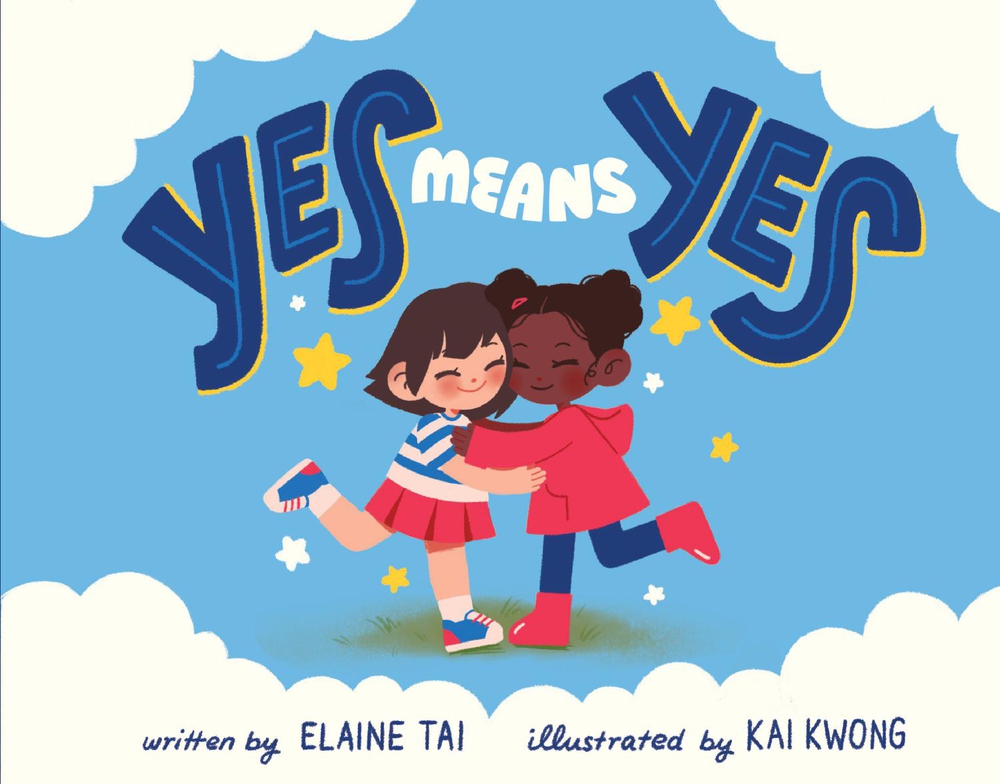
Yes Means Yes, written by Elaine Tai and illustrated by Kai Kwong, offers young children a clear, developmentally appropriate foundation in one of the first safety lessons they need: consent. Rather than centering “no means no,” this book teaches that consent is active, enthusiastic, and clear. This is a more realistic and accurate understanding for children who are still learning to read social cues and advocate for themselves.
The book uses simple, relatable scenarios that kids encounter in daily life, like wanting to hug a friend or sharing space, and models both asking for permission and recognizing when consent is not present. It also acknowledges some of the situations that are hardest for children, such as when relatives expect physical affection or even when a parent encourages it. Through these examples, young readers are guided to understand that silence, uncertainty, or unease are not signs of consent.
“Only you get to control your body. And others get to control theirs.”
Elaine Tai, Yes Means YesWhat sets this book apart is how it builds self-awareness alongside social skills. Listening to the body helps children trust the signals they already feel, and the scenarios encourage readers to check in with themselves: Would this feel okay to me? What would I say? Rehearsing those questions on the page builds the confidence to use them in real life.
In one scene, a child admires another child’s hair, and the book offers a respectful alternative for showing interest without touching someone’s body, helping children see that curiosity can be expressed kindly while still honoring boundaries.
Across the story, Yes Means Yes steadily builds three connected ideas: asking before entering someone’s space, using words to communicate and protect personal boundaries, and listening to the body for signals when something doesn’t feel right.
Kwong’s illustrations are cartoon-like, with rounded, friendly characters and expressive faces that make emotions easy for young readers to interpret. Minimal backgrounds keep the focus on social interactions, body language, and the core ideas being modeled in the foreground.
Yes Means Yes gives children clear words and strategies for protecting their own bodies and respecting others’, starting at the age when those habits are forming. Best suited for read-alouds from preschool through 2nd grade, it’s a timely pick for National Child Safety and Protection Month and a fit for classrooms, counseling offices, and home libraries alike.
- How can you tell if a friend wants a hug? What could you ask?
- What does your body feel like when something doesn’t feel okay?
- What are some ways to say hello if you don’t feel like hugging?
- Why isn’t staying quiet the same as saying yes?
- One child in the book is curious about a friend’s hair. What are kind ways to show you like something about a friend without touching?
- Why might it be hard to say no to a grown-up you love? Who could you talk to if something doesn’t feel right?
Greeting Choices
Create a greeting chart with pictures for a wave, high five, elbow bump, hug, and smile. Each morning, children point to the greeting they’d like, and classmates practice honoring that choice.
Asking Out Loud
Partners role-play everyday moments like borrowing a crayon, sitting close, or joining a game. They take turns asking, answering yes or no, and responding kindly to either answer.
Model the response to no: Children learn as much from how adults react to a no as from hearing about consent. When a student says no to a hug or other touch, a simple “Thanks for telling me” shows that boundaries are respected in your classroom.
Listen with care: If a conversation about the book leads a child to share something concerning, stay calm, thank them for telling you, and follow your school’s guidance.