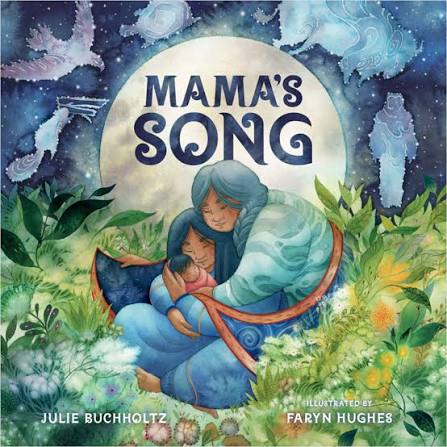
Mama’s Song, written by Julie Buchholtz and illustrated by Faryn Hughes, is a tender story that weaves the Seven Grandfather Teachings into a lullaby sung from mother to child. As an Own Voices author and a member of the Bay Mills Tribe of Chippewa Indians, Buchholtz brings cultural authenticity and the gift of language to the story.
The story begins during the Budding Moon, when Big Brown Mama welcomes her baby into the world. As she sings her song of mino-bimaadiziwin (the good life), she shares the traditional Seven Grandfather Teachings, each one embodied by its sacred animal. Hughes’s soft watercolor illustrations trail footprints across the pages and weave ancestral figures into the landscape, showing how the past supports and holds the present.
"She could feel the arms of her ancestors holding her close and lifting her up."
Julie Buchholtz, Mama’s SongFramed as a lullaby, Mama’s Song invites a calm, warm read-aloud that children can settle into. Each teaching, from wisdom and love to respect and bravery, offers a natural place to pause and ask what that value looks like in a child’s own life. These teachings belong to Anishinaabe tradition, and children of every background can find meaning in them. The Anishinaabemowin words and phonetic pronunciations for each teaching and animal name invite children to hear and speak a living Indigenous language. And because Big Brown Mama passes on what her own mother taught her, the book opens conversations about what children learn from the grown-ups in their families, and what they might one day pass on.
By framing these teachings as song, the book honors oral tradition as an act of both cultural transmission and maternal love. As someone who loves language and is always looking for ways to share new ones with my own children, I was especially drawn to the Anishinaabemowin woven throughout. Indigenous languages are rarely given this kind of space in picture books, and Buchholtz places hers at the heart of the story. The detailed appendix provides a deeper dive into each teaching. Mama’s Song is perfect for kindergarten through third grade, especially during Native American Heritage Month or other Indigenous observances.
- Why do you think Mama sings to her baby even before the baby can understand the words?
- Which animal in the book was your favorite? What does it teach?
- What is something a grown-up in your family has taught you?
- Mama learned her song from her own mother. Why might families pass down lessons as songs or stories?
- Look for the footprints in the pictures. What might it mean to walk in the footsteps of the people who came before you?
- Choose one of the Seven Grandfather Teachings. How could you practice it this week?
Footsteps of Family
Have children trace their own footprints on paper. On each one, they draw or dictate something a family member taught them, then line the footprints up along a classroom wall as a shared path.
Teachings in Our Lives
Each student chooses one of the Seven Grandfather Teachings that speaks to them, then draws or writes about a time they saw someone in their family or community live it.
Practice the language first: Read through Buchholtz’s pronunciation guide before sharing the book, and invite students to say each Anishinaabemowin word back with you. It honors Anishinaabemowin as a living language spoken today.
Read it like a lullaby: Let your voice slow and soften. This is Mama’s song to her baby, and an unhurried pace helps students hear the story the way it was written.
Let the pictures teach: Pause before turning pages so students can find the footprints and ancestral figures in Hughes’s watercolors. These details carry the book’s idea of continuity without a single word.
Pair it with the author’s debut: Mama’s Song follows Buchholtz’s first book, Who Am I? (Sleeping Bear Press, 2023), illustrated by Aliya Ghare, in which a mother shows her daughter how she is connected to the earth and to those who came before her.