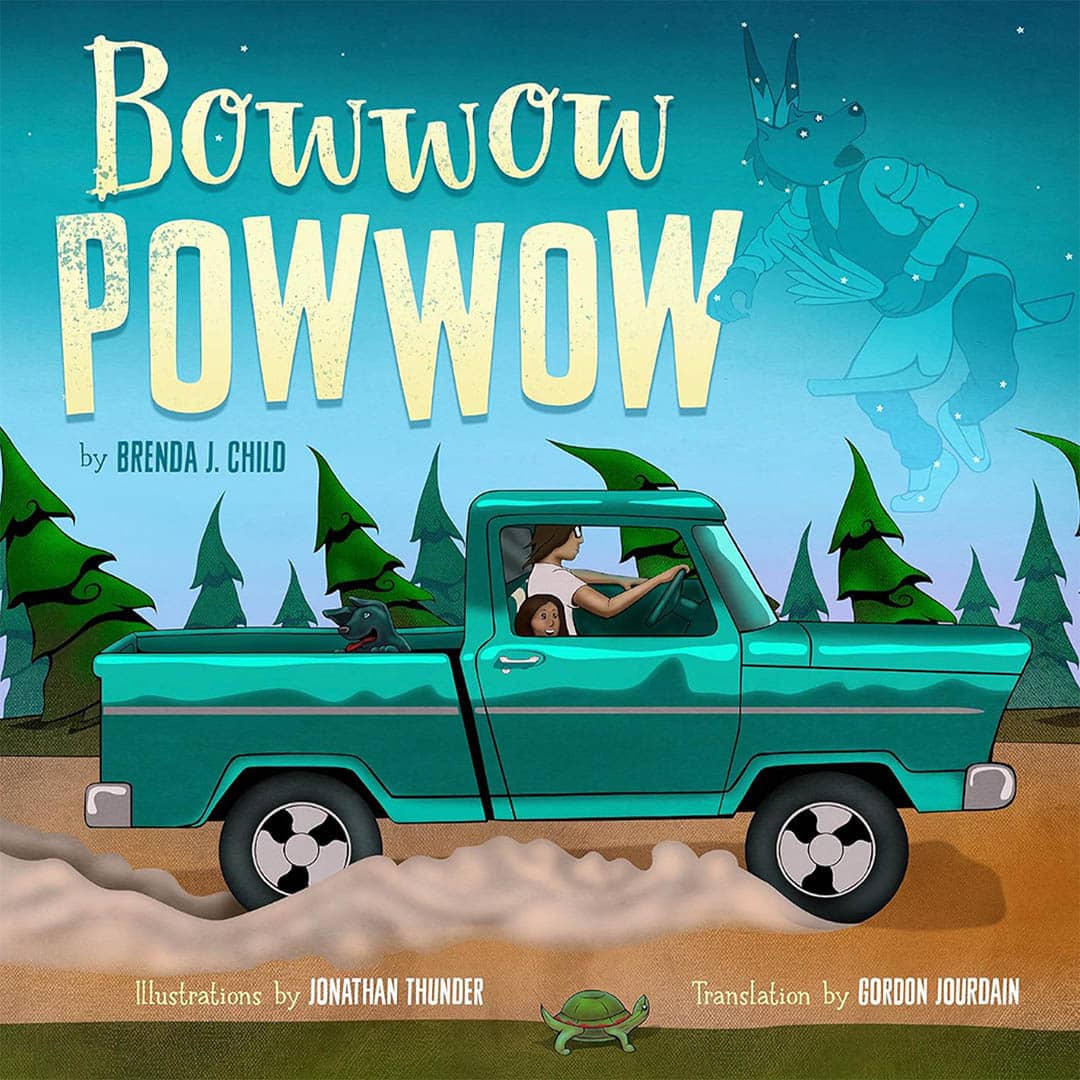
Brenda J. Child’s Bowwow Powwow opens as Windy Girl finds her canine companion, Itchy Boy. In the car with her uncle, she listens to stories about their ancestors, the powwows of years past and the long connection between their people and dogs. At the powwow, after hours of drumming and singing, Windy Girl falls asleep on a makeshift bed, and her uncle’s stories come back to her in a dream.
Every page appears in English and in the Ojibwe language, Ojibwemowin, translated by Gordon Jourdain. Jonathan Thunder’s illustrations keep ancestral and present-day life side by side across the car ride, the powwow and the dream. Like Child, Thunder is Red Lake Ojibwe.
“Windy Girl and Itchy Boy knew that Uncle’s pickup truck was the best place for stories.”
Brenda J. Child, Bowwow PowwowThe book’s layers reward rereading, as children trace how the uncle’s words return in the dream. The bilingual text matters too. Ojibwemowin is considered severely endangered, with most first-language speakers now elders, so a picture book like this helps keep the language in children’s hands. The car ride holds its own lesson. Sitting side by side, adults and children often have their most meaningful conversations, and students can think about who shares family stories with them and where it happens.
Many readers will relate to drifting off as a child at a community gathering, long after bedtime, while the music plays on. The car ride stayed with me too. Once I was old enough to sit in the passenger seat beside my dad, many of our best conversations happened on those drives. Bowwow Powwow is a strong read-aloud for Grades K through 3, and older students can explore how the book connects past and present.
- How do Windy Girl and Itchy Boy feel about each other? What clues in the pictures or stories tell you?
- What stories does Uncle tell Windy Girl in the car?
- Who tells you stories? Where are you when they tell them?
- Why do you think Uncle’s stories show up in Windy Girl’s dream?
- Every page has English and Ojibwe. Why might the author want both languages in the same book?
- Think of a long car ride or another moment together with a grown-up. What did you talk about?
- Find a place where the illustrations connect the past and the present. What do you notice?
- Why does it matter for a language to appear in the books children read?
Where Stories Happen
Children draw a place where a grown-up tells them stories, such as a car, a kitchen table or a bedtime spot, then share one thing they remember hearing there.
Story Keepers
Students ask a family member for a story about a gathering from when that person was young, then retell it to the class in a few sentences or pictures.
Hear the Ojibwe: Read a page in both languages, or invite an Ojibwe speaker to share it. If no speaker is available, the Ojibwe People’s Dictionary has audio from first-language speakers so students can hear how words sound.
Powwows happen today: Present the powwow as a living community gathering that families attend now, not something only from the past. Dancers wear regalia, not costumes, so skip dress-up or craft activities that imitate it.
Slow down for the dream: Pause when Windy Girl falls asleep and give students time with Thunder’s dream pages. Ask what they notice before you read on.
Send the conversation home: Invite students to ask a grown-up for a family story during a car ride or other time together this week.