🐢 Meet the Galápagos Tortoises
Galápagos tortoises are the biggest tortoises in the whole world! They live on islands near South America called the Galápagos Islands. Some tortoises can be as heavy as a piano!
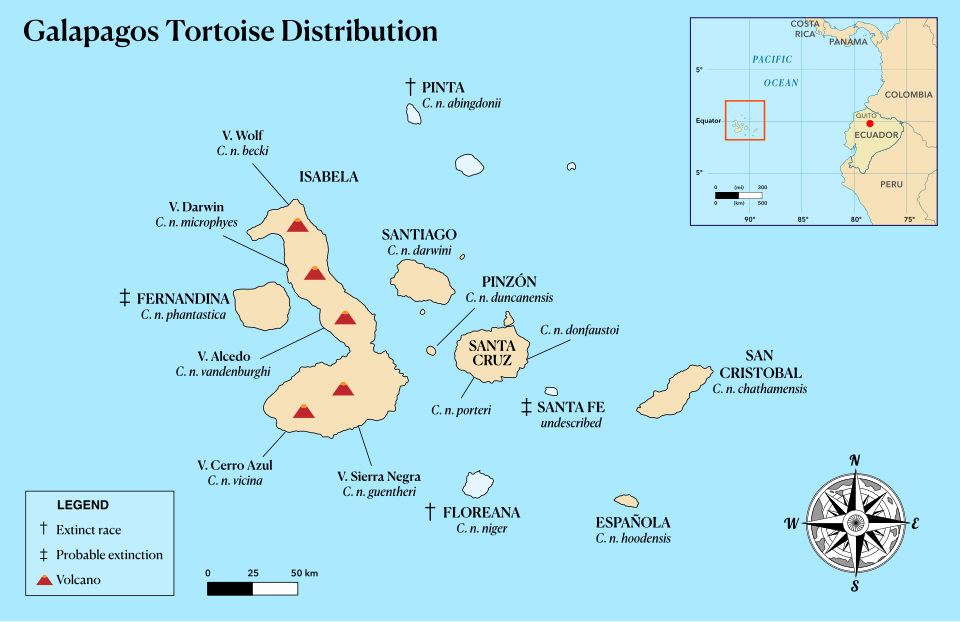
The Galápagos Islands off the coast of Ecuador. Different kinds of tortoises live on different islands!
These amazing animals can live for more than 100 years. That means a tortoise could be older than your great-great-grandparents!
The Galápagos giant tortoise is the largest living species of tortoise on Earth. These remarkable reptiles can weigh up to 417 kilograms (919 pounds) and are also the largest cold-blooded land animals in the world.
These tortoises are found on seven of the Galápagos Islands, which are located about 600 miles off the coast of Ecuador in South America. Spanish explorers arrived at the islands in the 16th century and named them after the Spanish word "galápago," meaning tortoise.
With lifespans exceeding 100 years in the wild, Galápagos tortoises are among the longest-living vertebrates on the planet. One famous captive tortoise named Harriet lived to be at least 175 years old!
The Galápagos tortoise (Chelonoidis niger) represents one of only two surviving radiations of giant tortoises in the modern world. The species comprises 15 subspecies—12 currently surviving and 3 extinct—distributed across seven of the Galápagos Islands.
These tortoises hold multiple biological distinctions. Weighing up to 417 kilograms (919 pounds), they are the largest living tortoise species and the largest extant terrestrial ectotherms (cold-blooded animals). Their longevity is equally remarkable: wild populations commonly exceed 100 years, while captive individuals have lived up to 177 years.
The Galápagos archipelago, located approximately 1,000 kilometers off Ecuador's coast, was named by 16th-century Spanish explorers who arrived at the islands. The Spanish word galápago means "tortoise," reflecting how central these creatures were to early European impressions of the islands.
🛡️ Two Different Shell Shapes
Galápagos tortoises have two different shell shapes, and each shape helps them survive in different places!
Dome Shell
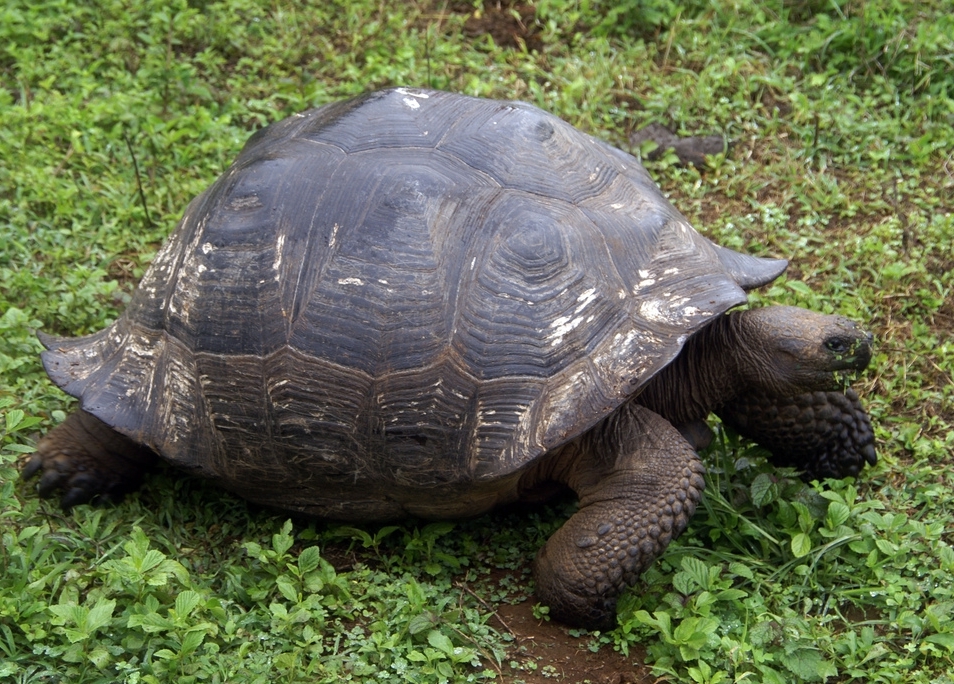
- Round like a hill
- Short neck
- Lives where there's lots of food on the ground
- Found in wet, grassy areas
Saddleback Shell
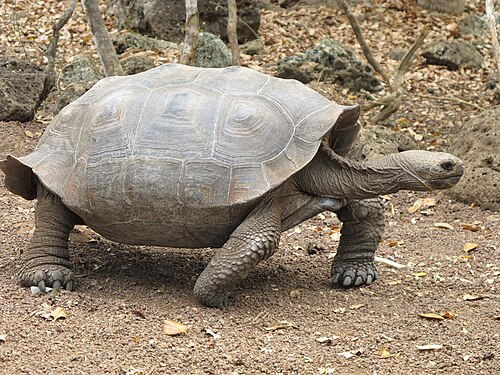
- Curved up like a saddle
- Long neck
- Reaches up high for food
- Lives in dry areas with tall plants
Shell size and shape vary significantly between different tortoise populations, and these differences are adaptations to their specific island environments.
Dome-Shelled Tortoises
- Large, rounded dome-shaped shell
- Short neck and legs
- Found on islands with humid highlands
- Abundant low-growing vegetation
- Grazes on grass and ground plants
Saddleback Tortoises
- Shell curves upward at the front
- Long, extended neck and legs
- Found on dry, arid islands
- Less ground-level vegetation
- Reaches up to eat cactus and tall shrubs
Galápagos tortoises exhibit striking morphological variation that corresponds directly to environmental conditions across the archipelago. This pattern of adaptation represents a classic example of evolutionary divergence driven by ecological pressures.
Dome-Shelled Morphotype
- Carapace: Large, rounded dome structure
- Neck length: Proportionally short
- Habitat: Islands with humid highlands and abundant rainfall
- Vegetation: Dense ground-level grasses and low shrubs
- Feeding strategy: Grazing herbivore
Saddleback Morphotype
- Carapace: Anterior elevation resembling saddle horn
- Neck length: Elongated for vertical reach
- Habitat: Arid lowland islands with sparse rainfall
- Vegetation: Elevated browse including Opuntia cacti
- Feeding strategy: Browsing herbivore with extended vertical range
🔭 Charles Darwin and the Theory of Evolution
A scientist named Charles Darwin visited the Galápagos Islands in 1835. He noticed that tortoises on different islands looked different from each other. This made him think: Why are they different?
Darwin's big theory of evolution is that animals change over many, many generations to fit where they live. This idea helped scientists understand how life on Earth works!

Charles Darwin (1809-1882), the scientist who studied Galápagos tortoises and developed the theory of evolution
In 1835, British naturalist Charles Darwin visited the Galápagos Islands during the second voyage of HMS Beagle. During his five-week stay, he made detailed observations of the islands' wildlife, including the giant tortoises.
Darwin noticed something remarkable: the tortoises on different islands had noticeably different shell shapes and body structures. Some islands had tortoises with dome-shaped shells, while others had tortoises with saddleback shells. Even more interesting, he learned that experienced sailors could identify which island a tortoise came from just by looking at its shell!
Charles Darwin, whose observations of Galápagos wildlife contributed to his groundbreaking theory of evolution
These observations became crucial evidence in Darwin's development of the theory of evolution by natural selection. He realized that these differences weren't random—they represented adaptations that helped each tortoise population survive in its specific island environment.
Charles Darwin's 1835 visit to the Galápagos Islands during the second voyage of HMS Beagle provided pivotal observations that would fundamentally reshape biological science. During his five-week exploration of the archipelago, Darwin documented distinctive morphological variations among tortoise populations inhabiting different islands.
Darwin noted that the vice-governor of the islands could determine a tortoise's island of origin merely by examining its shell characteristics. This remarkable degree of inter-island variation—particularly the correlation between shell morphology and local environmental conditions—challenged the prevailing scientific doctrine of species immutability.
Charles Darwin (1809-1882), whose theory of evolution by natural selection was significantly influenced by his observations of Galápagos fauna
These observations contributed substantially to Darwin's formulation of the theory of evolution by natural selection, published in On the Origin of Species (1859). The tortoises exemplified how geographic isolation, environmental variation, and hereditary traits could drive speciation through differential survival and reproduction.
📉📈 A Conservation Success Story
Long ago, there were more than 250,000 Galápagos tortoises. But by the 1970s, there were only about 15,000 left! That's because people took too many tortoises, and brought animals like rats and goats to the islands that hurt the tortoises.
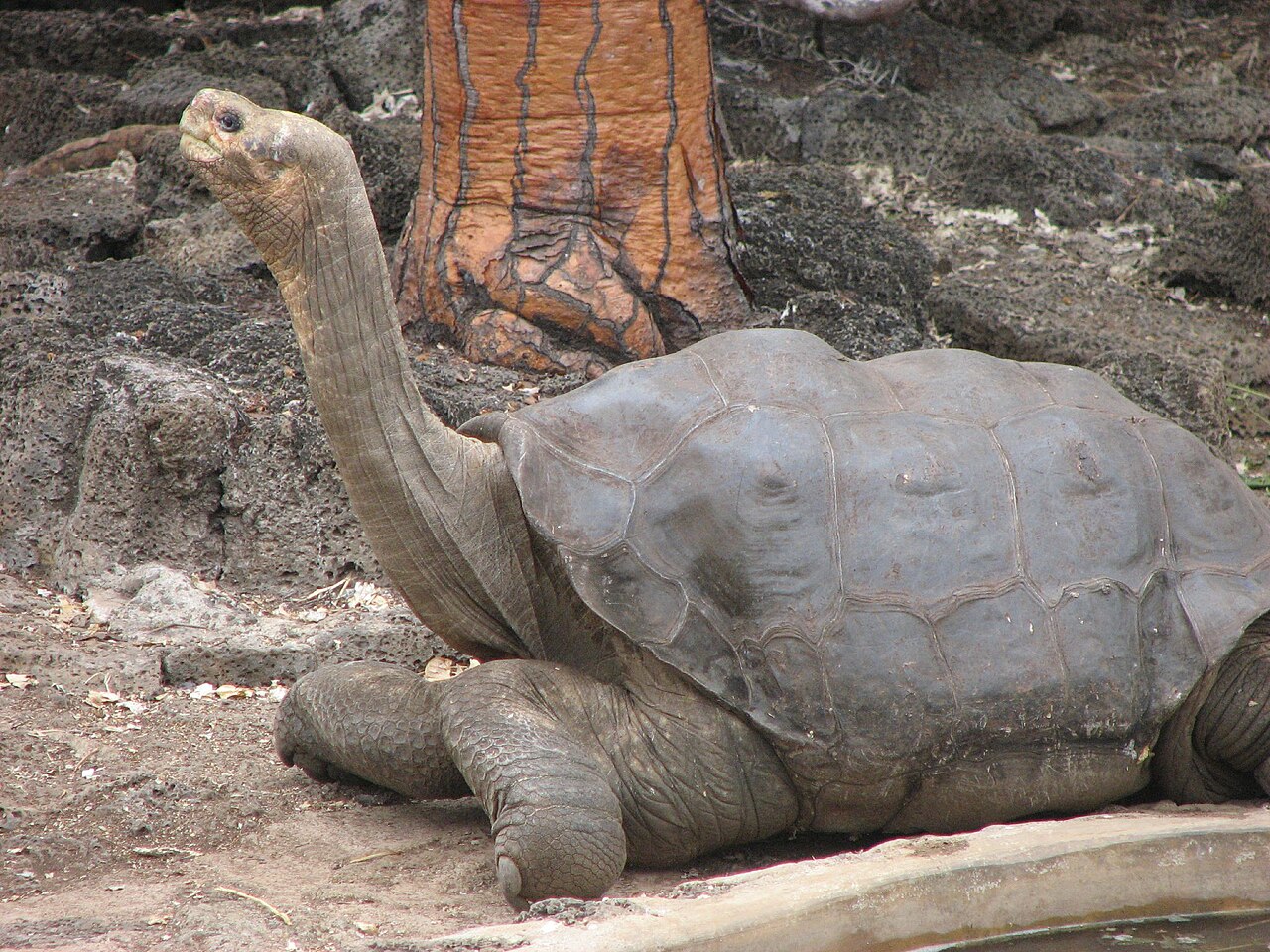
This is Lonesome George. He was the very last tortoise of his kind. When he died in 2012, his type of tortoise disappeared forever.
But good news! Scientists and helpers worked hard to save the tortoises. Today, there are more than 19,000 tortoises again! People are still working to help them.
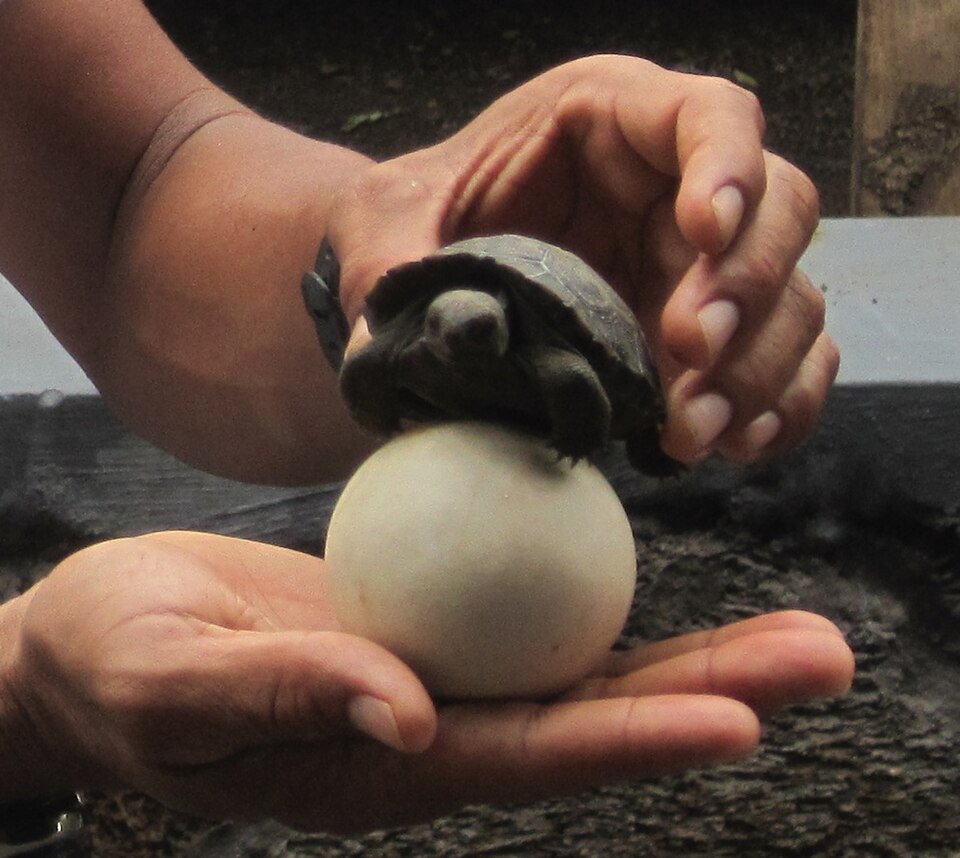
A baby tortoise just hatched! Scientists raise these tiny babies until they're big and strong enough to live safely on the islands.
The history of Galápagos tortoises is both tragic and inspiring. In the 16th century, when Spanish explorers arrived at the islands, scientists estimate there were over 250,000 tortoises. However, by the 1970s, the population had crashed to only about 15,000 individuals.
This dramatic decline had three main causes: sailors and whalers captured tortoises for food (they could survive on ships without food or water for months), people cleared tortoise habitat for agriculture, and humans introduced non-native animals—rats ate tortoise eggs, while goats and pigs competed with tortoises for food.
Three subspecies went completely extinct, and several others were reduced to just a handful of individuals. The most famous was Lonesome George, the last member of his subspecies, who died in 2012.
Lonesome George (c. 1910–2012), the last known individual of the Pinta Island subspecies (C. n. abingdonii)
However, conservation efforts beginning in the 20th century have been remarkably successful. Scientists established breeding programs, removed invasive species, and released thousands of captive-raised young tortoises back to their native islands. By the start of the 21st century, the population had rebounded to over 19,000 individuals!
A newly hatched tortoise emerges from its egg. Captive breeding programs raise hatchlings until they're large enough to survive predation, then release them to their ancestral islands—a process called "headstarting."
The demographic trajectory of Galápagos tortoise populations provides a stark illustration of anthropogenic impacts on island ecosystems and the potential for science-based conservation intervention. Historical population estimates suggest over 250,000 individuals inhabited the archipelago when Europeans arrived in the 16th century. By the 1970s, this number had plummeted to approximately 15,000—a 94% reduction.
This catastrophic decline resulted from multiple synergistic threats. Maritime exploitation was particularly severe: 18th and 19th century whalers and sailors harvested tortoises extensively for their meat and oil, taking advantage of the animals' remarkable ability to survive months without food or water. Habitat degradation for agricultural development further reduced carrying capacity. Perhaps most devastatingly, introduced species—Rattus rattus (ship rats), Sus scrofa (feral pigs), and Capra hircus (goats)—wreaked havoc through egg predation, nest destruction, and resource competition.
Three subspecies (C. n. niger from Floreana Island, C. n. abingdonii from Pinta Island, and an undescribed subspecies from Santa Fe Island) were driven to extinction in historical times. The death of Lonesome George in 2012 marked the extinction of C. n. abingdonii.
Distribution map of Galápagos tortoise subspecies across the archipelago. Crosses indicate extinct populations; triangles show volcanoes. Each island hosts genetically distinct populations adapted to local conditions.
Lonesome George (c. 1910–2012), the final individual of Chelonoidis niger abingdonii, whose death marked the extinction of the Pinta Island subspecies
Beginning in the 20th century, multi-faceted conservation programs have achieved remarkable results. Strategies include captive breeding and headstarting (raising juveniles to a size where predation risk is minimal), invasive species eradication, habitat restoration, and translocation of captive-bred individuals to ancestral ranges. These interventions increased total population to over 19,000 by the early 21st century—though all surviving subspecies remain classified as Threatened by the IUCN.
Hatchling tortoise with egg at a conservation facility. Headstarting programs incubate eggs, rear juveniles to approximately 5 years of age (reducing vulnerability to introduced predators), then repatriate individuals to native habitat—a critical intervention for population recovery.
⏳ Timeline: Galápagos Tortoises Through History
Spanish explorers arrive at the Galápagos Islands and name them after the giant tortoises they encounter. Over 250,000 tortoises inhabit the islands.
Charles Darwin visits the Galápagos aboard HMS Beagle. His observations of tortoise variations between islands contribute to his theory of evolution.
Whalers and sailors harvest thousands of tortoises for food. Three subspecies go extinct during this period. Introduced animals like goats, rats, and pigs devastate populations.
Population reaches its lowest point: only about 15,000 tortoises remain. All surviving subspecies are at risk of extinction.
Conservation programs begin breeding tortoises in captivity and releasing juveniles back to their native islands. Invasive species are removed from critical habitat areas.
Lonesome George, the last known individual of the Pinta Island subspecies, dies at approximately 100 years old, marking the extinction of his subspecies.
Population rebounds to over 19,000 individuals! Ongoing conservation work continues to protect and restore tortoise populations across the archipelago.
🔬 Scientists Discover "Extinct" Tortoises
Something amazing happened! Scientists thought one kind of tortoise was gone forever. But they found tortoises with special genes that showed some of them were still related to the "extinct" tortoises!
This is exciting because it means scientists might be able to help bring back these special tortoises by carefully choosing which tortoises have babies together.
In recent years, scientists made an exciting discovery using DNA testing. Even though some tortoise subspecies are considered extinct, genetic analysis revealed that hybrid individuals—tortoises with mixed ancestry—exist on other islands.
Most remarkably, some of these hybrid tortoises carry genetic material from subspecies thought to be completely gone, like the Floreana Island tortoise (Chelonoidis niger niger). This happened because sailors in the past sometimes moved tortoises between islands, allowing different subspecies to interbreed.
While these hybrids are not purebred members of the extinct subspecies, they represent a genetic lifeline. Conservation scientists are now exploring whether selective breeding programs could gradually recover some of the lost genetic diversity and traits of extinct subspecies.
Recent applications of molecular genetics to Galápagos tortoise conservation have yielded unexpected and scientifically significant findings. Comprehensive genetic surveys using microsatellite markers and mitochondrial DNA sequencing have identified hybrid individuals on several islands that possess genetic contributions from subspecies previously considered extinct.
Most notably, tortoises sampled on Isabela Island's Wolf Volcano exhibit genetic signatures consistent with Chelonoidis niger niger, the Floreana Island subspecies declared extinct in the mid-19th century. This genetic persistence likely resulted from historical maritime practices: sailors frequently translocated tortoises between islands and occasionally abandoned them on islands other than their origin.
These hybrid populations present both challenges and opportunities for conservation genetics. While no purebred individuals remain, the presence of extinct subspecies' alleles in hybrid genomes opens the theoretical possibility of "genetic rescue" through selective breeding. By preferentially breeding individuals with the highest proportion of target subspecies ancestry over multiple generations, conservation scientists might partially reconstitute the genetic and phenotypic characteristics of extinct forms.