✿ ❧ 💧 ❧ ✿

Teacher's Guide to Songkran

สงกรานต์ — Thai New Year Festival
Water, Renewal, and the Blessings of a New Year
🏫 Grades K–5 📅 Observed April 13–15 🌏 Thailand & Thai Diaspora 🏛️ UNESCO Intangible Heritage (2023)

Subject Areas: Social Studies, Language Arts, Science (water/seasons), Art, Music

Cultural Focus: Thai culture, Buddhism, Southeast Asian New Year traditions, intergenerational respect

Key Themes: Renewal, cleansing, family, elders, gratitude, community

Prepared by: This Month™ | For K–5 classroom and homeschool educators

🌊 Educator Overview

Songkran (สงกรานต์) is one of the most joyful and culturally rich festivals in Southeast Asia — Thailand's traditional New Year celebration, now inscribed on UNESCO's Representative List of the Intangible Cultural Heritage of Humanity (2023). It is observed each year on April 13, with the official holiday period extending through April 15.

For elementary educators, Songkran offers a remarkable entry point into Thai culture, Buddhist values, and cross-cultural concepts of renewal, gratitude, and family bonds. The festival blends ancient ritual — honoring elders, cleansing Buddha statues, building sand stupas — with the exuberant public water fights that have made it internationally famous.

Why Songkran in the Classroom?

Songkran connects to universal themes every child can relate to: starting fresh, showing respect for family, and celebrating with community. It also provides a window into Thai Buddhist traditions and the rich tapestry of Southeast Asian cultures represented in many American schools and communities.

This guide is designed to help you teach Songkran with cultural depth — moving beyond the water-fight spectacle to explore the spiritual, familial, and community dimensions of the festival. It also provides guidance for inviting Thai families and community members to share their experiences authentically with your class.

Background for Educators

The word Songkran derives from the Sanskrit word saṅkrānti (संक्रान्ति), meaning "movement" or "astrological passage" — specifically, the sun's movement from Pisces into Aries, marking the start of the solar new year.[1] This solar new year is shared across much of South and Southeast Asia, including Myanmar, Laos, Cambodia, Sri Lanka, and parts of India, though traditions vary significantly by country.

In Thailand, Songkran was the official New Year until 1888, when it was moved to April 1, and then again to January 1 in 1940. Since then, Songkran has been maintained as a beloved national holiday, carrying deep cultural and spiritual meaning.[1]

📚 A Note on Depth vs. Surface Learning:
Many resources focus on the water-fight aspect of Songkran. This guide deliberately centers the ritual dimensions — elder-blessing, Buddha cleansing, merit-making — so students develop genuine cultural understanding rather than surface-level awareness.
📜 Cultural & Historical Background

Ancient Origins

Songkran has been celebrated in Thailand for centuries. Traditionally, the date was calculated by royal astrologers using an ancient astronomical system called Suriyayart — the Thai adaptation of the Hindu Surya Siddhanta — to determine precisely when the sun entered Aries. This careful calculation connected the festival to cosmic cycles, underscoring the belief that the new year is not an arbitrary date but a moment of genuine astronomical and spiritual significance.[1]

Even today, some astrologers — especially in northern Thailand — publish their own Songkran predictions covering the economy, agriculture, and political affairs based on observations made during the festival period.[1]

The Three Days of Songkran

The festival unfolds across three meaningful days, each with its own name and significance:[1]

  • April 13 — Maha Songkran: The final day of the old year. The sun moves from Pisces to Aries. Families begin rituals of cleansing and preparation.
  • April 14 — Wan Nao: The transitional day — neither old year nor new. A liminal, in-between time for deepening rituals and family togetherness.
  • April 15 — Wan Thaloeng Sok: New Year's Day itself, meaning "to begin a new era." Ceremonies of blessing and renewal reach their culmination.

The Meaning of Water

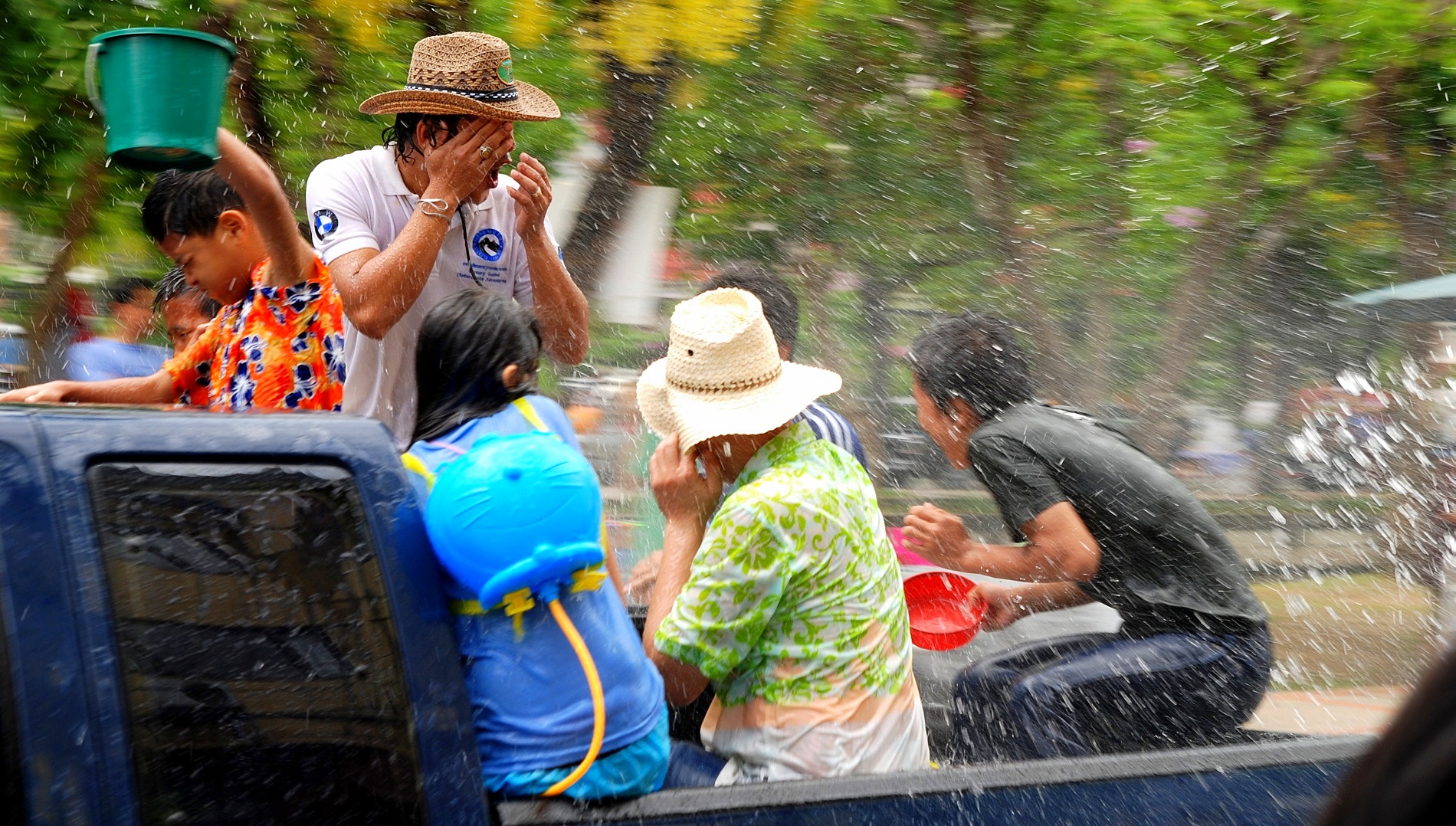
Water sits at the very heart of Songkran — but it carries layered significance far beyond splashing and play. In Thai Buddhist tradition, water is a vehicle of purification and blessing. Pouring water gently over the hands of elders (rot nam dam hua) is an act of profound respect — the younger generation showing gratitude to those who came before, while elders offer blessings in return.

Similarly, bathing statues of the Buddha with scented water is an act of merit-making and spiritual cleansing. The water "washes away" the troubles, sins, and misfortunes of the previous year, preparing both community and individual for a fresh, auspicious beginning.

💧 Water as Symbol: In many cultures, water symbolizes life, purity, and transformation. Songkran invites students to explore how a single element — water — can carry vastly different cultural meanings: as ceremony, as blessing, as playful community celebration.
Community water celebration during Songkran festival

Community Songkran water celebrations — joyful, communal, and deeply meaningful. Photo: Wikimedia Commons.

Nang Songkran: The Festival's Celestial Guardian

Thai tradition personifies Songkran as a Nang Songkran — a celestial goddess who arrives at the new year riding a sacred animal (which changes each year according to the day of the week Songkran falls on). Her image appears on traditional Thai calendars and captures the mythological richness embedded in the festival.[1]

Regional Variations Within Thailand

While Songkran is a national celebration, it looks different in different parts of Thailand. Chiang Mai in northern Thailand is globally renowned for its elaborate multi-day Songkran festivities. In 2013, the Chiang Mai Provincial Council even defied the government-set holiday schedule by rescheduling ceremonies according to traditional astronomical calculations — illustrating the living tension between local tradition and national standardization.[1]

UNESCO Recognition

In 2023, Songkran was inscribed on UNESCO's Representative List of the Intangible Cultural Heritage of Humanity, recognizing its deep cultural significance and the living traditions it carries across generations.[1]

A Shared New Year Across Asia

Songkran is part of a family of solar new year celebrations observed across South and Southeast Asia — including Thingyan in Myanmar, Pii Mai in Laos, Chaul Chnam Thmey in Cambodia, Vaisakhi in parts of India, and Sinhala New Year in Sri Lanka. Each tradition is distinct, but all share the underlying theme of cosmic renewal at the spring solar transition.

🎒 Grade-Differentiated Teaching Content
K–1: Learning the Big Ideas

Core Concepts for Kindergarten & First Grade

Young learners in K–1 are ready to explore the feelings and experiences of Songkran — the joy of water, the warmth of family, and the idea of starting something new.

Key Understandings

  • In Thailand, April is when people celebrate a special New Year.
  • People pour water on each other and on special statues as a way of saying "happy new year" and "thank you."
  • Younger people show respect to grandparents and elders by gently pouring water on their hands.
  • Water in Songkran is like a big, joyful bath for the whole community — washing away anything old or sad.

Classroom Connections

  • Read Aloud: Share picture books featuring Thai culture or water celebrations. Pause to ask: "How does water feel when it touches you?" / "What would it feel like to start a brand-new year?"
  • Water Play Exploration: Set up a sensory water table. Label it "Songkran Water Bowl." Invite children to pour water gently into small dishes and discuss how it feels.
  • Thank-You Gestures: Practice a gentle, respectful gesture (like a bow or pressing hands together) to demonstrate how Songkran honors elders.
  • New Year Wishes Art: Children draw or paint one thing they hope for in a new year and share it with a partner.

Discussion Starters (K–1)

  • "What do you do on New Year's Day with your family?"
  • "If you could pour water on something to make it clean and new again, what would it be?"
  • "Who in your family do you say 'thank you' to? How do you show it?"

2–3: Building Cultural Understanding

Core Concepts for Grades 2–3

Students in grades 2–3 can begin to explore Songkran as a cultural system — understanding that the water isn't just play, but carries ritual meaning, and that the festival connects family, community, and spiritual life.

Key Understandings

  • Songkran is Thailand's traditional New Year — celebrated on April 13 each year.
  • The word "Songkran" comes from Sanskrit and means "the sun moving from one place to another" — the start of a new cycle.
  • People visit temples, make offerings, and pour scented water on Buddha statues as acts of respect and merit-making.
  • The ceremony of rot nam dam hua (washing elders' hands with water) is a powerful expression of gratitude and love across generations.
  • Songkran is celebrated across Thailand and by Thai communities around the world.

Classroom Activities

  • Mapping Activity: Locate Thailand on a world map. Find other countries that celebrate spring solar new years. What do they have in common geographically?
  • Symbols in Water: Discuss how water is used in ceremonies in different cultures (baptism, ritual washing, rain dances). What makes water such a powerful symbol?
  • "Thank You" Letter: Write a short letter to an elder in your family or school community. What have they taught you? What are you grateful for?
  • Sand Stupa Craft: Research sand stupas — small Buddhist towers built during Songkran as acts of merit. Create model stupas using sand, clay, or blocks and discuss what "building something as a gift" means.

Discussion Starters (2–3)

  • "Why might pouring water be a way of saying 'I respect you' or 'I'm grateful'?"
  • "What does 'starting fresh' mean to you? What would you wash away from last year?"
  • "How is Songkran similar to or different from New Year celebrations you know?"

4–5: Deeper Historical & Cultural Inquiry

Core Concepts for Grades 4–5

Older elementary students can explore the layered history, regional diversity, and global context of Songkran — including its astronomical origins, its place within Theravada Buddhist practice, and its evolving role in contemporary Thai society and diaspora communities.

Key Understandings

  • Songkran's date was historically calculated by royal astrologers using ancient Hindu-Buddhist astronomical texts. The sun's entry into Aries — observed through the sidereal zodiac — marks the beginning of the new year.
  • Thailand's official New Year shifted over time (from Songkran, to April 1 in 1888, to January 1 in 1940), but Songkran remained the cultural new year, illustrating how deeply embedded it is in Thai identity.
  • Chiang Mai's decision in 2013 to reschedule ceremonies according to traditional astronomical calculations — defying the government-set holiday — shows how local communities negotiate between tradition and modernity.
  • Songkran belongs to a regional family of spring solar new years, but each country's tradition (Myanmar, Laos, Cambodia, Sri Lanka) has distinct practices and meanings.
  • UNESCO's 2023 inscription reflects global recognition of intangible cultural heritage — the knowledge, practices, and skills passed down through communities.

Inquiry-Based Activities

  • Timeline Analysis: Create a timeline of Songkran's official status in Thailand — from traditional new year, to April 1, to January 1, to national holiday. What does this reveal about how governments and cultures interact?
  • Comparative Religion & Culture: Research how Buddhist values (merit, compassion, respect for elders) are expressed through Songkran rituals. Compare with merit-making practices in another tradition.
  • Intangible Heritage Research: What does UNESCO mean by "intangible cultural heritage"? Students explore the UNESCO list and identify 3 other inscribed traditions. What do they share?
  • Sanskrit Roots: Trace the etymology of "Songkran" from Sanskrit saṅkrānti. Explore other English or Thai words with Sanskrit origins. What does this reveal about cultural exchange in ancient Asia?
  • Primary Source Analysis: The historical Prakat Songkran was an official royal announcement issued each year. What might such a document include? Students draft their own "New Year Announcement" for a community.

Discussion Starters (4–5)

  • "What is the difference between a country's official new year and its cultural new year? Why might they differ?"
  • "Why do you think Songkran survived even when Thailand officially changed its New Year date?"
  • "What does it mean to 'inscribe' a tradition on a UNESCO list? Who decides what is worth preserving?"
  • "How might Thai Americans experience Songkran differently than people in Thailand?"
🙏 Cultural Sensitivity Guidelines

Songkran is a living, sacred tradition — not a costume or a party theme. These guidelines will help you teach it with the respect it deserves.

✅ Do

  • Explain that the water has deep spiritual and ritual meaning — it is not just a fun water fight.
  • Center the elder-honoring and merit-making dimensions alongside the water play.
  • Use the correct name: "Songkran" (not "Thai Water Festival" as the primary label).
  • Acknowledge that Thai Buddhism shapes the festival — treat this with the same respect given to other religious traditions.
  • Welcome Thai families to share their own family's Songkran practices (which may vary by region, generation, and family tradition).
  • Note that Songkran is also celebrated by diaspora Thai communities throughout the world, including in the United States.
  • Distinguish Songkran from other Southeast Asian spring new years — they are related but distinct.

🚫 Don't

  • Reduce Songkran to "the holiday where you throw water at people."
  • Use squirt guns or water balloons in classroom simulations — these miss the ritual significance and may feel disrespectful.
  • Dress students in Thai traditional dress for "dress-up" activities without meaningful cultural context.
  • Conflate Thai, Lao, Cambodian, or Burmese New Year traditions — they each deserve their own recognition.
  • Present Buddhism as exotic or mysterious; frame it as one of the world's major living spiritual traditions.
  • Assume all Thai students or families observe Songkran the same way — practices vary widely.
  • Treat Songkran as a purely secular festival; its roots are deeply spiritual.
⚠️ A Note on Classroom Water Activities:
If you wish to do a water activity inspired by Songkran, frame it explicitly as "inspired by" the tradition — not as a re-enactment. Focus on the meaning of gentle, intentional water-pouring (over hands, into a bowl) rather than the exuberant water-fight aspect. This keeps the classroom experience pedagogically grounded.

Language Guidance

  • Pronounce "Songkran" as: song-KRAHN (the 'g' in 'song' is soft)
  • The Thai script สงกรานต์ is worth showing students — Thai is a tonal language with its own unique alphabet.
  • Avoid calling it a "Thai Christmas" or making direct comparisons to Western holidays that flatten its distinctiveness.
🎨 Cross-Curricular Activities

🌍 Social Studies

  • World New Year Mosaic: Research when different cultures celebrate their new year (January 1, Lunar New Year, Nowruz, Songkran, Diwali, Rosh Hashanah, etc.) and create a class calendar mosaic showing cultural diversity across the year.
  • Thailand Geography: Explore Thailand's geography, neighboring countries, and regional culture. Why might a spring new year make sense in this climate and agricultural context?
  • Intangible Heritage Map: Mark UNESCO Intangible Heritage sites on a world map. Discuss: what kinds of traditions get recognized?

📖 Language Arts

  • Letter to an Elder: Write a Songkran-inspired thank-you letter to a family elder, community elder, or someone who has guided you. What blessings would you ask for them?
  • New Year Poetry: Write a short poem or haiku about the feeling of starting fresh. What would you wash away? What would you welcome?
  • Vocabulary Exploration: Trace the Sanskrit word saṅkrānti and explore other English words with Sanskrit roots (shampoo, jungle, yoga). What does this reveal about language and cultural exchange?

🔬 Science & Math

  • Solar Cycles: Explore what it means for the sun to move from Pisces to Aries (the vernal equinox region). How do ancient cultures used the sky as a calendar?
  • Water Science: Conduct simple experiments on water — surface tension, evaporation, absorption. Discuss water's properties that make it symbolically powerful (it cleanses, it sustains life, it is shared).
  • Calendar Math (Grades 4–5): The historical Songkran calculation used a formula based on a solar year of 365.25875 days. Compare this to the Gregorian year of 365.2425 days. What is the difference per year? What does it add up to over centuries?

🎨 Visual Arts

  • Sand Stupa Sculpting: Using damp sand or air-dry clay, students build small tiered towers (stupas) — a traditional Songkran merit-making activity. Decorate with flower petals, flags, or painted patterns.
  • Nang Songkran Illustration: Research the traditional image of Nang Songkran — the celestial goddess of the festival. Students create their own interpretive illustration of a "guardian of new beginnings."
  • Water Watercolor: Using blue watercolors, students paint flowing water scenes inspired by Songkran, experimenting with wet-on-wet technique to capture water's movement.
Sand stupas built at Wat Pho during Songkran, Bangkok 2025

Sand stupas (เจดีย์ทราย) built at Wat Pho, Bangkok during Songkran 2025 — a traditional merit-making practice that students can explore through art. Photo: Wikimedia Commons.

🎵 Music & Movement

  • Listen to samples of Thai classical music and Thai popular music. Discuss the differences in instrumentation and mood.
  • Learn a simple Thai greeting and respectful gesture (wai — pressing palms together at chest or forehead). Practice using it as an elder-honoring gesture in role-play scenarios.
🏡 Family & Community Engagement

Inviting Thai families and community members to share their Songkran experiences enriches learning immeasurably. These suggestions frame family sharing as a two-way exchange — families bring cultural knowledge; students bring curiosity and respect.

Inviting Thai Families to Share

When reaching out to Thai families, consider framing the invitation openly: "We are learning about Songkran and would love to hear how your family celebrates — whether in Thailand, here in the U.S., or both. There is no single 'right' way to celebrate, and we want to learn from your family's experience."

What Families Might Share

  • Family photographs or video from Songkran celebrations in Thailand or locally
  • Traditional foods prepared during Songkran (such as khao chae — chilled rice in jasmine-scented water, a cooling Songkran dish)
  • The rot nam dam hua elder-blessing ceremony — a family visitor might demonstrate the gentle hand-pouring gesture and explain its meaning
  • Stories of Songkran in their hometown in Thailand — how it differs from Bangkok celebrations, Chiang Mai celebrations, or celebrations in rural villages
  • Thai language: greetings, blessings, and songs associated with Songkran

Preparing Students for a Community Guest

  • Pre-teach key vocabulary and cultural context so students arrive with genuine curiosity rather than surface-level questions.
  • Have students prepare questions in advance: "What does the water mean to your family?" / "What do you do first when Songkran starts?" / "What do you miss most about Songkran if you're in the U.S.?"
  • Brief students on respectful listening — this is an opportunity to receive knowledge, not perform entertainment.

Family Homework Connections

  • All Families: Ask a grandparent or older family member: "What is a tradition in our family that has been passed down? Who taught it to you?" Share responses in class.
  • All Families: Find one thing in your home that has been "washed" or cleaned to start fresh (a new year, a new season, a new school year). What does renewal mean in your family?
  • Thai Families (optional): Share a Songkran photo, food, or memory with the class — whatever feels comfortable and meaningful.

Local Community Resources

Many cities with Thai communities host Songkran festivals in April. Thai Buddhist temples are often centers of community celebration. Check with local Thai associations, Thai restaurants, or Buddhist temples to find public Songkran events — these can be meaningful field trip destinations or sources of community guest speakers.

📚 Vocabulary
Word / Phrase Thai Meaning & Context
Songkran สงกรานต์ Thailand's traditional New Year festival, observed April 13–15; from Sanskrit saṅkrānti meaning "astrological passage."
Maha Songkran วันมหาสงกรานต์ "Great Songkran" — April 13, the final day of the old year when the sun moves into Aries.
Wan Nao วันเนา April 14 — the transitional "in-between" day, neither old year nor new.
Wan Thaloeng Sok วันเถลิงศก "To begin a new era" — April 15, New Year's Day itself.
Rot nam dam hua รดน้ำดำหัว The ceremony of pouring scented water over elders' hands as a gesture of respect and blessing.
Nang Songkran นางสงกรานต์ The celestial goddess who personifies Songkran, depicted riding a sacred animal; changes each year based on the day Songkran falls.
Stupa / Chedi เจดีย์ A tiered Buddhist tower. Building sand stupas at temples during Songkran is a merit-making tradition.
Wai ไหว้ A traditional Thai greeting performed by pressing the palms together near the chest or forehead; expresses respect.
Theravada Buddhism The branch of Buddhism most widely practiced in Thailand, Laos, Cambodia, Myanmar, and Sri Lanka; emphasizes the teachings of the earliest Buddhist texts.
Merit-making ทำบุญ Acts of generosity, devotion, and virtue that generate positive karma in Buddhist practice — central to Songkran rituals.
Intangible Cultural Heritage UNESCO's term for living traditions, knowledge, and practices passed down through generations — as opposed to physical monuments. Songkran was inscribed in 2023.
Saṅkrānti (Sanskrit) संक्रान्ति The Sanskrit root of "Songkran" — meaning "movement" or "astrological passage," referring to the sun's movement through the zodiac.
🔗 Resources for Educators

Online Resources

  • UNESCO Intangible Cultural Heritage – Songkran: ich.unesco.org — Official UNESCO inscription page with background information and multimedia.
  • Tourism Authority of Thailand: tourismthailand.org — Cultural background and festival information.
  • Amazing Thailand (official): Search for Songkran videos and photo galleries showing both ritual and community celebration dimensions.
  • Google Arts & Culture – Thailand: Virtual museum collections featuring Thai Buddhist art, temple architecture, and cultural traditions.

Books for Classroom Use

  • Water Festival — look for age-appropriate picture books about Southeast Asian water festivals for K–2 read-alouds.
  • Thailand (Countries of the World series) — informational text for grades 3–5 geography and culture units.
  • Search your school library for books featuring Thai characters, Thai-American families, or Buddhist traditions for additional representation.

Media

  • Search YouTube for "Songkran Chiang Mai" or "Songkran elder ceremony" — videos showing both the water-fight spectacle and the quieter, ritual dimensions provide powerful comparative viewing for older students.
  • The TAT (Tourism Authority of Thailand) YouTube channel offers professional documentary-quality Songkran footage.

Community Connections

  • Thai Buddhist temples in your area are often excellent community partners — many host Songkran celebrations open to the public in April.
  • Thai Student Associations at nearby universities may be able to connect you with cultural ambassadors willing to visit classrooms.
  • Thai restaurants sometimes host Songkran events — reaching out may yield a community guest or catered cultural lunch.
📎 Citations & Source Credits

This guide was prepared using the following sources. Educators are encouraged to consult primary sources for deeper research.

  1. "Songkran." Wikipedia: The Free Encyclopedia. Wikimedia Foundation. Accessed April 2025. Available at: https://en.wikipedia.org/wiki/Songkran. Content used under the Creative Commons Attribution-ShareAlike 4.0 International License. Includes etymological, historical, astronomical, and regional information about the festival.
  2. UNESCO. "Songkran in Thailand, traditional Thai New Year festival." Intangible Cultural Heritage. Inscribed 2023, 18th Session of the Intergovernmental Committee. Reference 01719. ich.unesco.org
  3. Additional cultural context and classroom framing developed by This Month™ editorial team, drawing on publicly available educational resources on Thai culture, Theravada Buddhism, and Southeast Asian traditions.
Image Credits:
  • Community Songkran water celebration photograph: Wikimedia Commons, used under Creative Commons license.
  • Sand stupas (เจดีย์ทราย) at Wat Pho, Bangkok, Songkran 2025: Wikimedia Commons, used under Creative Commons license.
  • Additional educators seeking public domain or Creative Commons-licensed images of Songkran may consult Wikimedia Commons (search "Songkran") for photographs appropriately licensed for educational use. Always review individual image licenses before classroom display.