AN INSTANT GUIDE TO THE
ARTEMIS II MOON PHOTOS
Six Historic Images from the Lunar Flyby · April 6, 2026
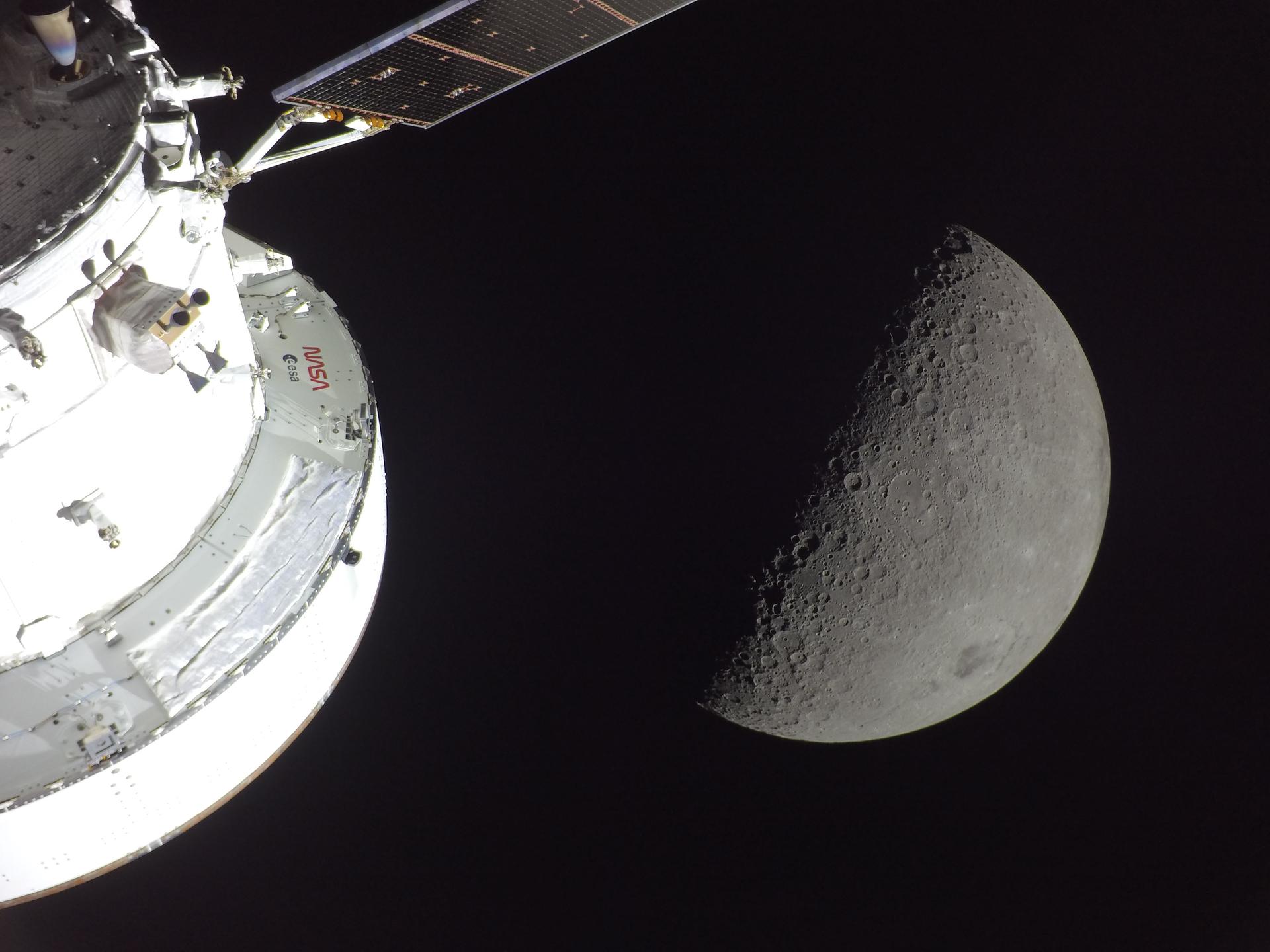
🚀 That's the spaceship! It's called Orion, and four astronauts are riding inside it. The Moon is right behind it — you can see the craters on the Moon's surface! The Sun is shining on the spaceship and making it glow bright white.
This photo shows Orion — the crew capsule carrying the four Artemis II astronauts — with a first-quarter Moon visible in the background. You can see the spacecraft's solar panel at the top, collecting sunlight for power. Near the Moon's bottom-right edge, look for the Orientale Basin: a 600-mile-wide impact crater with a distinctive dark patch of ancient lava at its center.
Orion is seen here sunlit against the lunar surface during approach. The first-quarter Moon appears at roughly half-illumination from this viewing geometry. The Orientale Basin, visible at the lower right limb, is a multi-ring impact structure straddling the near and far sides of the Moon — one of the youngest large basins and exceptionally well-preserved. Its dark interior is solidified mare basalt: ancient lava that flooded the basin floor after the original impact billions of years ago.
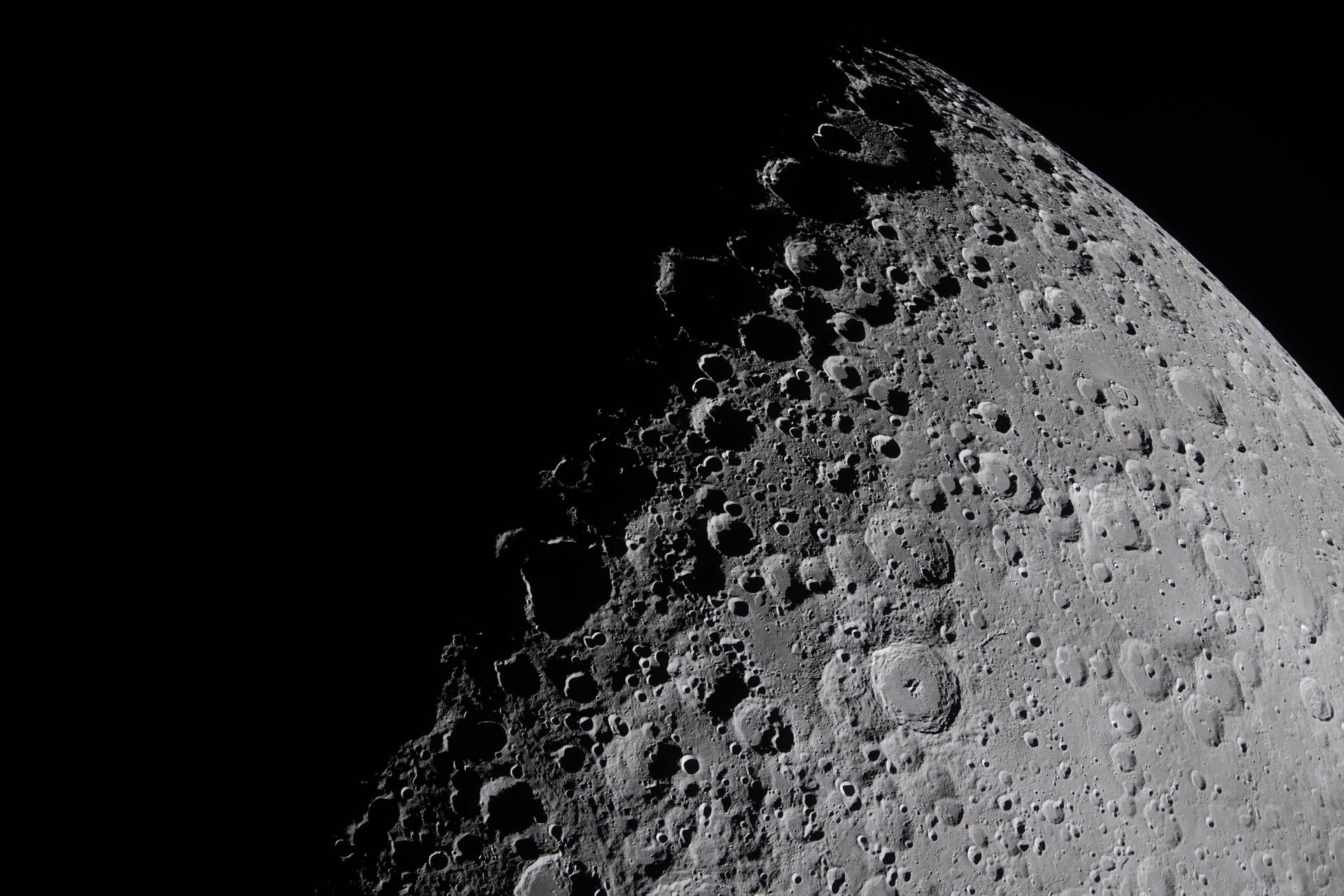
🌓 See how half the Moon is bright and half is dark? The line in the middle is called the terminator — it's where day meets night on the Moon! Because the sun shines from the side, the craters make giant shadows. It looks like a bumpy, crinkled surface!
This dramatic image was captured about three hours into the crew's lunar observation period, as they flew around the far side. The bright line dividing light and shadow is called the terminator — the boundary between lunar day and night. When sunlight hits at a very low angle, it can't fill in the shadows inside craters, making them look incredibly deep and dramatic. Features like Jule Crater, Birkhoff Crater, and Stebbins Crater stand out clearly in this light.
The terminator is the day-night boundary on any spherical body. At this zone, solar illumination arrives at an extremely low angle — called grazing incidence — causing even small surface features to cast long shadows. This makes the terminator the ideal region for studying lunar topography: relief that would be invisible under direct overhead illumination becomes starkly apparent. The craters visible here — Jule, Birkhoff, and Stebbins — are located in the heavily cratered highlands of the lunar far side, a region that never faces Earth.
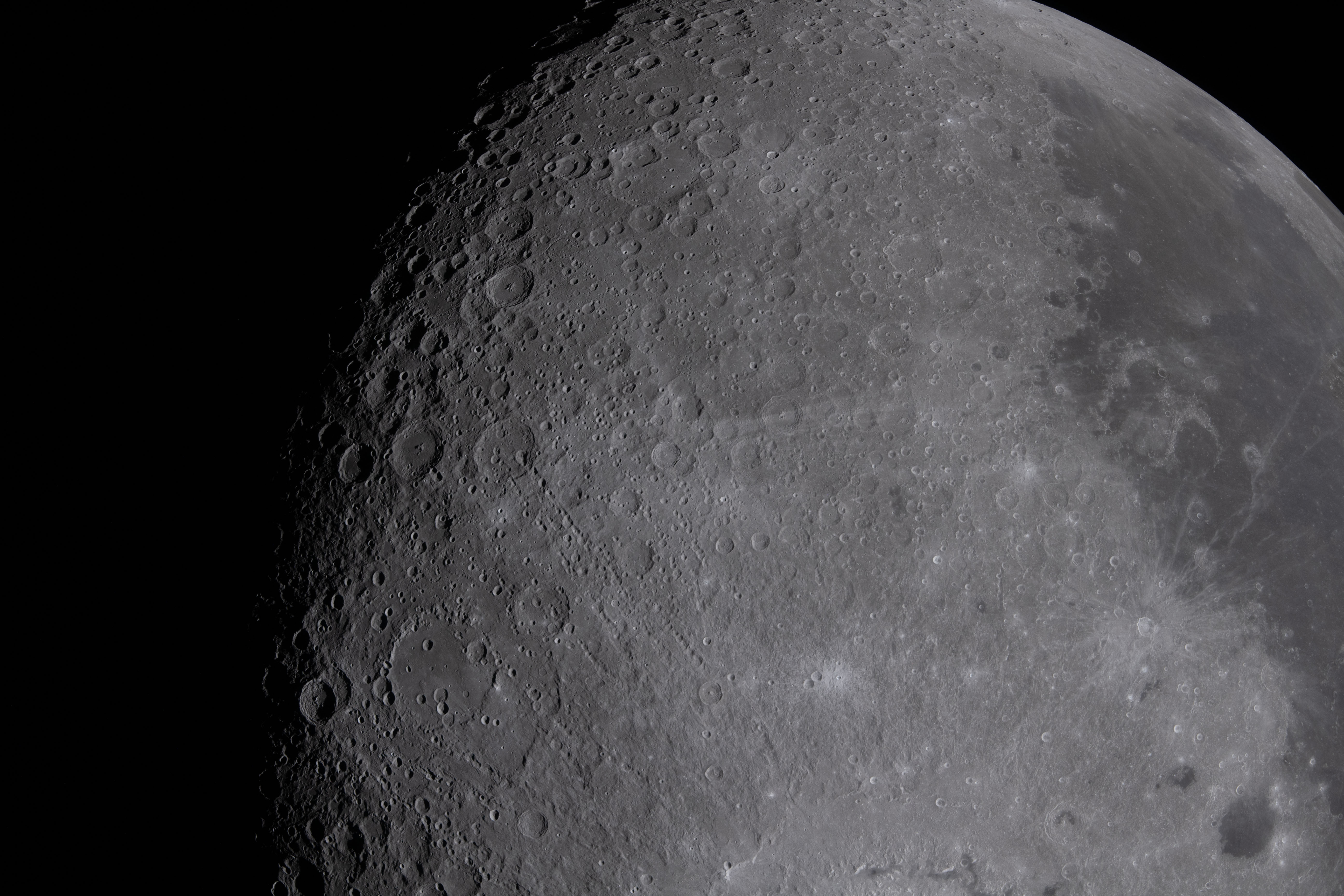
🌕 Look at all those different textures on the Moon! The darker patches are called plains — they're flat, smooth areas filled with old, dark rock. The lighter, bumpier parts are the highlands — older and more covered with craters. Scientists gave names to all the big craters so we can talk about them!
This image shows many different kinds of lunar landscapes at once — what scientists call geologic terrains. The dark, smooth regions are called maria (MAR-ee-uh), which is Latin for "seas" — early astronomers thought they might be water! They're actually vast plains of dark volcanic rock. The bright, heavily cratered regions are called highlands — they're older and more battered by space rocks. Visible features include Ohm crater, Grimaldi crater, Oceanus Procellarum, and the enormous Hertzsprung Basin.
This single frame captures a cross-section of lunar geological history. Oceanus Procellarum ("Ocean of Storms") is the largest of the lunar maria — a massive expanse of dark basaltic plains formed by volcanic flooding billions of years ago. Hertzsprung Basin is one of the Moon's largest ancient impact features, its structure partially erased by subsequent cratering. The contrast between dark maria and bright anorthositic highland crust reflects the Moon's two-stage formation: an early magma ocean that crystallized the highlands, followed by volcanic resurfacing of low-lying basins.
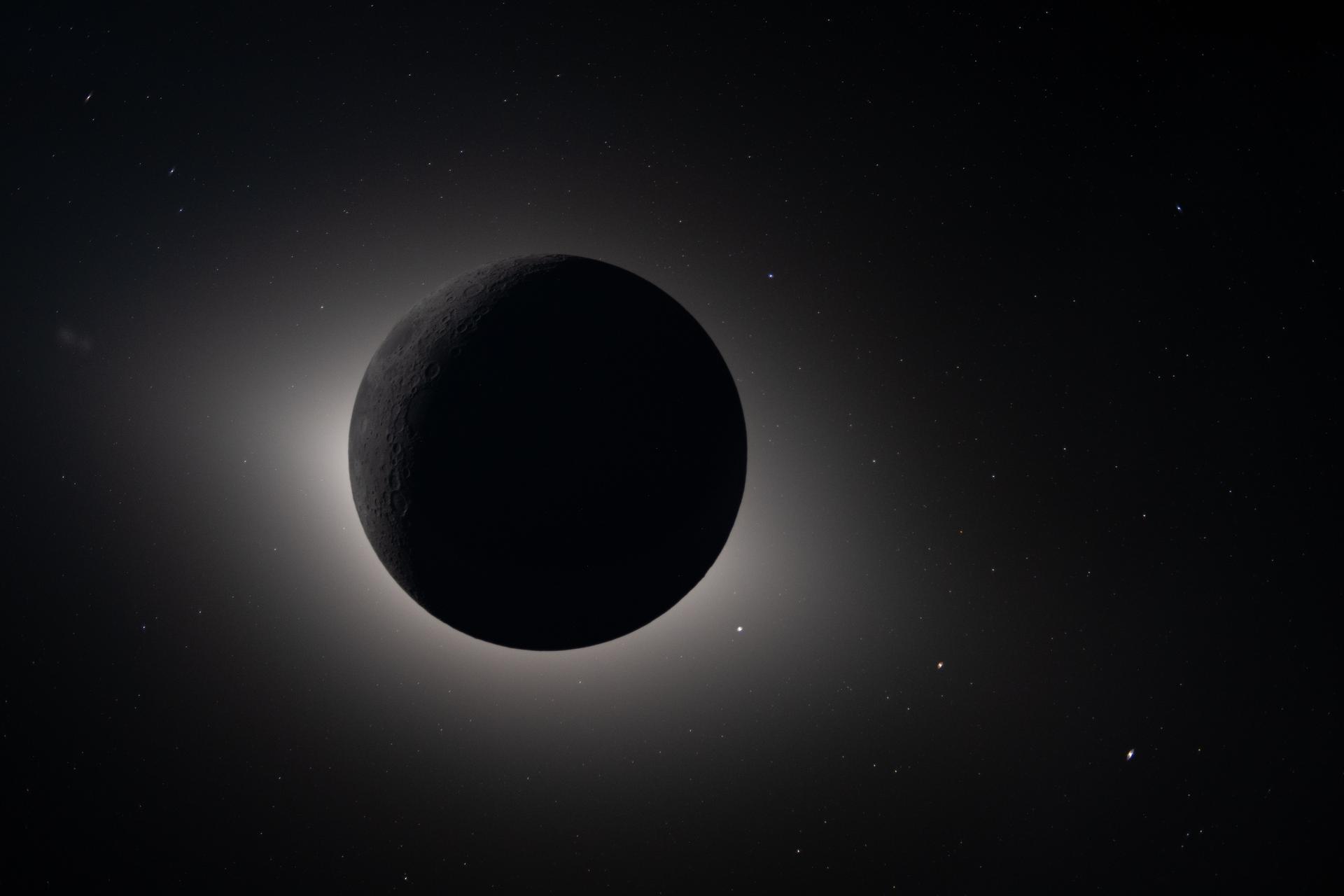
🌑 WOW! The Moon is blocking the Sun! When the Moon gets right in front of the Sun, it's called an eclipse. See the glowing ring around the Moon? That's light from the Sun peeking around the edges! And look — you can see stars in this picture, because the Moon blocked the blinding sunlight. The astronauts saw this for almost 54 whole minutes!
This stunning image captures a solar eclipse as seen from the Artemis II spacecraft — but from much closer to the Moon than any eclipse on Earth. When the Moon perfectly blocked the Sun, the crew experienced 54 minutes of totality — far longer than any solar eclipse visible from Earth's surface, which lasts only a few minutes. You can see stars normally too faint to photograph near the Moon, now visible because the blinding sunlight was blocked. A glowing halo rings the dark lunar disk.
From their position approximately 4,000 nautical miles above the lunar surface, the Artemis II crew experienced 54 minutes of solar totality — a duration impossible from Earth, where the Moon's shadow races across the surface. The glowing halo surrounding the dark lunar disk is under scientific investigation: it may be the Sun's corona (the outer atmosphere, normally invisible), zodiacal light (sunlight scattered by interplanetary dust along the ecliptic), or a combination of both. Stars are visible in this exposure — ordinarily outcompeted by solar glare, they become photographable when the Sun is occulted. The faint glow on the Moon's nearside disk is earthshine: light reflected from Earth, illuminating the otherwise dark lunar face.
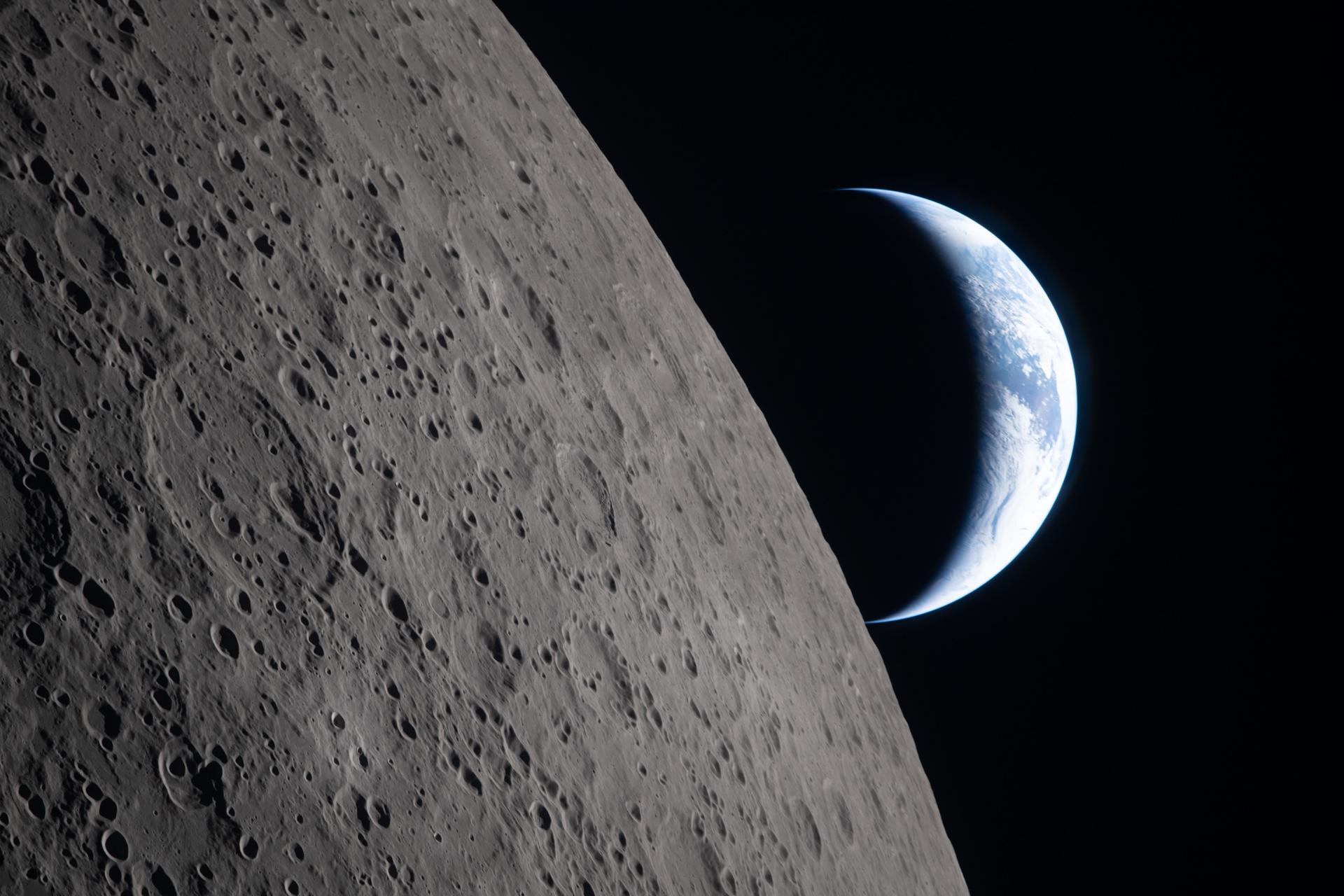
🌍 Can you find Earth in this picture? It's that little blue crescent peeking out from behind the Moon! This is what the astronauts saw just before the Moon blocked their radio signal to Earth. For a little while, they were completely alone — no calls, no texts, no messages — just them and the Moon and the stars. That blue light is your home, Earth!
This image was captured just as the crew was about to fly behind the Moon and experience a planned loss of signal — the moment when the Moon blocks all radio communication with Earth. The blue crescent you see is Earth, appearing to "set" over the Moon's horizon. This edge of the Moon is called the lunar limb. In the foreground, you can see Ohm crater, with terraced walls and a flat floor with central peaks — peaks that formed when molten rock splashed upward during the ancient impact. The dark side of Earth is experiencing nighttime; the bright crescent shows Australia and Oceania in sunlight.
This image was taken approaching the far side, moments before loss of signal (LOS) — a planned communication blackout as Orion passed behind the lunar body, blocking all radio contact with Earth. The lunar limb is the observed edge of the visible disk; from this perspective it reads as a curved horizon against space. The crescent Earth shows a thin arc of illumination: Australia and Oceania sunlit, the rest in darkness. In the foreground, Ohm crater displays classic complex crater morphology — terraced walls (caused by post-impact slope collapse) and central peaks (caused by rebound of the liquefied lunar surface during impact, similar to a water drop splash frozen in stone). This photo directly echoes the iconic "Earthrise" from Apollo 8 in 1968 — but with far greater surface resolution and from a different geometry.
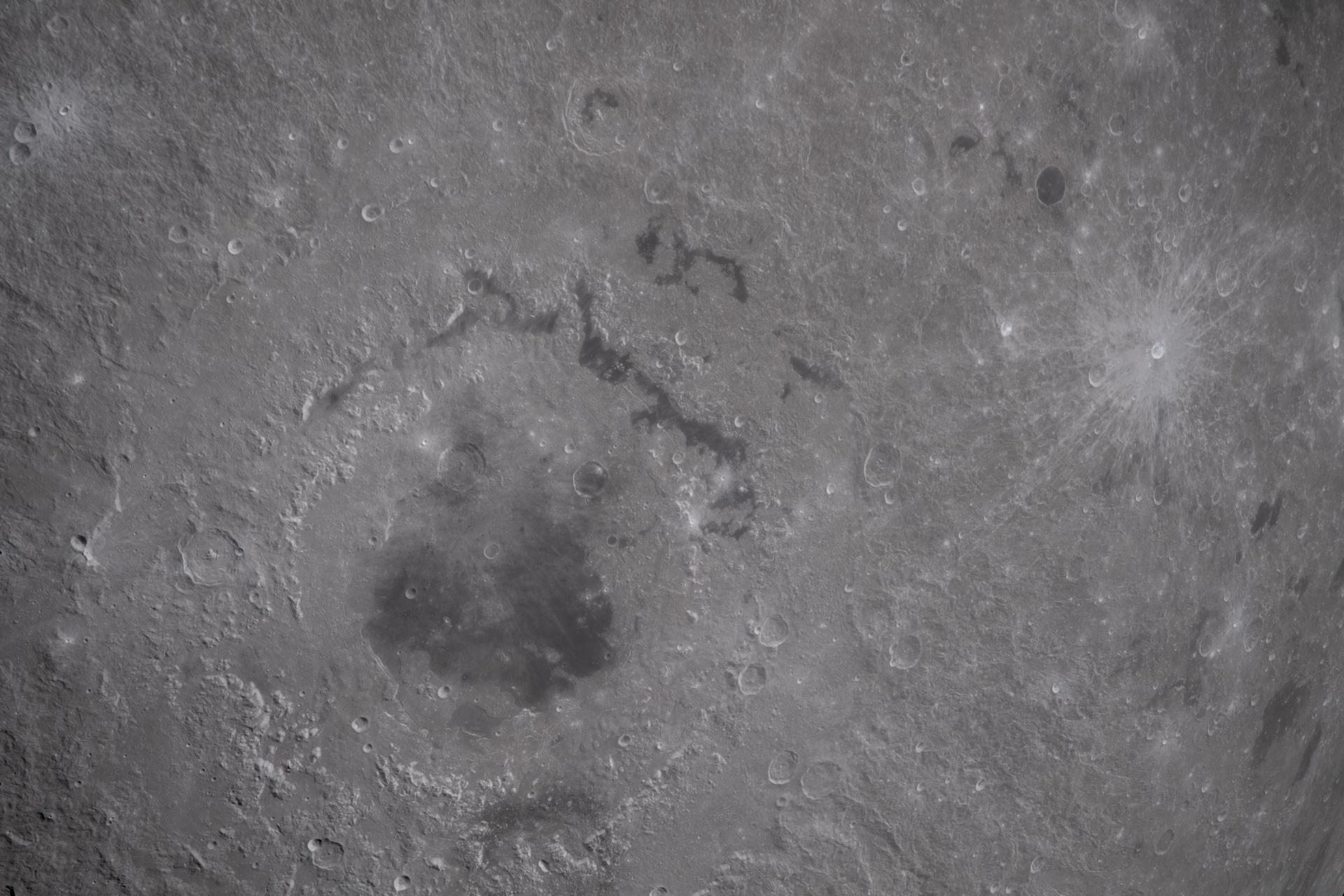
💥 A very, very long time ago — billions of years! — a giant space rock crashed into the Moon. BOOM! It made a huge hole with rings around it, like ripples when you drop a rock into a pond. This is called the Orientale Basin. The dark part in the middle is old lava that filled it up. Scientists love studying it because it's one of the best-preserved big craters on the Moon!
This close view of the Orientale Basin shows its remarkable ring structure. When the original space rock hit the Moon with tremendous force, it didn't just make a hole — the force was so large that the ground rippled outward like rings on a pond, creating concentric mountain ranges around the impact site. Over time, lava seeped up from below and filled the center with dark volcanic rock. Orientale is special because it's one of the youngest large basins on the Moon, meaning its ring structure hasn't been worn away yet.
The Orientale Basin is a multi-ring impact basin — one of the Moon's youngest and best-preserved examples of this structure. Upon impact by a massive bolide, the lunar surface behaved briefly like a fluid: material was excavated from depth, displaced outward, and then the surface rebounded and collapsed, creating concentric ring scarps (mountain ranges) surrounding the central depression. The dark fill visible here is mare basalt — volcanic rock that subsequently flooded the floor. Orientale straddles the near and far sides of the Moon and is difficult to observe from Earth, making these crew photographs scientifically valuable. Its preservation makes it a key reference point for understanding the Late Heavy Bombardment period when the inner solar system was intensely cratered.
Look at the eclipse photo (Photo 4). What shape is the glowing ring around the Moon? Have you ever seen a solar eclipse from Earth?
In Photo 5, can you find the crescent Earth? How many people do you think live on that tiny blue shape?
2. The crew lost radio contact with Earth for several minutes while behind the Moon. How do you think that felt? What would you do if you couldn't communicate with Earth?
3. Why do you think the maria (dark plains) have fewer craters than the highlands? Hint: think about which came first.
2. Orientale Basin has mountain rings formed by the impact — similar to ripples in water. But the Moon's surface is rock, not liquid. What does this tell you about the forces involved in a large impact?
3. Earth appears as a crescent in Photo 5. From the Moon, Earth has phases, just as the Moon has phases for us. Draw and explain what causes Earth's phases as seen from the Moon.