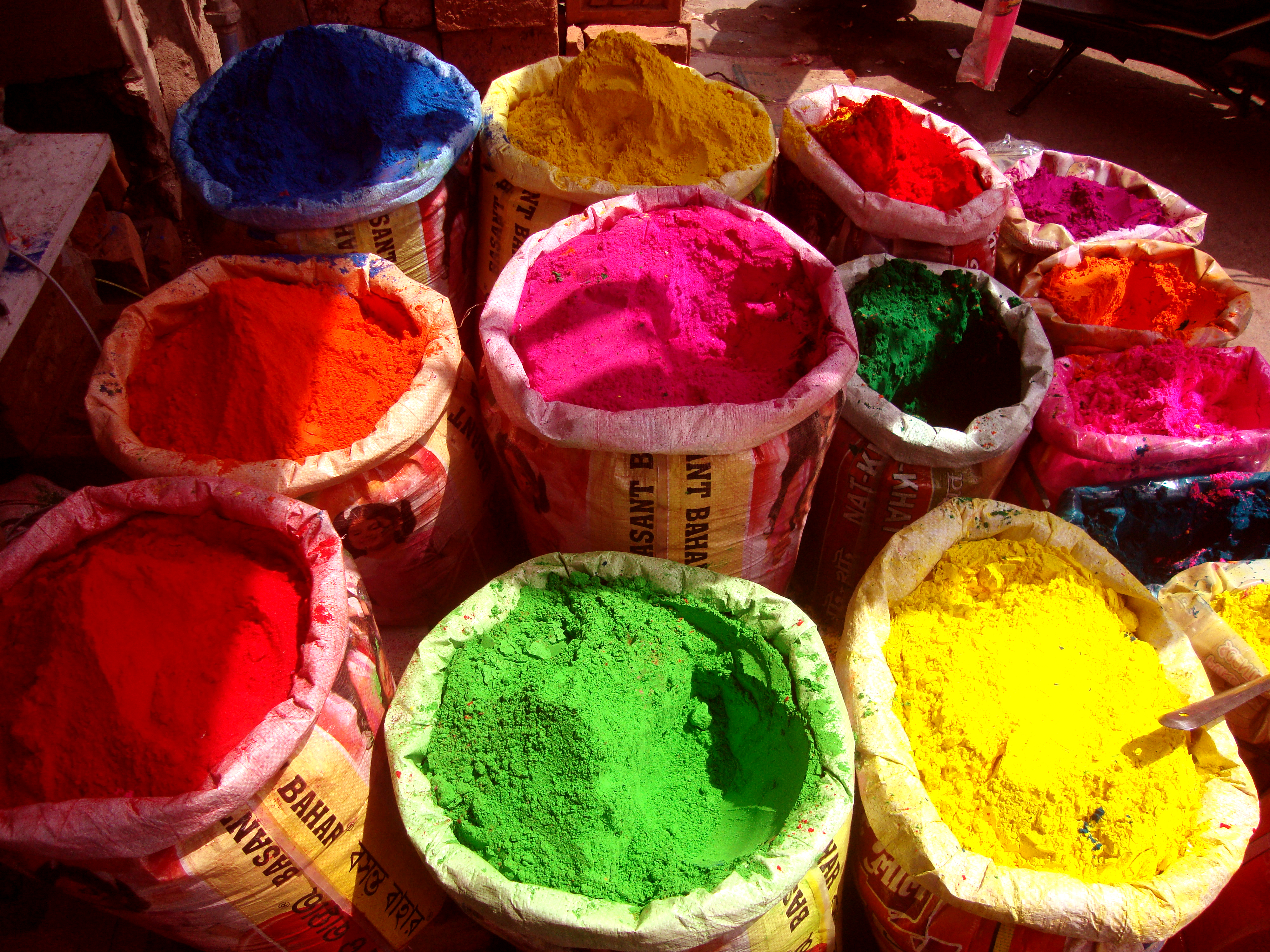
A vibrant shop selling gulal β€” the colored powders used in Holi celebrations

Teacher's Guide to Holi

Festival of Colors, Love & Spring

Target Audience: K–5th Grade Educators

Cultural Context: Hindu Festival / South Asian & Diaspora Traditions

Timing: Full moon of the Hindu month of Phalguna (typically February–March)

Subject Areas: Social Studies, ELA, Art, Science, SEL

🌸 What Is Holi?
β–Ό

Holi (pronounced HOH-lee) is one of the most joyful and widely recognized festivals in the Hindu tradition. Celebrated across India, Nepal, and among South Asian diaspora communities around the world, it marks the arrival of spring, the triumph of good over evil, and the enduring power of love and community.

Quick Facts

  • When: Evening of the full moon (Purnima) in the Hindu month of Phalguna β€” typically late February or March
  • Duration: A night and a day
  • Who Celebrates: Hindus across India, Nepal, Fiji, Mauritius, the Caribbean, the UK, the US, and beyond; also celebrated secularly by many non-Hindus
  • Key Activities: Lighting bonfires (Holika Dahan), throwing and smearing colored powders (gulal), water play, family gatherings, eating traditional foods
  • Central Themes: Spring's arrival, love and renewal, good over evil, community across differences
For Teachers: Holi is celebrated by an estimated one billion people worldwide, making it one of the most widely observed festivals on Earth. In many US and UK cities, your students may have Hindu, Gujarati, Punjabi, Bengali, Nepali, or Caribbean classmates who observe Holi in ways specific to their family's regional tradition.

Why Multiple Meanings?

Hinduism encompasses enormous regional and cultural diversity. Holi is an ancient tradition β€” references to Holi-like celebrations appear in 7th-century Sanskrit texts β€” and over centuries it has accumulated layered meanings: agricultural, spiritual, social, and communal. There is no single "correct" way to celebrate Holi; the festival looks different in Vrindavan, Bengal, Punjab, Fiji, and Trinidad.
πŸ“– The Stories Behind Holi
β–Ό

Holi is rooted in two primary narratives from Hindu sacred tradition. Understanding both helps educators discuss the festival with depth rather than reducing it to a "color-throwing day."

Story 1: The Love of Radha and Krishna

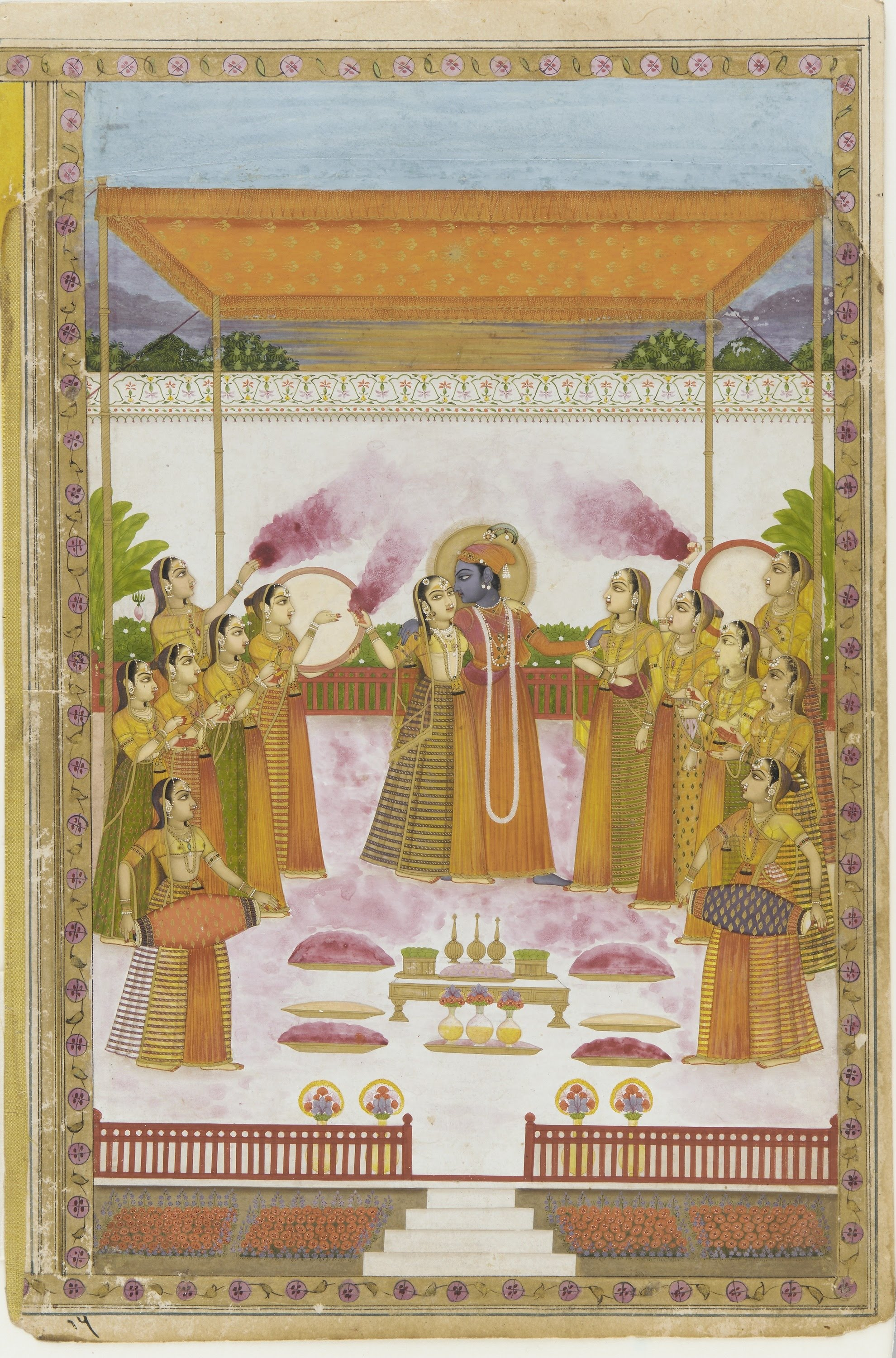
The most beloved story associated with Holi tells of Lord Krishna β€” a principal deity in Hinduism, believed to be an incarnation of Vishnu β€” and his deep, playful love for Radha. According to tradition, Krishna (whose skin has a blue hue) was playfully envious of Radha's fair complexion. His mother suggested he color Radha's face, so they could match. This divine, joyful act of coloring is said to be the origin of the color play central to Holi. The festival celebrates eternal love, joy, and the bonds between people.

"People talk about 'playing' Holi in the powdered clouds of colour. It is an immersive experience. Everyone comes together and merges in the magic of the crowd. Traditional hierarchies are suspended."
β€” Rina Arya, Professor of Critical and Cultural Theory, University of Hull
A classical Indian painting depicting a Holi festival with Krishna, Radha, and the Gopis

A classical Indian painting depicting Krishna, Radha, and the Gopis celebrating Holi β€” the divine love at the heart of the festival's tradition. (Public Domain)

Story 2: Prahlad, Holika, and the Triumph of Good

The second narrative gives us the festival's name and explains the bonfire tradition. A demon king named Hiranyakashipu demanded that everyone worship him. His own son, Prahlad, refused β€” he remained devoted to Lord Vishnu. Enraged, Hiranyakashipu ordered his sister Holika to kill the boy. Holika had a power that made her invulnerable to fire, so she sat with Prahlad on a burning pyre. Yet Prahlad's faith protected him β€” he survived unharmed, while Holika burned. The first night of Holi, called Holika Dahan (the burning of Holika), commemorates this triumph of devotion and good over arrogance and evil.

Story 3: The Spring Harvest

In 17th-century literature, Holi was also identified as a festival celebrating agriculture and the promise of a good spring harvest. Many Hindus believe this is a time to welcome spring's abundant life, to say farewell to winter, and to reset and renew relationships β€” releasing accumulated tensions and starting fresh.

Classroom Note: These stories are sacred to Hindu communities. Present them as living traditions β€” stories that real families honor β€” not as myths or fairy tales. Use terms like "according to Hindu tradition" or "in this story from Hinduism."
🎨 The Colors & Their Meaning
β–Ό

Color is at the very heart of Holi. The powders used β€” called gulal in Hindi β€” carry rich symbolic meaning rooted in Hindu visual tradition.

πŸ”΄
Red
Fertility, love, and marriage. Widely used in Hindu wedding celebrations.
🟑
Yellow
Auspiciousness, prosperity, and turmeric β€” a sacred and healing spice.
🟒
Green
New beginnings, spring, and the renewal of nature.
🟣
Purple
Wisdom and spirituality in Hindu color symbolism.
🟠
Orange/Saffron
Courage, sacrifice, and the sacred β€” used widely in Hindu ceremony.

From Natural to Synthetic β€” and Back

Traditionally, the colored powders were organically sourced from dried flowers, herbs, and natural pigments β€” such as turmeric (yellow), dried hibiscus (red), indigo (blue), and neem (green). These had additional properties: some were believed to have cooling and skin-benefiting effects as Holi occurs during the hot pre-summer season in India.

Today, most commercially available gulal is synthetic. There is a growing movement β€” especially among diaspora communities and eco-conscious celebrants β€” to return to natural, skin-safe powders, which are now widely sold as "organic Holi colors." When discussing Holi in class, this is a meaningful connection to science, sustainability, and cultural history.

Science Connection: Ask older students to research what plants produce these colors. Turmeric = curcumin (yellow-orange). Indigo plant = blue. Beets = deep red/pink. This connects art, chemistry, and cultural knowledge.
πŸ•―οΈ How Holi Is Celebrated: The Sequence of Events
β–Ό

Holi unfolds over a night and a day, with distinct phases that each carry their own significance:

Night One: Holika Dahan (The Bonfire)

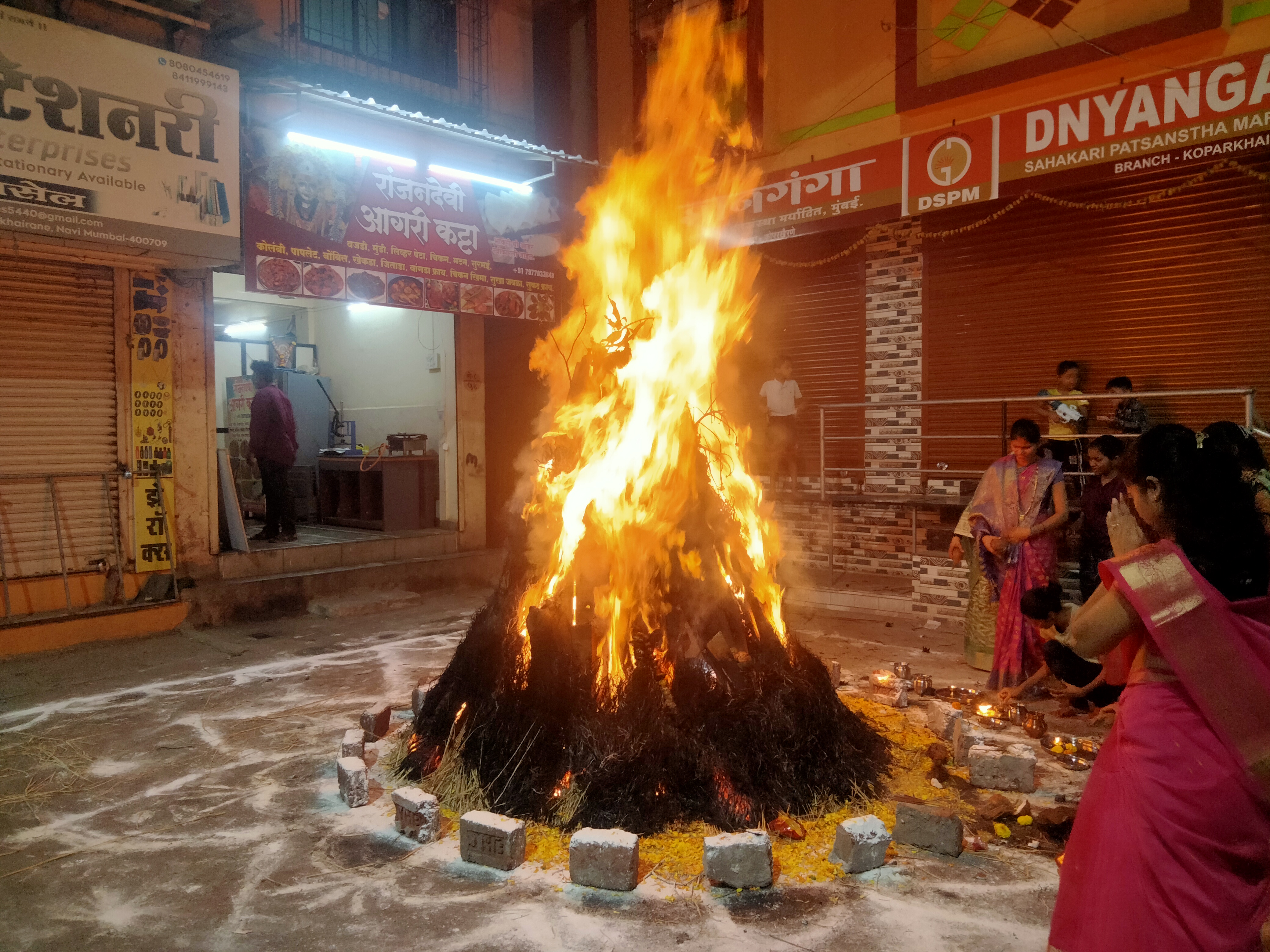
On the eve of Holi β€” the night of the full moon β€” communities gather to light large bonfires. This ritual, known as Holika Dahan ("the burning of Holika"), re-enacts the triumph of Prahlad's devotion. Grains, coconut, and other foods are thrown into the fire as offerings. The ashes are considered auspicious; some families bring them home. This marks the end of winter and the expulsion of evil.

Holika Dahan bonfire celebration at Koparkhairane, Navi Mumbai

Holika Dahan β€” the sacred bonfire lit on the eve of Holi β€” at Koparkhairane, Navi Mumbai. Communities gather to mark the triumph of good over evil. (Wikimedia Commons)

Next Morning: Rangwali Holi (The Play of Color)

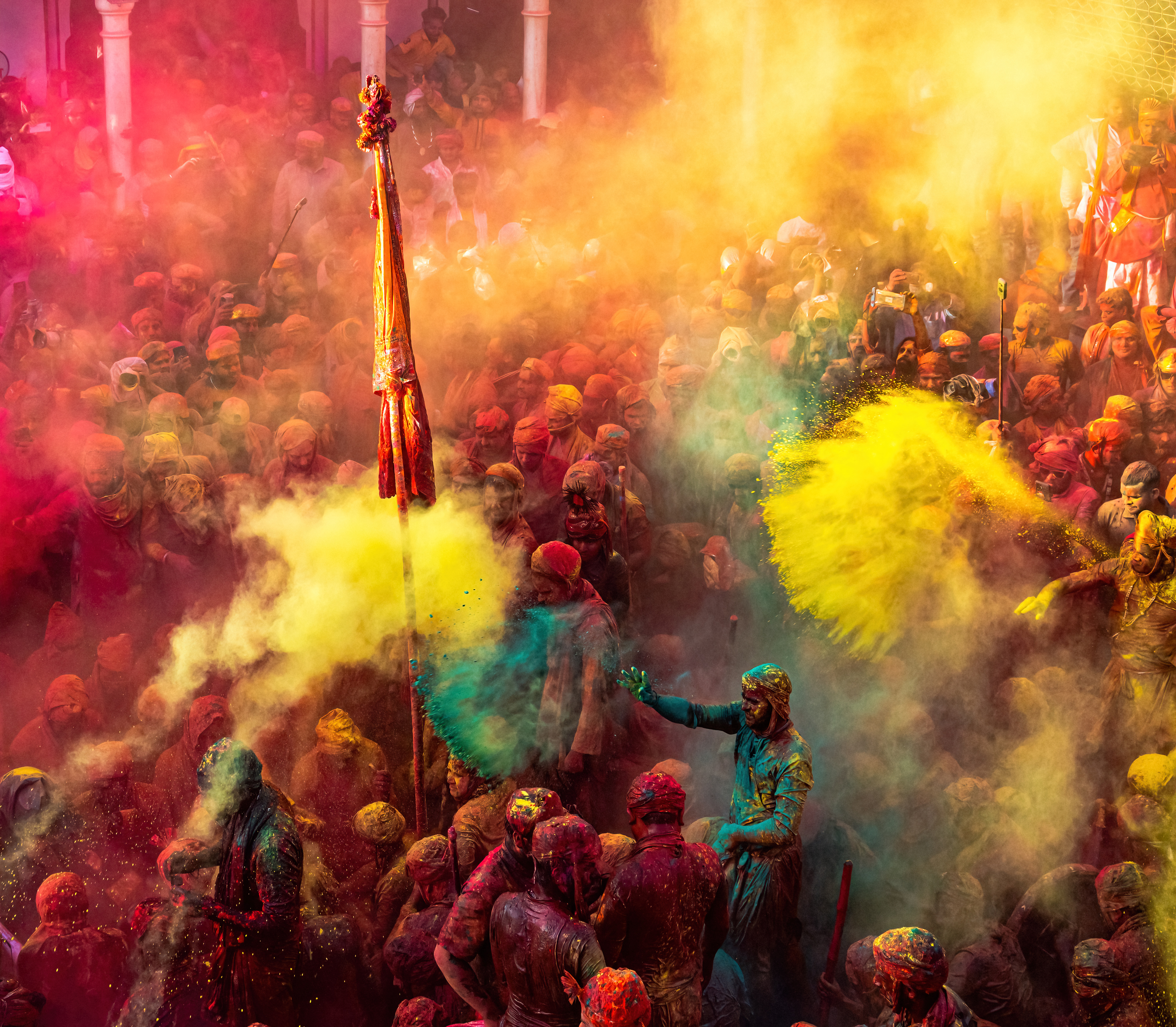
The main event! People take to the streets, parks, and courtyards. Friends, family, and strangers alike throw handfuls of gulal, spray colored water using pichkaris (water guns), and drench each other in color. Social distinctions β€” age, class, caste β€” are temporarily set aside. Everyone plays together. This is the image most associated with Holi in popular culture.

Lathmar Holi celebration in Nandgaon, Uttar Pradesh, 2022

Lathmar Holi in Nandgaon, Uttar Pradesh (2022) β€” one of India's most famous regional Holi traditions, where women playfully chase men with sticks, re-enacting the playful love between Radha and Krishna. (Wikimedia Commons)

Evening: Family Gathering & Food

After washing off the colors and changing into clean clothes, families and friends gather to share traditional foods. Common Holi foods include gujiya (a sweet fried dumpling filled with khoya and nuts), thandai (a spiced milk drink), dahi vada (lentil dumplings in yogurt), and various fried snacks. This is a time for reconciliation, forgiveness, and renewed bonds.

The Social Meaning of Color Play

The act of playing with color has profound social significance. Holi has historically been one of the few occasions when people across caste, class, and age differences could celebrate together. Scholars note that "traditional hierarchies are suspended" during Holi β€” a powerful social function embedded in a joyful tradition.

🌍 Holi Around the World: Many Names, One Spirit
β–Ό

Holi is not one uniform festival β€” it has regional identities, different names, and distinct local traditions across the Indian subcontinent and diaspora communities worldwide. This is a wonderful opportunity to teach students that cultural celebrations are diverse and dynamic, not fixed or monolithic.

Dol Jatra / Boshonto Utshob West Bengal & Bangladesh β€” "Swing Festival" / "Spring Festival"
Phakua / Dol Jatra Assam, Northeast India
Phagu Purnima Hilly Nepal β€” "Full Moon of Phalguna"
Fagua / Phagua Eastern UP, Bihar, Jharkhand
Phagwah Trinidad, Guyana, Suriname, Jamaica β€” Caribbean Hindu communities
Phagua Fiji β€” Indo-Fijian communities
Shigmo Goa
Yaosang Manipur, Northeast India

Holi in the United States & United Kingdom

Hindu diaspora communities in the US and UK celebrate Holi through temple organizations and community associations. Unlike in India β€” where celebrations are public and widespread β€” diaspora celebrations tend to be organized in specific venues and times. Temple events often include dramatic re-enactments, dance performances, music, and heritage programming alongside color play.

In recent years, secularized "color runs" and commercial Holi-inspired events have become popular in many Western cities. While these have helped raise awareness of Holi, they have also prompted important conversations about cultural appropriation β€” the use of cultural elements stripped of their religious and spiritual meaning for commercial or entertainment purposes. This nuance is worth addressing with older students.

Classroom Connection: Ask students: If your family has a special tradition, how would you feel if it became a commercial event where people didn't know (or care about) its meaning? This is a rich SEL and social studies discussion for grades 4–5.

Non-Hindu Participants

Holi has always welcomed broader participation β€” the festival itself celebrates the breaking down of social barriers. Many non-Hindus in India and around the world participate in Holi celebrations alongside Hindu neighbors, friends, and colleagues. The key is respectful, informed participation that honors the festival's sacred origins.

🀝 Cultural Sensitivity Guidelines for Educators
β–Ό

βœ… DO

  • Present Holi as a living, sacred Hindu tradition β€” not just a fun "color party"
  • Acknowledge the religious stories (Holika Dahan, Radha-Krishna) with respect
  • Use correct vocabulary: gulal, pichkari, Holika Dahan, Rangwali Holi
  • Recognize regional diversity β€” there is no single "correct" Holi tradition
  • Invite Hindu students/families to share their own family's traditions if they are comfortable
  • Connect Holi's social message (breaking barriers, renewal) to broader values of inclusion
  • Discuss both the original organic powders and modern synthetic ones
  • Acknowledge that diaspora celebrations look different from celebrations in India

❌ DON'T

  • Reduce Holi to "the holiday where you throw paint at each other"
  • Use synthetic color products in classroom activities without careful thought and family consent
  • Treat Hindu deities (Krishna, Vishnu, Radha) casually or humorously
  • Assume all South Asian students celebrate Holi β€” not all South Asians are Hindu
  • Stage commercial "color run" style activities and call them authentic Holi celebrations
  • Portray Holi as exotic or "other" β€” it is a major world festival practiced by hundreds of millions
  • Use clip art or cartoonish depictions that trivialize the festival
  • Make students feel obligated to participate in color activities that may conflict with their own beliefs

A Note on "Playing" Holi in the Classroom

Some schools attempt classroom Holi activities using colored chalk powder or cornstarch. If you consider this, please note: (1) this should be done only with explicit family consent and awareness of allergies; (2) it should be framed as inspired-by, not as "celebrating Holi"; (3) centering the stories, music, food, and art of Holi typically provides richer learning with less risk of misrepresentation. Alternatives are provided in the activities section.

Language Matters

Hinduism is the world's third-largest religion, practiced by over one billion people. Holi is described in scholarly sources as "sacred" and "ancient." Use that respectful framing in your classroom β€” the same framing you would use for any major world religious tradition.

πŸ‘¨β€πŸ‘©β€πŸ‘§β€πŸ‘¦ Inviting Families to Share Their Traditions
β–Ό

If you have Hindu students β€” particularly from Indian, Nepali, Fijian, or Caribbean backgrounds β€” their families may be wonderful resources for authentic cultural education. Here's how to approach family involvement thoughtfully:

Before You Invite

  • Ask privately and without pressure β€” never put a student on the spot to represent their entire culture
  • Be clear about what you're asking: a brief share, a visit, bringing food, showing photos, telling a story
  • Acknowledge that Holi traditions vary by region and family β€” there is no one "right" way
  • Make clear that participation is always optional and the student will not lose any standing by declining

What Families Might Share

  • Family stories β€” How does your family celebrate? What does Holika Dahan look like? What foods do you make?
  • Regional traditions β€” Families from Bengal celebrate Dol Jatra differently than families from Uttar Pradesh or Trinidad
  • Traditional foods β€” Gujiya, thandai, dahi vada, and other Holi sweets and snacks (allergy awareness required)
  • Music β€” Traditional Holi songs, called phag or Holi geet, are a joyful part of the celebration
  • Photos or videos β€” Family archives showing Holi in India or locally
  • Natural colors β€” Some families may bring organic gulal to show (not necessarily to use)

Sample Family Invitation Language

"We are learning about Holi as part of our spring cultural celebrations unit. If your family celebrates Holi and you'd be willing to share something about your tradition β€” whether that's a story, a food, a song, or photos β€” we would be honored to learn from you. There is no obligation, and we recognize every family's traditions are personal and unique. Please let me know if this feels comfortable."
Caribbean & Diaspora Connections: Students of Indo-Caribbean descent (Trinidadian, Guyanese, Surinamese, Jamaican) may celebrate Phagwah, which has its own unique musical and communal character. Don't assume that South Asian appearance = Indian heritage; ask and listen.
πŸ“š Grade-Differentiated Classroom Activities
β–Ό

🟑 Grades K–1: Learning Through Story & Senses

Learning Goal: Children understand that Holi is a spring festival where people celebrate with color, and that it comes from Hindu traditions in India and other countries.

  • Read Aloud: Picture books such as Holi by Nilufar Knight or Festival of Colors by Surishtha Sehgal & Kabir Sehgal. Ask: What do you see? How do the people feel?
  • Color Mixing: Using washable watercolors or food coloring, let students explore mixing colors. Discuss what colors mean in Holi (red = love, green = new beginnings).
  • Storytime: Tell the story of Prahlad and Holika in simple, age-appropriate terms: "A boy stayed kind and good even when things were very hard, and goodness won."
  • Spring Senses Chart: What do we see/hear/smell/feel in spring? Connect to Holi's celebration of the new season.
  • Movement: Play traditional-style Indian music and let students move freely β€” joyful, expressive movement mirrors the spirit of Holi.

🟒 Grades 2–3: Exploring Culture, Story & Symbol

Learning Goal: Students understand the multiple meanings of Holi β€” spring, love, good over evil β€” and can identify that Hinduism is a major world religion with beautiful traditions.

  • Story Mapping: Create illustrated story maps of the Prahlad and Holika narrative, identifying characters, problem, and resolution. Connect to universal themes: standing up for what you believe in.
  • Color Symbolism Art: Give students a blank silhouette or mandala template. Using the color meanings of Holi, have them create a symbolic artwork β€” choosing colors based on their own feelings or values.
  • World Map Activity: Place markers on all the countries/regions where Holi is celebrated. Discuss: Why might a festival travel with people when they move to a new country?
  • Vocabulary Cards: gulal, pichkari, Holika Dahan, Rangwali Holi, Phalguna, diaspora β€” create illustrated vocabulary cards as a class.
  • Compare Traditions: "In Bengal it's called Dol Jatra. In Trinidad it's called Phagwah. What does this tell us about how traditions travel and change?"

🟣 Grades 4–5: Critical Thinking & Cultural Depth

Learning Goal: Students analyze Holi's historical, social, and spiritual dimensions; consider cultural authenticity and appropriation; and connect Holi's social themes to current issues of inclusion and equity.

  • Primary Source Analysis: Using the article by Dr. Rina Arya (University of Hull) from The Conversation, have students identify the article's main claims, evidence, and author credentials. Practice academic reading skills.
  • Research Project: Students research one regional variation of Holi (Dol Jatra in Bengal, Phagwah in Trinidad, Shigmo in Goa) and present it to the class, emphasizing how local culture shapes the celebration.
  • Debate/Discussion β€” Cultural Appropriation: "Some non-Hindu businesses create 'color run' events inspired by Holi without acknowledging its religious meaning. Is this respectful, or does it cause harm? What's the difference between appreciation and appropriation?"
  • Natural vs. Synthetic: Research the original organic Holi colors (plants, herbs, flowers) vs. modern synthetic versions. Design a "sustainable Holi colors" proposal using locally available plants.
  • Social Justice Connection: Holi has historically suspended caste and class hierarchies. Research what caste is and why its suspension for Holi was significant. Connect to concepts of equity and inclusion.
  • Creative Writing: Write from the perspective of a Hindu child celebrating Holi for the first time after immigrating to the US or UK. What feels the same? What's different? What does this celebration mean to you now?

Cross-Curricular Connections

  • Science: Plant pigments and natural dyes; seasonal changes and spring ecosystems
  • Math: Lunar calendar calculations; color mixing ratios
  • ELA: Narrative structure in the Prahlad story; vocabulary development; persuasive writing (appropriation discussion)
  • Art: Color symbolism; mandala and rangoli patterns; natural dye projects
  • Social Studies: Geography of South Asia; diaspora communities; world religions; social structures
  • SEL: Themes of standing up for beliefs; renewal and forgiveness; community across differences
  • Music: Traditional phag songs; Indian classical and folk music
πŸ’¬ Discussion Questions by Grade Band
β–Ό

🟑 K–1

  • What colors did you see in pictures of Holi? What is your favorite color, and what does it make you think of?
  • In the story of Prahlad, he stayed kind and good even when it was very hard. Has there ever been a time you did the right thing even when it was hard?
  • Holi celebrates spring. What do you love about spring?
  • Why do you think people might celebrate with color?

🟒 Grades 2–3

  • Holi has many different names in different places. Why might the same celebration have different names?
  • Colors in Holi have meanings β€” red means love and fertility, green means new beginnings. If you could assign a meaning to a color, what would it be and why?
  • During Holi, people celebrate the end of winter. Does your family have any traditions to celebrate a change in seasons?
  • The story of Prahlad tells us goodness can survive even very difficult challenges. What stories from your own culture talk about the same idea?
  • Holi is celebrated in India, Nepal, Fiji, Trinidad, and many other places. What does that tell you about how people carry their traditions when they move?

🟣 Grades 4–5

  • Holi has historically been described as a moment when caste and class divisions are "suspended." What does this mean, and why might a festival have this social function? Does this happen completely, or are there limits?
  • Commercial "color runs" inspired by Holi have been criticized for cultural appropriation. What is the difference between appreciation and appropriation? Where do you draw the line?
  • Why might diaspora communities celebrate Holi differently from communities in India? What challenges do they face in maintaining traditions in a new country?
  • Holi colors were originally made from plants and herbs. What does the shift to synthetic colors tell us about modernization, trade-offs between convenience and tradition?
  • Holi celebrates "the triumph of good over evil." How is good and evil defined in this story? Are there other stories β€” from other cultures β€” that explore the same theme?
πŸ“‹ Educator Resources & Citations
β–Ό

Scholarly Sources

  • Arya, Rina. "Holi: what the clouds of colour in the Hindu festival mean." The Conversation, March 25, 2024. University of Hull. Read here (Creative Commons license)
  • "Holi." Wikipedia: The Free Encyclopedia. Wikimedia Foundation. Accessed 2025. Read here
  • National Council of Science Museums, India. "Science Behind Holi – The Festival of Colors." Google Arts & Culture. Read here
  • Victoria & Albert Museum. "Festival: Holi." V&A Blog. Read here
  • Basumatary, Puja, et al. "Holi: The Festival of Colors." International Journal of Current Microbiology and Applied Sciences, 2021. (On traditional/natural dyes)

Recommended Books for the Classroom

  • Festival of Colors by Surishtha Sehgal & Kabir Sehgal, illus. Vashti Harrison
  • Holi:Celebrations & Festivals by Sital Gorasia Chapman
  • Maya's Holi by Thrity Umrigar
  • Holi Hai! by Chitra Soundar
  • Prahlad Celebrating Holi by Dr. Shivam Dubey & Nidhi Garg

Media Resources

  • Google Arts & Culture: Search "Holi" for museum-quality images and educational stories
  • Smithsonian Folkways: Traditional Indian music for classroom listening
  • PBS LearningMedia: Search for South Asian culture and Hindu festivals content
  • LACMA (Los Angeles County Museum of Art): Historical Indian paintings including Radha-Krishna imagery β€” collections.lacma.org

Image Credits

  • Header: Holi shop selling colors (gulal) β€” Wikimedia Commons
  • Section 2: A Holi Festival β€” Krishna, Radha, and Gopis β€” Classical Indian painting, Public Domain
  • Section 4: Holika Dahan at Koparkhairane, Navi Mumbai β€” Wikimedia Commons
  • Section 4: Lathmar Holi 2022, Nandgaon, Uttar Pradesh β€” Wikimedia Commons
Attribution Note: This guide draws on scholarship published under Creative Commons license from The Conversation (Rina Arya, University of Hull, 2024) and publicly available information from Wikipedia. Content has been transformed for educational purposes. Teachers are encouraged to cite the original sources when sharing this material.

Professional Development

  • Consider reaching out to local Hindu temples or South Asian cultural organizations for educator workshops or classroom visits
  • Many temples welcome teachers who reach out respectfully in advance of Holi to ask questions about local traditions
  • South Asian Journalists Association (SAJA) has published resources on respectful coverage of South Asian cultures that translate well to classroom contexts