❄️ Winter Light & Shadows
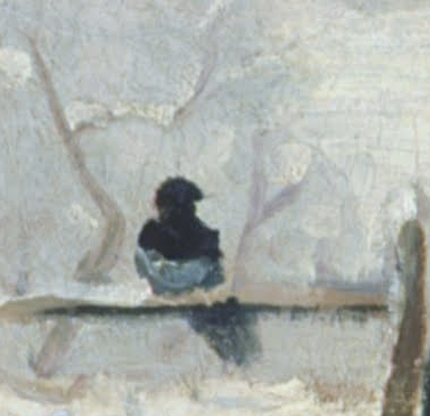
Notice the vibrant blue shadow cast by the fence and the bird's delicate black and white feathers
📚 Lesson Overview
Learning Objectives (K-1st Grade)
- Observe and describe shadows in winter sunlight
- Identify colors in snow shadows (blues, purples)
- Explore light and shadow through simple experiments
- Respond to Monet's painting with personal observations
- Create winter shadow artwork using cool and warm colors
🎨 Materials Needed
For Art Exploration
- Printed color copy of "The Magpie" (provided link)
- White and light blue construction paper
- Blue, purple, yellow, and orange crayons/markers
- Cotton balls or white paper for texture
- Optional: Watercolors for blending colors
For Science Observation
- Access to outdoor space with snow (or sandbox/white surface)
- Various objects to create shadows (blocks, toys, sticks)
- Observation journals or clipboards
- Colored pencils for recording observations
- Optional: Camera or device for documenting shadows
For Classroom Display
- Interactive whiteboard or projector
- Chart paper for class observations
- Color wheel poster (for discussing complementary colors)
- Optional: Additional Monet winter paintings for comparison
📋 Standards Alignment
Make observations to determine the effect of sunlight on Earth's surface.
Plan and conduct investigations to determine the effect of placing objects made with different materials in the path of a beam of light.
Plan and conduct an investigation to describe and classify different kinds of materials by their observable properties.
Support an argument that the gravitational force exerted by Earth on objects is directed down (affects how light hits surfaces at different angles).
Science Standards
Obtain, evaluate, and communicate information to describe objects in terms of the materials they are made of and their physical attributes. Students will explore how light interacts with different materials including snow and ice.
Obtain, evaluate, and communicate information to investigate light and sound. Students observe and record effects of light on various materials and surfaces.
Obtain, evaluate, and communicate information about the properties of matter and changes that occur in objects. Students investigate how light creates shadows and how Earth's position affects light angles.
Obtain, evaluate, and communicate information about the similarities and differences of the sun, moon, and Earth. Students understand how the sun provides light and how Earth's tilt affects seasons and light angles.
Obtain, evaluate, and communicate information about the nature of light and how light interacts with objects. Students plan and carry out investigations to observe and record how light interacts with various materials.
Obtain, evaluate, and communicate information to explain the differences between a solar system, galaxy, and the universe. Students understand Earth's position relative to the sun and how this creates seasons with different light characteristics.
Visual Arts Standards
Engage in the creative process to generate and visualize ideas by using subject matter and symbols to communicate meaning.
Create works of art based on selected themes. Students create winter landscapes demonstrating understanding of light and shadow.
Understand and apply media, techniques, and processes of two-dimensional art. Students explore color mixing and complementary color relationships.
Reflect on and interpret works of art, using aesthetic vocabulary. Students analyze Monet's use of color, composition, and technique in "The Magpie."
Integrate information from other disciplines to enhance the understanding and production of works of art. Students connect science concepts about light to artistic representation.
Engage in the creative process to generate and visualize ideas by using subject matter and symbols to communicate meaning through art production.
English Language Arts Standards
Participate in collaborative conversations with diverse partners about grade-appropriate topics and texts with peers and adults in small and larger groups.
Write informative/explanatory texts to examine a topic and convey ideas and information clearly through observations and descriptions.
Recount or describe key ideas or details from a text read aloud or information presented orally or through other media. Students discuss and analyze Monet's painting and The Conversation article.
Engage in exploration and imaginative play with materials.
Identify and interpret works of art or design that reveal how people live around the world and what they value.
Interpret art by analyzing characteristics of form and structure, contextual information, subject matter, visual elements, and use of media.
Create works of art that reflect community cultural traditions.
Participate in collaborative conversations about grade-appropriate topics with diverse partners.
Write informative/explanatory texts to examine a topic and convey ideas and information clearly.
Include multimedia components and visual displays in presentations to clarify information.
🎨 Interactive: Explore Color Theory
Click any color segment to explore color theory!
Learn about primary, secondary, and tertiary colors, plus complementary relationships and color temperature.
🔬 The Science Behind Winter Shadows
When we look at snow shadows, we're actually seeing something scientifically fascinating! Shadows aren't just "darkness"—they're areas blocked from direct sunlight but still lit by indirect skylight. On clear winter days, this skylight is predominantly blue (scattered from the atmosphere). Meanwhile, areas in direct sunlight appear warm yellow-orange because we see the full spectrum of sunlight. This creates the complementary color contrast that Monet captured: cool blue shadows and warm golden light.
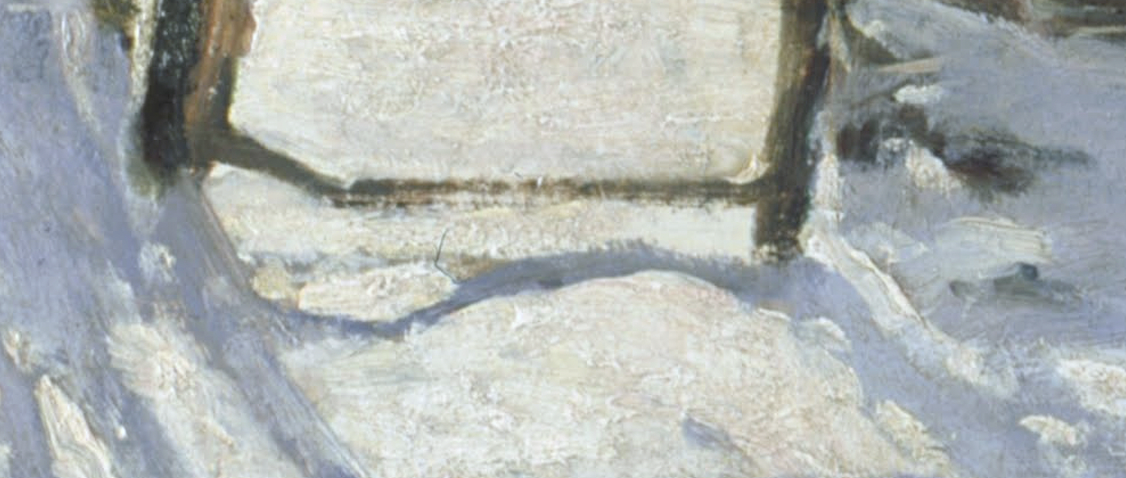
See for yourself! This close-up from "The Magpie" shows the vibrant blue and purple tones in the snow shadows. Monet painted what he actually observed—not what people thought snow "should" look like!
In winter, the sun travels lower across the sky, creating longer shadows and more dramatic light. This is why winter shadows are so visible compared to summer.
Direct sunlight contains all colors but appears "warm" (yellow-orange). Skylight reflected in shadows appears "cool" (blue-violet). Artists call this color temperature.
Our eyes automatically adjust for lighting, which is why we don't always notice colored shadows. Monet trained himself to see these colors by painting what he saw, not what he thought he "should" see.
"... here is a little square of blue, here is an oblong of pink, here is a streak of yellow; now paint, just as it looks to you, the exact colour and shape until it gives you your own naïve impression of the scene before you."— Claude Monet
🎨 Monet's Story: Painting in the Snow
It was a crisp December morning when 28-year-old Claude Monet walked into the snowy countryside near his home in Étretat, carrying his canvas and paints. He was newly reunited with his girlfriend Camille and their baby son Jean, living in a cottage provided by a kind patron after a difficult period.
Monet was fascinated by the challenge of capturing winter light. As art historian Ted Snell explains, Monet "wanted to capture the truth of his experiences in front of his motif as the sun rose higher in the sky and the light and colour changed before his eyes." Unlike most painters who worked in warm studios, he set up his easel outdoors, working quickly to record those fleeting moments before the light changed.
Art critic John Berger reminds us that "Monet wanted to paint not things in themselves but the air that touched things—the enveloping air." It was that magical atmosphere—the silence, the cold, the quality of winter light—that Monet was trying to capture.
For several mornings over the Christmas-New Year period, Monet returned to this same spot at the same time of day to paint under consistent conditions. He worked with new color theories that said shadows weren't gray or black—they were full of color reflected from the sky!
And that magpie? Did it fly into the scene, or did Monet add it later to give the painting life? We'll never know for certain, but that little black bird on the wooden gate has become one of the most beloved details in art history.
✨ Lesson Activities
Looking at The Magpie
Time: 15 minutes
Display the painting and use the "Notice, Wonder, Connect" method:
- Notice: What do you see? (colors, objects, the bird)
- Wonder: What do you wonder? (Why is the bird there? Why are shadows blue?)
- Connect: What does this remind you of? (Your own winter experiences)
Shadow Hunt
Time: 20-30 minutes
Go outside on a sunny winter day (or use a lamp and white surface indoors):
- Find shadows on snow or white surfaces
- Look closely: What colors do you see?
- Draw or photograph your findings
- Compare shadows at different times of day
Color Mixing Experiment
Time: 20 minutes
Explore complementary colors:
- Create yellow/orange "sunlit" areas
- Create blue/purple "shadow" areas
- Notice how they look brighter next to each other
- Try other complementary pairs (red/green, etc.)
Create Your Own Winter Scene
Time: 30-40 minutes
Paint or draw a winter scene with colored shadows:
- Use white/light blue paper for "snow"
- Add blue/purple shadows
- Add yellow/orange sunlight areas
- Include an animal or person (like Monet's magpie)
✅ Interactive: Shadow Hunt Checklist
🎯 Interactive: Test Your Winter Light Knowledge
1. Why are snow shadows blue instead of gray?
2. What are complementary colors?
3. Why did Monet paint "The Magpie" outdoors in the cold instead of in a warm studio?
🎨 Interactive: Think Like Monet
❄️ If you were painting a winter scene, what would you include?
🌈 What colors do you see in snow?
⏱️ Why paint quickly outdoors instead of slowly in a studio?
🔬 How are art and science connected?
💭 Discussion Questions by Grade Level
Grades K-1:
- What colors do you see in the snow in Monet's painting?
- Where is the sunlight coming from?
- Why do you think Monet put a bird in his painting?
- If you were in this painting, would you feel cold or warm? Why?
- What sounds do you think you would hear in this quiet place?
Grades 2-3:
- Why are the shadows blue instead of gray or black?
- How did Monet show that it's a cold winter day without writing words?
- What do you think the magpie is doing? Is it coming or going?
- Compare the sunlit areas to the shadowed areas. What differences do you notice?
- Why do you think Monet painted this scene outdoors in the cold instead of inside from memory?
Grades 4-5:
- Analyze the complementary color relationships in this painting. Why are blue and orange/yellow opposites?
- How does the low angle of winter sunlight affect the shadow lengths and colors?
- Monet was part of the Impressionist movement. How is this different from realistic photography?
- This painting was rejected from the Paris Salon in 1869. Why might critics have thought it was wrong?
- How do you think Monet's scientific approach (painting outdoors, observing directly) influenced his art?
🌟 Extensions & Cross-Curricular Connections
Mathematics Connection:
- Measure shadow lengths at different times of day and create a graph
- Calculate angles of shadows using simple protractors
- Create geometric patterns inspired by Monet's brushstrokes
- Compare ratios of blue shadow areas to yellow sunlit areas in the painting
Language Arts Connection:
- Write a story from the magpie's perspective: Where did it come from? Where is it going?
- Create descriptive paragraphs about winter light using sensory details
- Research and write about Monet's life and the Impressionist movement
- Write a letter to Monet explaining what you learned from his painting
Technology Integration:
- Use photo editing apps to analyze color values in winter photos
- Create a digital gallery of class winter shadow observations
- Research other Monet winter paintings online and compare them
- Use time-lapse photography to document shadow movement throughout a day
Social Studies Connection:
- Explore 19th-century France during Monet's lifetime
- Compare winter landscapes from different cultures and time periods
- Discuss how new inventions (like metal paint tubes) changed art
- Research the Impressionist movement and its rejection by traditional art critics
✅ Assessment Opportunities
Watch how students examine the painting. Do they notice details? Do they reference their own experiences? Can they identify colors in shadows?
During discussions, note students' use of color vocabulary, scientific reasoning about light, and connections between art and science.
Collect observation journals, artwork, and written reflections. Look for evidence of understanding light, shadow, and color relationships.
Assess final artwork for use of complementary colors, shadow placement, and artistic choices that show understanding of winter light.
- K-1: Draw a picture showing one thing you learned about shadows today
- 2-3: Write 3-5 sentences explaining why snow shadows are blue
- 4-5: Create a Venn diagram comparing Monet's painting techniques to modern photography
📥 Download High-Resolution Image
Get a printable version of "The Magpie" for your classroom or home
Download Painting🧠 Why This Interdisciplinary Approach Works
This lesson engages multiple learning pathways simultaneously:
- Visual Processing: Analyzing art develops visual literacy and attention to detail
- Scientific Inquiry: Hands-on shadow experiments build concrete understanding
- Emotional Connection: Monet's personal story creates narrative engagement
- Creative Expression: Art-making consolidates learning through creation
- Real-World Application: Winter is happening NOW—immediate relevance
Studies show that integrating arts with STEM (creating STEAM) improves retention, increases engagement, and develops critical thinking skills. When students see the same concept through multiple lenses—artistic, scientific, mathematical—they build deeper, more flexible understanding.